



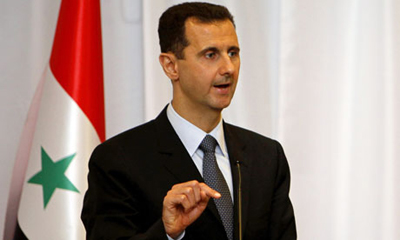
 DAMASCUS: Syria's President Bashar al-Assad is to deliver a speech Wednesday in which he may lift emergency rule, one of the main demands of two weeks of unprecedented protests that have left dozens dead.
An ally of Iran and sworn foe of Washington's key regional partner Israel, Syria's government is facing demands for major change by protesters emboldened by movements that topped autocratic regimes in Tunisia and Egypt.
"The president will deliver a major speech to the Syrian people, linked to domestic issues and recent developments in Syria," the official SANA news agency reported.
The report came a day after a senior official told AFP that Assad "will address the country tomorrow, Wednesday, from parliament," without giving any further details.
Assad is expected to elaborate on a string of reforms announced last week, which came in response to two weeks of protests demanding reform and more freedoms in the country ruled by the Baath party for nearly 50 years.
Facebook group The Syria Revolution 2011, which has emerged as the motor behind demonstrations demanding "freedom" in Syria, has called for sit-ins across the country Friday, despite the government's conciliatory moves.
The wave of protests, which began on March 15 in Damascus, were quickly contained by security forces, before taking root in the southern tribal region of Daraa and the multi-confessional coastal city of Latakia in the north.
Daraa has sustained the most casualties, with activists estimating at least 100 people killed on Wednesday last week in clashes with security forces.
The March rallies are the first such protests since the Baath seized power in 1963, the year a state of emergency was declared.
After a series of palace coups, Bashar's father Hafez al-Assad, rose to presidency in 1970, and had crushed any signs of dissent in his three-decade rule.
Syrian rights activists have accused security forces of killing 130 people in the state crackdown on protesters. Amnesty International says upward of 55 people have been killed. Officials put the toll at some 30 killed.
Presidential adviser Buthaina Shaaban at the weekend told AFP the authorities had decided to lift the state of emergency.
The Syrian government is also studying the liberalisation of laws on media and political parties as well as anti-corruption measures.
But analysts have said the move will be symbolic at best unless accompanied by other major reforms.
"To lift the state of emergency is a symbolic gesture at best," said Faysal Itani, deputy head of Middle East and North Africa forecasting at London-based risk assessment group Exclusive Analysis.
"Even if it were followed through... it would not address the key issue, which is the high degree of economic and political power in the hands of a select political elite," Itani told AFP.
"The only thing that would do, in the current situation, would be sweeping reform of how power is distributed."
The United States has hinted that Syria will not face the fate of Libya anytime soon.
Secretary of State Hillary Clinton on Tuesday also urged the "timely implementation of reforms" but congressional leaders brushed aside any talk of regime change in Syria.
Prime Minister Mohammed Naji Otri tendered his government's resignation on Tuesday and now acts in a caretaker capacity.
The new cabinet, which is expected to be announced by the end of the week, will face the task of implementing the reforms.
Authorities have accused fundamentalists and "armed gangs" of aiming to incite unrest in the country, particularly Daraa and Latakia, which have emerged as the focal points of dissent.
Hundreds of thousands of supporters of Assad, who rose to power after the death of his father Hafez al-Assad in 2000, gathered in central Damascus Tuesday for hours in a state-organised show of support for the embattled leader.




















Comments
Comments are closed for this article.