



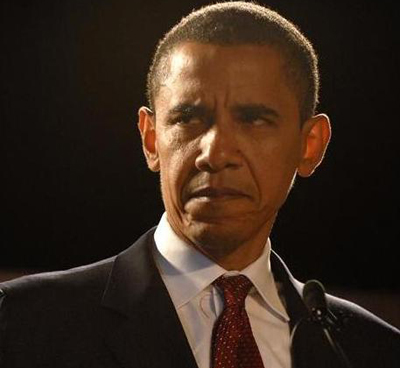
 WASHINGTON: President Barack Obama will tell Americans on Monday that the assault on Moamer Qadhafi's forces averted a humanitarian "catastrophe," US officials said, as critics demand explanations and an exit strategy. In a speech at 7.30 pm (2330 GMT), Obama will explain to a war weary nation why it was in the United States' national security interest to help set up a no-fly zone over Libya after a teetering Qadhafi threatened a bloodbath. The critical address will come on the eve of a major international conference on next steps on Libya in London, and as Libyan rebels, aided by coalition bombardments, make quick gains against loyalist forces. Obama will also discuss the handover of the mission's command and control responsibility to NATO, as Washington cedes the lead in the air campaign that was launched after a key UN Security Council vote March 17.
"He will discuss how our efforts in Libya have advanced our interests and averted a catastrophe," a US official said, adding that Obama would also talk about US policy "going forward" as the coalition hikes pressure on Qadhafi. Hours before the address, Obama took part in a video conference with leaders of US allies France and Britain, which have been leading the coalition against Qadhafi, and Germany, which declined to take part in the effort. Some analysts hope that Obama will use his speech to offer Americans a vision of how the conflict in Libya will end, amid fears the coalition has simply chosen sides in a civil war or that Qadhafi may survive. While Obama has said that Qadhafi has lost legitimacy and should go following an unprecedented uprising against his iron-fisted, four decades long rule, the UN mandate allowing the no-fly zone does not endorse his removal. The most powerful Senate Republican, Mitch McConnell, on Monday issued a set of pointed criticisms of Obama's approach.
"If the American people are uncertain as to our military objectives in Libya, it's with good cause," said McConnell.
"The president has failed to explain up to this point what follows the evident establishment of a no-fly zone over Libya, as it was originally described.
"Further, the president has articulated a wider political objective of regime change in Libya that is not the stated objective of our military intervention." McConnell also added his voice to complaints that Obama had failed to sufficiently consult Congress, which has the sole power under the US Constitution to declare war. Officials, conscious that a bedrock goal of Obama's administration is to get US troops home from conflicts in Iraq and Afghanistan, have shied away from describing the Libyan operation as a "war." They have also argued that time spent in a prolonged debate on Capitol Hill about the operation would have condemned untold numbers of Libyan civilians to death at the hands of Qadhafi's forces. Secretary of State Hillary Clinton made the case Sunday on the ABC show "This Week."
"Imagine we were sitting here and Benghazi had been overrun, a city of 700,000 people, and tens of thousands of people had been slaughtered, hundreds of thousands had fled, either with nowhere to go or overwhelming Egypt while it's in its own difficult transition," she said.
"The cries would be, 'Why did the United States not do anything?'" Some pressure on the administration was relieved by rapid advances over the weekend by Libyan rebels enabled by coalition air strikes on Qadhafi forces. In his address from the National Defence University in Washington, Obama will also seek to communicate his strategy to an audience outside the United States, including Middle Eastern populations caught in the throes of revolt. On Tuesday, Obama, who been criticized since military action began nine days ago for not getting his message across, will also give interviews on Tuesday with the anchors of three US television networks, the White House said. Clinton and Defence Secretary Robert Gates will also brief lawmakers to press home the administration's hard-sell defence of its policy this week. US public support for the conflict is lukewarm: a March 22 Gallup poll showed that 47 percent of Americans surveyed approve of action against Libya, less than at the outset for most US military campaigns over the past four decades.




















Comments
Comments are closed for this article.