



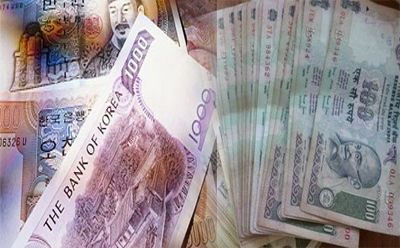
 SINGAPORE: The Philippine peso and the Indian rupee eased on Monday on dollar short covering, though equity inflows to the region will likely keep other Asian currencies trending higher in the near term.
Foreign investors have been net buyers of most regional equity markets for roughly a week in the face of a nuclear crisis in Japan, international military conflict in Libya and high oil prices.
The US dollar has been supported by hawkish comments from some Federal Reserve officials, helping to weigh on the euro but the weaker euro is not really hurting willingness to take risks among investors. That will keep emerging Asian currencies resilient, said Frances Cheung, a strategist at Credit Agricole CIB in Hong Kong.
"In Asia investors choose to focus on fundamentals - still resilient economic activity with rising inflation pressures," said Cheung.
Last week, the Malaysian ringgit hit its highest since the Asian financial crisis 14 years ago, and the Indonesian rupiah reached a four-year high.
Even with equity inflows supporting regional currencies, persistent strength in the dollar as well as intervention by foreign exchange authorities were risks that traders cited could drag on emerging Asian currencies.
"Foreign institutional investor flows into Asian equity are a key support for Asian currencies and flows have been more positive of late. How long this lasts remains to be seen," said Callum Henderson, global head of FX research with Standard Chartered Bank in Singapore.
"The DXY looks likely it is correcting higher short term and that could potentially spill over to Asia if sustained. Moreover, at some stage high oil prices will hurt the Asian growth outlook," he said.
PESO
The peso eased on dollar demand for fixing and a overall rise in the greenback.
Market players also covered dollar-short positions trying to front run possible dollar-buying intervention to check the peso's strength.
RUPEE
The Indian rupee snapped a six-day rally after most Asian peers and the euro eased from last week's highs, and traders were watching for oil import payments.
"The rupee is lower tracking the weakness in the euro," said a senior foreign exchange dealer with a state-owned bank. "But year-end dollar flows are still trickling in, so we could see the rupee in a 44.70-44.80 range."
SINGAPORE DOLLAR
The Singapore dollar edged lower as investors booked profits from its rally to a record high on Friday and selling by interbank speculators.
But its falls were limited with bids on the unit lined up around 1.2650 per dollar, traders said.
WON
Offshore hedge funds bought the won although currency players remained cautious over possible dollar-buying intervention by South Korea's foreign exchange authorities.
"They appear to bet on a further fall in USD/KRW," says a US bank dealer in Seoul, adding the hedge funds took any gains as chances to sell the pair.
Demand from the hedge funds came as foreign investors remained net buyers of Seoul shares for a ninth consecutive session.
Still, players stayed wary of intervention with importers buying the pair on dips for settlements, forcing the local currency to retreat from 1,111.5 per dollar, its strongest since Feb. 21.
On Friday, the authorities were spotted buying dollars to check strength in the South Korean currency, especially minutes before the local market closed.




















Comments
Comments are closed for this article.