



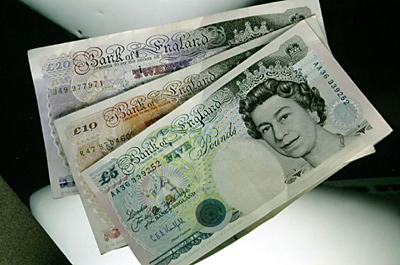
 LONDON: Sterling held steady near a two-month low against the dollar on Thursday with investors likely to drive it lower if UK retail sales data disappointed.
October retail sales data due at 0930 GMT are expected to show a 0.1 percent drop, down from a 0.6 percent rise in September, when consumers spent on new clothes after the Olympics had finished.
With food and energy prices rising in October, demand is likely to have been sluggish.
The pound was last trading at $1.5850, not far from $1.5837 struck in the Asian session, its lowest since Sept. 5 and steady on the day. Traders cited an option barrier at $1.5800 which is likely to sway trade.
The euro held on to recent gains, trading near a two-week high against sterling at 80.45 pence. Traders said the euro could rise past 80.50 pence to as high as 80.75 pence if UK retail sales numbers were weaker-than-forecast.
"We have been bearish about sterling/dollar and if retail sales numbers disappoint we could see it coming down even further," said Richard Driver, currency strategist at Caxton FX.
"And if the data surprises on the upside, it will be hard to inspire the pound."
Sterling came under broad pressure both against the euro and the dollar after after the BoE's Quarterly Inflation Report pointed to slow growth in the UK and after Governor Mervyn King left the door open for more quantitative easing.
King also said it would be hard for the economy to grow fast without further falls in the exchange rate, and that also weighed on the UK currency. All in all, sterling's losses saw the Bank of England's trade-weighted sterling drop to a three-week low of 83.5.
But for the year, trade-weighted sterling has gained 3.2 percent, a factor that has made UK exports less competitive at a time when the BoE is attempting to rebalance the economy towards exports. Those gains have come as the euro lost 3.5 percent against sterling during the same period.
And the euro could come under further pressure if the sovereign debt crisis continued and the euro zone faced a sharper slowdown than the UK.
"The problem for Governor King and the role of weaker pound in re-balancing the UK economy is that the UK's major trading partner, the eurozone, has a greater need of a weaker currency," said Chris Turner, head of currency strategy at ING.
"A weaker euro is going to have to play a key role and we see a risk that the European Central Bank shifts to negative deposit rates over the next six months. That is why we are retaining our view that euro/sterling trades down to 76 pence in the first half of next year."




















Comments
Comments are closed for this article.