



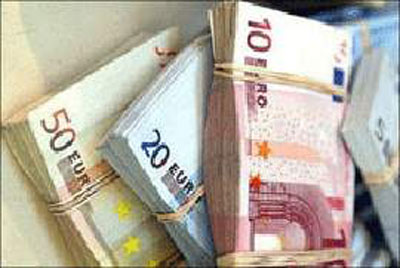
 LONDON: The European single currency slipped back Friday as strong US growth data buoyed the dollar and investors reviewed a troubled week amid fears over debt-laden Portugal.
Dealers said the dollar got a boost after news the US economy grew 3.1 percent in fourth quarter 2010, up from a previous estimate of 2.8 percent, bolstering hopes that Middle East unrest, Japan's devastating earthquake and eurozone debt problems will not derail the recovery.
Comments by a senior US Federal Reserve official that the US central bank should return monetary policy to more normal settings -- interest rates have been held close to zero since 2008 -- reinforced faith in the dollar and the economy.
The Fed and other central banks slashed interest rates to help their economies recover from the global financial crisis and there have been increasing signs recently that they could soon tighten policy.
Higher interest rates usually support a currency as they make it a more attractive investment proposition.
In late London trade, the euro fell $1.4071 from $1.4168 in New York late Thursday. The dollar advanced to 81.44 yen from 80.99 yen on Thursday.
A two-day EU summit concluded Friday in Brussels with expressions of support for Portugal after parliament voted out the government in protest at its latest austerity package.
At the same time, EU leaders, most notably German Chancellor Angela Merkel, called on Portugal to abide by the targets already agreed with Brussels in order to stabilise its strained public finances.
"The EU summit concludes today but without the silver bullet which would resolve the eurozone debt and banking crisis in an orderly way," VTB Capital economist Neil MacKinnon said.European leaders indicated Portugal would need a 75-billion-euro bailout, following on from last year's rescues for Greece and Ireland.
Luxembourg Prime Minister Jean-Claude Juncker, who chairs the group of eurozone finance ministers, insisted Thursday that "Portugal won't be left exposed by its European partners."
At the same time, should Lisbon require assistance, Juncker suggested 75 billion euros ($100 billion) would be "appropriate" -- but only "under strict conditions."
In late London trade on Friday, the euro changed hands at $1.4071 against $1.4168 in New York late Thursday, at 114.60 yen (114.76), £0.8779 (0.8789) and 1.2930 Swiss francs (1.2868).
The dollar stood at 81.44 yen (80.99) and 0.9189 Swiss francs (0.9082).
The pound was at $1.6026 (1.6117).
On the London Bullion Market, the price of gold fell to $1,436 an ounce from $1,447 late Thursday, when it hit a record high of $1,447.82.




















Comments
Comments are closed for this article.