



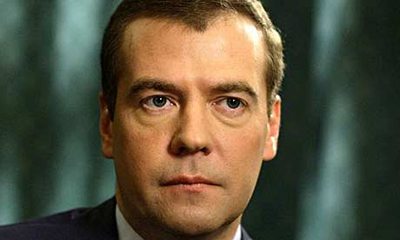
 MOSCOW: Russian President Dmitry Medvedev urged his US counterpart Barack Obama on Thursday to avoid civilian casualties in Libya and limit the international campaign to the goals set by the United Nations. The Kremlin said Medvedev called Obama to discuss the Libyan crisis amid Russian worries that the air offensive could soon spill over into a ground campaign specifically aimed at removing strongman Moamer Qadhafi from power. Russia abstained from last week's UN Security Council resolution authorising a no-fly zone over Libya and strongly objects to the inclusion of a phrase calling for "all necessary measures" to protect civilians from Qadhafi's regime. The Kremlin said Medvedev outlined these and other concerns in a telephone call that also touched on the two sides' disagreements over a missile defence shield for Europe and other international security problems.
"The Russian president especially noted the need to avoid casualties among the civilian population and the priority of achieving goals set by UN Security Council Resolution 1973," the Kremlin statement said.
Moscow has been one of the world's most vocal critics of the Libyan campaign despite its recent "reset" in relations with Washington and efforts by the two sides to erase the confrontational tone of the previous decade. Russia has won the Obama administration's backing in its bid to join the World Trade Organisation and has been praised by the United States for opening its skies to deliveries for the NATO-led campaign in Afghanistan. But the Libyan crisis has reintroduced a chill to the two sides' relations that was particularly noticeable during this week's visit to Moscow by US Defence Secretary Robert Gates. The Pentagon chief arrived in Moscow only hours after Prime Minister Vladimir Putin, a former president who is widely seen as Russia's supreme leader, compared the UN resolution to a medieval call to crusades. Medvedev publicly criticised Putin for his harsh comments but then told Gates about "the indiscriminate use of force by the aviation" in Libya. A seemingly puzzled Gates walked out of that meeting noting that he found Russia's arguments difficult to comprehend.
"It's almost as though some people here are taking at face value Qadhafi's claims about the number of civilian casualties, which as far as I'm concerned is just outright lies," Gates told reporters on his way out of Moscow. Russia has struggled to formulate a unified stance on Libya amid initial suggestions that it was willing to act as a mediator between the Qadhafi regime and the West.
Moscow still has an embassy open in Tripoli and argues that the opposition cannot be recognised as the country's legitimate power because it has failed to unify behind a single new leader or idea. But Kremlin officials have also been openly critical of Qadhafi amid suggestions that Russia would prefer to see the conflict resolved internally without foreign help.
"We maintain diplomatic relations (with the Libyan government). We legally have to maintain them, but not politically," the top Kremlin foreign policy adviser Sergei Prikhodkov told one Russian news agency on Wednesday. But the aide added that the problem for the international community was that "Libya has no political elite while the opposition has not presented a partner for negotiations.
"That is the main danger of the situation in Libya (and its difference) from the situations in Egypt and Tunisia," Prikhodko said.




















Comments
Comments are closed for this article.