



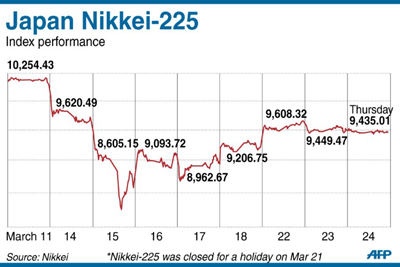
 TOKYO: Tokyo shares turned lower after a strong start on Thursday as uncertainty over Japan's post earthquake nuclear crisis and a deepening food radiation scare eroded earlier bullish sentiment.
The Nikkei 225 index slipped 18.97 points or 0.20 percent to 9,430.50. The Topix index slipped 5.11 points, or 0.59 percent, to 855.99.
Concern over contaminated Tokyo tap water, a deepening food radiation scare and more smoke reported from TEPCO's troubled Fukushima Daiichi nuclear site unnerved the market despite a strong lead from Wall Street, dealers said.
The site's cooling systems were knocked out following Japan's huge 9.0 magnitude earthquake and subsequent tsunami on March 11, leaving engineers scrambling to contain overheating reactors and triggering explosions and fires.
"The rebound from Wednesday is over, and now the market lacks direction, waiting for more information on the nuclear crisis," said Yumi Nishimura, deputy general manager of investment strategy at Daiwa Securities.
The Dow Jones Industrial Average added 0.56 percent on Wednesday as industrial and mining companies were boosted by rising commodity prices amid expectations of high demand for Japanese reconstruction and fears over Middle East unrest.
But exporters were showing renewed weakness as many production sites were damaged by the earthquake. Toyota was off 1.66 percent 3,250 yen after the automaker said it may expand the scope of production suspension in North America due to the quake.
Sony was off 1.54 percent at 2,556 and Canon fell 1.74 percent to 3,650.
Tokyo Electric Power (TEPCO), which operates the stricken plant, tumbled 12.4 percent to 919 yen.
Reconstruction-related shares were seen to benefit, however, with Komatsu gaining 1.13 percent to 2,664.
The yen was slightly weaker against the dollar at 81.00 from 80.93 in New York overnight. It was stronger against the euro, with the single currency at 114.07 yen from 114.70.
Japan and its G7 allies on Friday intervened jointly in currency markets for the first time in a decade to calm turmoil sparked by the country's worst natural disaster in nearly a century, after the unit soared to a postwar high 76.52.




















Comments
Comments are closed for this article.