



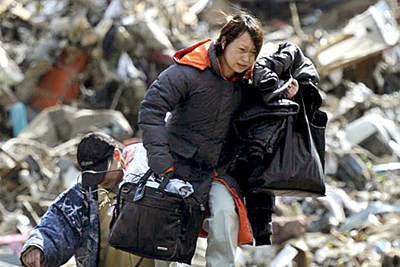
 KAMAISHI: No running water, no electricity and precious little fuel and food. But for some of Japan's tsunami survivors, it's still home and they're not leaving.
For all the privations they now face, they are among the "lucky" ones; their houses spared often by just a matter of metres from the wall of water that wiped out the rest of their communities more than 10 days ago.
The majority opted to join their newly homeless neighbours in evacuation shelters which, while far from comfortable, offered companionship and some basic amenities.
But a few decided to stick it out where they were, stubbornly refusing to vacate their homes.
"I never thought of leaving," said Mayumi Ozawa, 52, who lives alone in a hillside home overlooking the devastated northeastern fishing port of Kesennuma.
"It's not been easy. I have to go out every day to look for supplies and it's cold at night, but this is my home and, as long as it's standing, I'll stay here," she told AFP.
Their reasons for staying put are varied, ranging from a simple desire to maintain some semblance of independence and privacy to the need to care for incapacitated family members.
Some have simply refused to abandon their pets which are not allowed in the public shelters.
For Rueko Shitara, an elderly mother and ailing, bed-ridden father precluded any move to the cramped local shelter where evacuees sleep huddled together on mattresses laid out on the floor.
"The fact that we still have our house and are still alive makes us very happy," said Shitara.
Every morning she and her 75 year old mother Kiyoko hike from their modest wooden home to a hillside stream to collect buckets of fresh water which they deposit in large, plastic lined jars outside the house.
It's a traditional home, and the family has resorted to traditional methods to get by.
Kiyoko boils water in a kettle placed on a metal grate over a "kagizuru" a recessed four sided hearth in the floor of the living room fuelled by lumps of charcoal.
On the other side of the room, a similar hearth is covered by a "kotatsu" a low wooden table with a blanket under which the family members wrap their lower bodies to keep warm in the near-freezing temperatures.
A single candle keeps the room lit at night.
"Right now, we don't know when everything will work again; we don't know how long this will last," Rueko said.
The family had some dried and prepared foods in stock before the tsunami hit, but those supplies ran out fast and Rueko spends much of her day searching for anything to eat.
"For people who aren't in the evacuation centres and are staying in their homes, food is a big problem because most of the shops are closed," said Patrick Fuller of the International Federation of Red Cross and Red Crescent Societies.
"They can get food from the municipal offices, but the offices are located up in the hills and very difficult to reach. People in the evacuation centres are possibly better off in terms of food supply," Fuller said.
Some of those remaining in their homes come to the shelters for government handouts that they then bring back for their families a tactic that has been criticised by the homeless evacuees.
"There's a bit of tension because the people in the shelters believe those in their own homes have enough," said Kiyoshi Murakami, an official helping with the emergency response in Rikuzentakata, one of the worst hit coastal towns.
"Some people in the shelters are complaining. Of course it's not everybody, but a number of people who make a big noise are complaining."
In Kamaishi, Takashi Osaka, a retired seaman, decided to remain in his house where he has lived alone since the death of his wife, to whom he keeps a small shrine in one room.
He is better off than some others, having taken the precaution of storing extra kerosene and gas containers which allow him to cook and fuel a heater.
Asked why he chose not to move to a shelter, Osaka dismisses the question with a simple statement.
"I was born in this house," he said.




















Comments
Comments are closed for this article.