



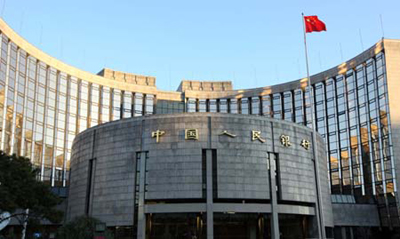
 BEIJING/SHANGHAI: Chinese interest rate swaps and money market rates rose on Monday after the central bank unexpectedly raised banks' required reserve ratio (RRR) last Friday.
The latest increase in required reserves, the third so far this year, will lock up roughly 350 billion yuan ($53.3 billion) at the central bank that could otherwise have been lent out.
Investors had been anticipating further monetary tightening steps after the annual session of parliament, which ended March 14, including potentially this year's second benchmark interest rate rise.
However, such expectations had eased recently after the earthquake, tsunami and nuclear crisis in Japan, leading to excessive falls in IRS and money market rates in the past week.
"In that sense, the tightening is less than previously expected," said a trader at a state-owned bank in Beijing.
He said there was no fundamental change in liquidity conditions as the central bank had ended punitive reserve ratio rises for some banks before raising the industry-wide RRR.
The benchmark five-year IRS, which had plunged 76 basis points over the past month, was up 17 basis points at 4.04 percent at midday, and may find a floor at around 4 percent, traders said.
However, that did not imply any heightened expectations of interest rate rises, as reflected by the fact that the yield on the benchmark five-year government bond remained unchanged at 3.52 percent.
"Of course, further interest rate increases cannot be ruled out, considering inflationary pressure in the first half," said the trader.
"But there are no strong expectations now. Some are actually saying that we are near the end of this round of interest rate rises," he said.
The People's Bank of China (PBOC) has drained net funds through bills and bond repurchase agreements in each of the last two weeks, which was part of the reason behind the hope that Beijing may not turn to harsher tools, including RRR rises.
"Open market operations are a must, but can only fine-tune liquidity," said Shi Lei, a senior analyst with Ping'an Securities in Beijing.
Close to 750 billion yuan in central bank bills are set to mature by the end of April, putting extra pressure on China to find ways to drain liquidity.
That, together with rising foreign exchange reserves and a possible rebound in bank loans in April, will probably prompt the central bank to raise the reserve ratio again in around a month, Shi said.
On Monday, the weighted average seven-day bond repurchase rate, the main barometer of short-term liquidity supply, moved up to 2.9727 percent at midday from Friday's close of 2.0245 percent.
It is expected to edge up further in the run-up to banks' actual payment of the required reserves on Friday, then ease back again, traders said.




















Comments
Comments are closed for this article.