



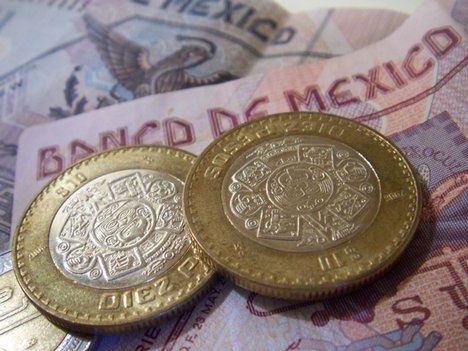
 RIO DE JANEIRO: Mexico's peso gained on Wednesday after minutes of the Federal Reserve's last policy meeting bolstered bets for another round of monetary stimulus, while Brazil's currency lost slightly.
Prompted by concerns about slow economic growth in the world's largest economy, the Fed's meeting minutes from August suggested that central bank was likely to provide another round of stimulus "fairly soon" unless conditions improve.
Monetary stimulus in the United States tends to drive down yields on Treasuries, boosting the appeal of higher-yielding emerging market assets.
Still, some analysts were not completely confident the Federal Reserve would deliver further monetary policy stimulus.
Since the meeting, there's been a spate of upbeat US economic news that could counter the bank's willingness to open up a third round of bond-buying, known as quantitative easing or QE3.
"I don't think the minutes are decisive indication that the Fed will intervene," said Vassili Serebriakov, currency strategist at Wells Fargo in New York. "I'm not sure that this alone will provide sustained positive momentum (of the Mexican peso). Markets are still very much focused on whether European tensions are going to ease in the coming weeks."
Mexico's peso strengthened 0.52 percent to 13.0888 per dollar.
Brazil's real bid down -0.07 to 2.0186 per dollar at the local market close. The real traded in a narrow range as investors remained concerned that the country's central bank would intervene.
Brazil's central bank, which had not waded into the market for several weeks, on Tuesday sold $350.2 million of reverse currency swap contracts, which mimic the purchase of US dollars in futures markets.
The central bank was seen again signaling to markets that it wanted to keep the real from reaching a point where it would hurt local industries competing against cheaper imports.
The real has been mostly trading between 2 per dollar and 2.05 per dollar since the end of June on the threat of central bank intervention.
In addition to acting to protect local exporters, Brazil's policymakers have acted to strengthen the currency if it weakens so much that it could raise import prices and stoke inflation.
Investors have been worried about slowing global growth as the euro zone crisis drags on.
To ease the crisis and spur growth, market players are looking for stimulus relief in the form of bond-buying programs. Both the Federal Reserve and ECB hold policy meetings next month that could decide which, if any, monetary measures they will take to address these problems.
GROWTH EXPECTATIONS IN CHILE
In Chile, the peso advanced 0.19 percent to 481.7000 further boosted by the expectation the economy will grow strongly and interest rates will remain steady.
That would boost revenue for companies while maintaining returns for investors. Interest rates in the United States, Europe and Japan are at or near zero and rates are falling in much of Latin America.
A central bank poll of traders said the bank is likely to hold its benchmark rate at 5.0 percent for three months.
A the same time, Chile's economy is expanding at a rate of about 5.0 percent, a trend that is likely to continue for the near term if economic conditions remain stable, Finance Minister Felipe Larrain said on Tuesday. The estimate is part of planning for the country's 2013 budget.
"The country is passing through a good moment despite the difficulties abroad, and in our region," he said.
Larrain added that the government raised its long-term price estimate for copper to 3.06 a pound from 3.02 a pound. Copper is responsible for more than half the country's exports.

























Comments
Comments are closed for this article.