



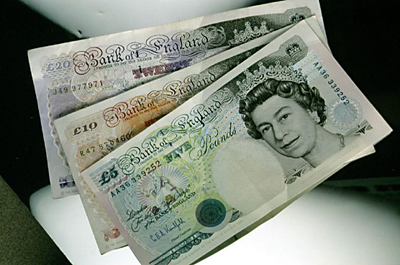
 LONDON: Sterling rose against the euro on Thursday after a German official quashed any thoughts of rapid decisions at a European Union summit, comments which weighed on overall risk appetite and dragged the pound to a two-week low versus the dollar.
Data confirming the UK economy fell into recession in the first three months of this year and contracted by more than previously thought in fourth quarter 2011 also helped dent the pound against the dollar.
German leaders have consistently played down expectations from a two-day summit starting later on Thursday. Some in the market were hoping that Europe's paymaster and largest economy would be more amenable to a banking union or some form of intervention to drive down borrowing costs for peripheral euro zone countries.
But a German government source told Reuters on Thursday the summit would produce no detailed decisions and that it will take time to resolve the bloc's debt crisis, causing traders to rush to sell the euro and buy safe havens like the dollar and the yen..
At the same time Spanish 10-year yields rose to trade above 7 percent, a level considered unsustainable, while Italian 10-year borrowing costs hit a six-month high of 6.19 percent at an auction.
The euro was down 0.2 percent against the pound at 79.90 pence, just above a four-week low of 79.85 pence hit earlier this week.
Data showing German unemployment rose more than expected in June also weighed on investor appetite for euro zone assets.
"The euro was sold very sharply on the back of some weak German data, and signs that Germany wasn't going to give ground at the EU summit. I think that pulled the whole market lower," Kathleen Brooks, research director at FOREX.com said.
But she added that in the short term it might be difficult for the euro to move much lower against the pound as there would be a lot of support for the common currency on the way down, including the first strong support level at 79.80 pence.
Against the dollar, the pound reversed earlier gains to fall 0.3 percent to $1.5525, its lowest in two weeks, as investors rushed to the safe-haven dollar. The pound was also weighed down by the grim gross domestic product numbers.
Data from the Office for National Statistics showed the economy contracted for a second successive quarter between January and March, and revised down the annual GDP growth rate to -0.2 percent.
Separate data showed Britain's current account deficit widened more than expected to 11.179 billion pounds from 7.228 billion pounds, equivalent to 2.9 percent of GDP.
The weak data confirmed that Britain is in the midst of a recession and will cement expectations that the Bank of England will resort to more quantitative easing next month.
Quantitative easing is usually seen as negative for the currency as it increases the supply of pounds in the system. But some analysts said signs policymakers would take active steps to protect the UK economy from the euro zone crisis may be seen as sterling positive.
"With gilt yields near historic lows, the fact that the UK has control of its own central bank and monetary policy makes it a relative safe haven from events in Europe, on a fiscal level, if not an economic one," Michael Hewson, market analyst at CMC, wrote in a note.




















Comments
Comments are closed for this article.