



FRANKFURT: Germany's trade surplus fell in February but stronger-than-expected demand from outside Europe may keep the eurozone's biggest economy out of recession, analysts said Tuesday.
Germany exported goods worth 91 billion euros ($119 billion) in seasonally-adjusted terms in February, up 1.6 percent from January, the national statistics office Destatis said.
At the same time, imports were up 3.9 percent at 77.4 billion euros, giving a trade surplus of 13.6 billion euros, down from 15.1 billion euros in January.
It was the second month in a row that exports have increased and defied analysts' expectations for a drop this month.
A breakdown showed that it was primarily demand from outside Europe that was behind the export growth.
While exports to the euro area rose a modest 3.3 percent year-on-year in February, exports to non-eurozone countries increased 9.7 percent and to non-European nations 13.4 percent, the figures showed.
On the other side, imports from the eurozone rose 5.5 percent year-on-year while imports from countries outside Europe grew 5.2 percent.
Analysts said that following disappointing manufacturing orders and industrial output data last week, the trade report suggested that Germany might be able to avoid a recession after all.
The German economy contracted 0.2 percent in the fourth quarter of 2011 and there are concerns it might shrink again in the first quarter of 2012. A recession is defined as two consecutive quarters of economic contraction.
"A string of poor numbers from manufacturing and lower purchasing managers' indices sparked fears that the German economy might actually be affected more than expected by the weak activity in the periphery," said Commerzbank economist Ulrike Rondorf.
However, the trade numbers "give hope that in the first quarter, gross domestic product expanded at least at a modest pace. Global economic activity has picked up again and competitive Germany should continue to profit in the coming quarters," she said.
ING Belgium economist Carsten Brzeski said that last week's "industrial data showed that the German economy is still flirting with a technical recession.
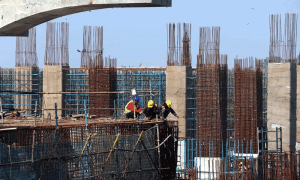
"However, a weather-driven sharp rebound in the construction sector, moderate production and today's trade data still have the potential to lift the economy into recession-free territory."
Germany's economic fate was "more and more in the hands of its trading partners outside the eurozone," Brzeski said.
"The main drivers of Germany's export engine are currently non-eurozone countries -- the United States, Britain and China."
Peter Kaidusch at Natixis said that while the economic news coming out of Germany is "hardly brilliant ... there is still a chance to achieve maybe zero growth in the first quarter and thus overcome hard times without a recession."
The German federation of exporters and wholesalers, BGA, said Tuesday it was projecting the trade surplus to remain more or less stable this year and that despite the debt crisis, "there are more opportunities than risks" for the German economy, which was fundamentally healthy.
















Comments
Comments are closed for this article.