



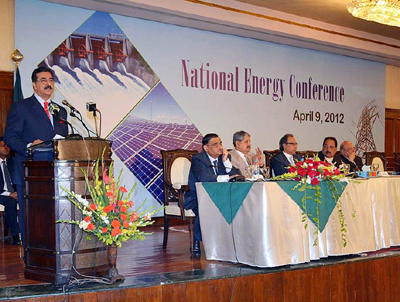
 LAHORE: Prime Minister Syed Yusuf Raza Gilani has emphasized upon the provinces to also play their due role in efforts for generating power to overcome energy crisis facing the country.
The Prime Minister said the federal government was committed to energy security for the people of Pakistan and "Our Strategy is to ensure sustainable power supply at competitive prices to all sectors.
"He elaborated that government strategy involves further exploitation of hydropower to reduce cost of inputs; developing coal reserves for power generation and to convert the plants from oil to coal in the interim, as the Thar Coal alone has 175 billion tonnes and is suitable for power generation of around 100,000 MW annuallly; developing and encouraging use of renewable energy resources (Solar, wind and biomass); increasing emphasis on nuclear energy resources; accelerating exploration and production of oil and gas reserves including off-shore drilling; targeted subsidies for the lowest slab users; encouraging use of LPG (Liquified Petroleum Gas) and import of LNG (Liquified Natural Gas) to meet gas requirement; recognizing the role of provinces in power generation, and energy efficiency and conservation.
He stated this in his inaugural address to the National Energy Conference held at 90 Shahrah-e-Quaid-i-Azam here on Monday. Punjab Chief Minister Shahbaz Sharif, as host of the moot, welcomed the guests and other participants, while AJK Prime Minister Chaudhry Abdul Majeed, KPK Governor Barrister Kausar Masood, KPK Chief Minister Amir Haider Khan Hoti, Sindh Chief Minister Syed Qaim Ali Shah, Balochistan Chief Minister Nawab Aslam Khan Raisani, Federal Finance Minister Dr. Abdul Hafeez Sheikh, Federal Minister for Water and Power Syed Naveed Qamar, Federal Minister for Petroleum and Natural Resources Dr. Asim Hussain, Gilgit-Baltistan's Senior Minister Muhammad Jafar and large number of parliamentarians, business community and other stakeholders attended the conference.
The Prime Minister said that energy issue was affecting all sagments of society and clogging the system and economic activitiy. "We remain a victim to shifts in the oil market until we have a national consensus on long-term policy for secure, affordable energy future and then execute it.
This challenge is huge and we all need to work in unison before the energy crisis overwhelms us completely." Invesment in the energy sector was not significant before 2008, while the previous regime had not made effort to capture hydel and coal potential and hence not a single megawatt of electricity had been added to the national grid, he said, saying, the present government inherited a supply shortage of 5,000 MW in 2008, and electricity demand and number of consumers is increasing by over seven percent and 5.5 percent per year respectively.
Gilani said that through effective steps, the present government had managed to add 34000MW the in power system over the last four years, besides changing the energy mix and shifting towards hydel and coal.
"For this, we have accelerated the work on Neelum-Jhelum power project; finalized financing for a more turbines in Tarbela with the assistance of World Bank; starting work on Diamer-Bhasha Dam; design is underway for Dasu Dam; rehabilitation of Jabban hydropower Malakand; Jaggran-II with the assistance of France; Gomal Zam and Satpara Dam with the US assistance and Patrind Hydropower (AJK) in the private sectro by a Korean Company," he maintained.
The Prime Minister said the government was also building Chasham-III and IV, and 747MW Guddu combined cycle with the assistance of China; improvement of transmission and distribution system as well as building new grid stations with major assistance of Asian Development Bank.
While, work is underway to tap Thar Coal potential and stretching the transmission lines to connect it to the national grid, he added.
Prime Minsiter Syed Yusuf Raza Gilani said on the institutional reform side, the DISCOs (Distribution companies) and GENCOs (Generation Companies) Board of Directors have been reconstituted by bringing more private sector professionals, besides providing over Rs one trillion from the budget to resolve the circular debt issue and swapped Rs 150 billion debt to provide liquidity to the power sector.
The government has also approved Petroleum Exploration Policy, LNG Policy, Low BTU Policy to attract investment in the gas sector, he said adding, the government is also pursuing a multi-pronged strategy that includes: 300mmcft through new exploration, securing 800mmcft through imported LNG and obtaining 300mmcft throuhg LPG Air Mix Projects.
"We have moved to develop regional pipelines for getting 2000mmcft combined. This includes preliminary talks with India," he maintained. Gilani said that challenges facing the energy sector can be broadly categorized as: Energy conservancy, generation and distribution, receivables and payables, gas sector issues, institutional reforms and the provincial role in energy sector.
"We are certain that these challenges demand combined efforts of all stakeholder: the government, the private sector, development partners and every citizen of Pakistan." Towards this end, he proposed the following framework: "First, we all need to make sacrifices in our consumerism to meet the crisis.
I am asking you for our nation's security to set your thermostates to save fuel, to close commercial establishments early, to go for street lights conservation, installation of solar geysers, water heaters and tubewells, to avoid illumination, to take no Unnecessary trips, to use carpools or public transport whenever you can.
Every act of energy conservation like this is more than just common sense- it is an act of patriotism. Second, We must address comprehensively the inefficiencies of our energy system, both power and gas where losses remain high, collections are low, and existence of a very high unaccounted gas compared to international benchmark.
Experts estimate that energy efficiency measures can generate 25 percent energy savings and can reduce approximately 50 percent oil imports. Our Government is working on Energy Efficiency legislation which will be ready soon for enforcement.
Third, We should develop an efficient clearing house for timely settlement of receivables and payables--- It needs to be recognized that inefficiencies of DISCOs in collection of bills and non payment of bills by consumers, including government departments in time, clogs the system.
It leads to non-payment to IPPs and oil companies resulting in less generation, and hence the power crisis. The DISCOs and the provinces need to play a vital role in improving the system.
Fourth, We need to better target our subsidies in the power and gas sector rather than providing general subsidies which are inequitable and a drag on the budget.
Fifth, Role of the Regulator is crucial in this entire spectrum. They need to look beyond tariff determination. They must ensure regular mandatory energy audits of plants and equipment, review cost efficiency, return on equity, return on assets and develop a fair system balancing the interests of both the consumers and investors.
Sixth, We firmly believe that the private sector is the engine of future growth in power generation and gas exploration in Pakistan.
For this, we will continue to push forward all alternates for investment in the sector: public, private and public-private partnership.
We are also open to role of private sector in existing public sector entities. I Would strongly urge the private sector to step forward to invest in hydro and coal projects for generation of Power and LNG import to overcome this national crisis.
Seventh, We need to forge a national consensus on pricing of petroleum products, electricity and gas in a manner that should put least pressure on the budget and not harm macroeconomic stability.
Eight, We should accelerate the on-going institutional reform in the power and gas sector to provide more professional management and encourage corporate culture in the public sector companies.
Ninth, provinces must assume more responsibilities in generation, better distribution and better collection, and must become an equal partner in resolving this crisis rather than considering it a federal issue only.
We firmly believe that regional cooperation in energy will lead to more stability and prosperity in the region. Recognizing these opportunities, we are working for regional gas pipelines as well as electricity transmission.
We will welcome further investments in these areas. We are confident that recommendations of the National Energy Conference will steer us in the direction of developing even better policy framework and greater cooperation in energy sector.
It will reinforce partnership between Pakistan, the domestic and international investors, other stakeholder and the consumers. Working together with the sense of a shared destiny, I am sure, we can transit towards energy security for Pakistan, he added.
Copyright APP (Associated Press of Pakistan), 2012













Comments
Comments are closed for this article.