



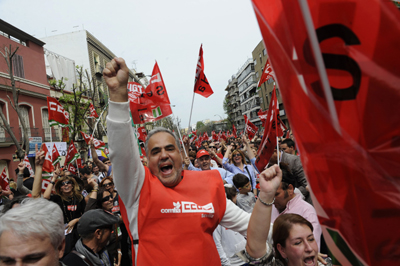
 MADRID: Recession-hit Spaniards staged a 24-hour general strike and took to the streets Thursday in anger over labour reforms, austerity cuts and soaring unemployment.
Carrying placards declaring "Work Reform, No", unions picketed businesses, wholesale markets, industry, banks and public transport hubs as police deployed in heavy numbers.
It was the first national strike to challenge Prime Minister Mariano Rajoy, who was sworn in 100 days ago vowing to cut Spain's 23-percent unemployment rate and fix its faltering finances.
Workers walked out a day before ministers adopt a 2012 budget set to axe tens of billions of euros more in spending, adding to cuts that have already squeezed public services.
Spain's major CCOO and UGT unions called the strike over the right-leaning government's February 11 labour reform which makes it cheaper to lay off staff and easier to cut salaries.
They plan protests in 100 towns and cities.
"If they don't go back on the reform there will be a growing social conflict until they fix it," said CCOO general secretary Ignacio Fernandez Toxo, warning of a new show of force May 1.
Minimum service agreements kept schools and hospitals open, ensured 20-30 percent of trains and buses ran, and allowed some planes to fly despite Iberia, Air Nostrum and Vueling cancelling two-thirds of flights.
Participation was reportedly patchy.
Interior ministry policy chief Cristina Diaz said fewer people took part than in the last general strike in September 2010 with near normal activity in many banks, supermarkets and offices.
But unions reported heavy participation including in some areas of industry such as car plants.
One measure of the impact -- electricity use -- was about 15 percent below normal in the early afternoon, according to the national network Red Electrica de Espana.
Police arrested 58 people and six police and three strikers were lightly injured in minor incidents in the morning, the interior ministry said.
One policeman hit a protester with his baton, cutting the activist above his eyebrow as he and others tried to stop buses leaving a station in Carabanchel, southern Madrid, an AFP photographer said.
At one union rally in Madrid that was hemmed in by police, 57-year-old Antonio Rodriguez said he had been laid off 10 days ago after 38 years working in a graphics design business which shut down.
"So you can have an idea of why we are here, I can tell you that I calculate I will be left with about 700 euros ($930) a month until I die. And that's after 38 years," he said.
The Popular Party government says the new labour law is needed to attack Spain's 22.85-percent jobless rate, which it predicts will rise to 24.3 percent this year as another 630,000 people lose their jobs.
But unions say the economy, not the law, is to blame for Spain's employment woes.
"I can understand why they strike. The reform is just to fire people more easily and more cheaply," said Pedro Moreno, who works at a large supermarket in the Madrid suburbs.
"But this is not the time to lose work days. I am lucky to have a job," the 32-year-old added as he took an underground train at Plaza de Castilla, one of the city's major hubs.
For Spain's prime minister, the timing of the strike could not be worse, just as he is trying to show European partners that Spain will fulfill its promises to cut spending and trim the public deficit to 5.3 percent of economic output this year from 8.51 percent last year.
The government has already announced budget cuts amounting to 8.9 billion euros and tax increases to rake in another 6.3 billion euros but analysts say Spain needs to shave a total 50 billion euros.




















Comments
Comments are closed for this article.