



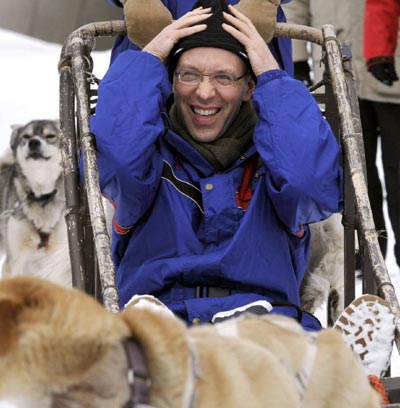
 SAARISELKA: European leaders' search for growth brought them to the farthest reaches of a continent on the brink of another recession this weekend, meeting in a snowbound log cabin in theArctic Circleto explore ways to boost the economy at a time of austerity.
Finnish Prime Minister Jyrki Katainen hosted a select group of influential people on the edge of Saariselka, aLaplandwinter resort and corporate retreat, to work out how to thaw European economies facing unprecedented spending cuts.
In discussions covering trade, jobs, the single market and the world's shifting power balances, Katainen picked the brains of the head of the World Trade Organisation, a European Central Bank board member, the EU's economy commissioner and others.
"The theme is more or less the future of Europe," Katainen said without overstatement, underlining just how much self-examination the continent is undergoing after two years of debt crisis that has called into question its economic viability.
"We need to look at how the European Union should be developed and what we have learned from the crisis," he said.
The focus was on finding ways to inject life into a moribund economy, especially the 17 countries that share the euro single currency, while not giving ground on the spending cuts and tax increases that leaders have committed to as part of efforts to quell the sovereign debt debacle.
It was, to use Katainen's slightly awkward phrase, about 'growsterity', a concept that may be tough to grasp for a country such asGreece, where the economy has contracted 17 percent in three years and more spending cuts are demanded.
Prime Minister Valdis Dombrovskis of Latvia, which has gone through one of Europe's toughest austerity programmes and re-emerged into growth, attended the gathering, as did Spain's EU minister, Inigo Mendez de Vigo, whose country is perhaps chaffing hardest against EU-demanded budget constraints.
LOST YEARS
With 24 million people unemployed across the 27 countries of the EU, the highest level of unemployment since 1998, and the euro zone economy expected to contract this year, the region faces its most challenging economic outlook in decades, one made more complex by sharply rising global oil prices.
"There's a risk of losing years," said Katainen, when asked if some euro zone countries were standing on the brink of a lost decade of growth, likeJapan's experience of the 1990s.
"But if you do change the structures that are not producing growth at the moment, then countries really can change direction," he said, referring toGreece,Portugal,SpainandItaly, all of which are in a low-growth, high-deficit spiral.
"It's clear that if you cut expenditures and raise taxes it will hit growth in the short term, but at the same time it will strengthen the credibility of the country, and once you earn back the credibility, the growth will follow."
The problem for European policy makers is that there are no easy, universal recipes for growth each economy has to build on its own competitive advantages and even when sound ideas have been identified, they have not always been implemented.
One of the biggest drivers of expansion, particularly inEurope's largest economy,Germany, has traditionally been exports, with theUnited StatesandChinamajor buyers of German-branded goods, from luxury cars to industrial equipment.
But trade disputes between the EU andChinaare growing and there is a threat of long-term repercussions for many European businesses, particularly fromChina's limits on the export of rare earth minerals used in leading high-tech industries.
A long-term refrain inEuropehas been the need to make the single market work properly - by ensuring a free-flow of goods, capital and labour throughout the EU and making markets in sectors such as energy and communications fully liberalised.
But the single market is riddled with inefficiency and countries have a vested interest in protecting national champions from outside competition, undoing the benefits that a unified market of 500 million people is supposed to create.
"We have plenty of things to do in the field of energy and electricity liberalisation," said Olli Rehn, European commissioner for economic and monetary affairs.
"The (EU) services directive has not yet been implemented in all the member states, the digital single market is still waiting to be created in a genuine sense of the word, so these things have to be moving forward."




















Comments
Comments are closed for this article.