


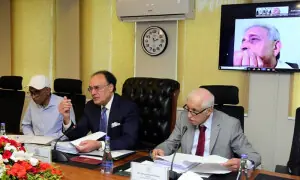
The Federal Textile Board (FTB) will meet today (Thursday), after the meeting was rescheduled twice, for threadbare discussion on Prime Minister's Incentives Package, plan to enhance textile exports and formulation of long-term plan for the development of the sector.
Spokesperson of the Ministry of Textile Industry, Kanwar Usman told Business Recorder that FTB would meet with Minister for Commerce Engineer Khurram Dastgir Khan where all the 11 members would participate. The meeting would discuss the issues confronted to the sector, besides plans to enhance country's exports, he added. According to sources, the FTB would discuss three-point agenda: Prime Minister Incentives Package; way forward/plan to enhance exports; and suggestions and recommendations by the associations for formulation of long-term plan for the development of textile sector. The FTB meeting was convened after textile exporters raised several questions/ambiguities with respect to Prime Minister's Incentives Package and needed clarification.
According to FTB members, the industry stakeholders would ask for formulation of China-Pakistan Economic Corridor (CPEC) Business Wing to safeguard the local industries. A committee may be constituted in consultation with the association concerned to take care of local industry so that domestic investor can reap benefits of this mega project. According to the member, the CPEC project has opened fundamentals of industrial co-operation between the two countries, paving way for new vistas of economic stability and development in Pakistan. However, the CPEC's cost and benefit ratio should be shared with associations to plan for future investments.
The stakeholders would stress on the implementation of Incentive Package designed to boost the country's exports. The incentive package will only be beneficial if implemented efficiently, said the FTB member.
According to an official, since the incentive package announced, the cotton yarn prices have been surging 10 to 15 per cent in different yarn counts, which is making garments sector uncompetitive. Stakeholders would ask for removal of 10 per cent regulatory duty and 5 per cent sales tax on import of yarn just as it removed duty and sales tax on imported cotton. Furthermore, the government would be requested to settle old outstanding of Sales Tax, Weboc Customs Rebate, Income Tax of FBR while may ask for paying dues under Textile Policy 2009-14 such as DLTL, Export Refinance Subsidy, R&D etc. The stakeholders would ask for special SRO to benefit SMEs. The previous DTRE procedure is too complicated for SMEs.
Currently garment sector is having a limited product line for export market due to non-availability of the latest fabric locally. The foreign buyers are demanding new garments based on G3, G4 and technical fabric material. Due to excessive problems faced in importing fabric from IOCO and customs for re-export, the garments manufacturers excessively rely on local fabrics and hence their product lines are limited to denim and cotton twill products for export. The competitors like Bangladesh do not face such problems and hence they are able to offer wide-ranging and verity of products. Competitors like Bangladesh, Vietnam and Cambodia ensure speedy clearance of fabrics and hence these countries have a very wide range of products, they can offer to the world.
Neither does Pakistan produce good fabrics for shirts nor does Bangladesh but the latter is a market-leader nowadays in shirts, because of the fact that its import policy is easy and people can import for re-export, they added. The government should ease importation of fabrics and accessories which are used in re-export. This will help the garment industry (especially SMEs) import new fabrics which are not available locally. Currently the DTRE procedure is very complicated due to which only large exporters use this scheme. By easing the DTRE regulations, the industry will be able to diversify its product base and venture into non-cotton based products which is a prime requirement for GSP Plus.
According to the FTB member, the government would be asked for introducing liberal import policy for raw materials for re-exports like duty-free import of fabrics and accessories which are not being manufactured in Pakistan. In this way, the Pakistan's garment manufacturers can increase the export of diversified products. To compete with Bangladesh and India, it is very important for Pakistan to offer same products as they are exporting in large variety.














Comments
Comments are closed for this article.