


Speakers at a seminar on Thursday condemned the global double standards on continued Indian atrocities by the security forces against innocent people of Indian-held Kashmir, and urged international organisations to play their role to stop the human rights violations in the territory.
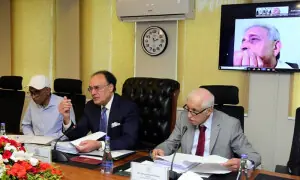
The seminar, "Solving the Kashmir Dispute: Exercise of the Right to Self-Determination," was held by the Institute of Strategic Studies, Islamabad (ISSI).
Speaking as chief guest, Sardar Awais Ahmed Khan Leghari, chairman of the National Assembly Standing Committee on Foreign Affairs, stated that there are three stakeholders in the Kashmir dispute, namely the Kashmiris, Pakistanis and Indians.
He highlighted what he termed as the hypocrisy of the international community and noted the international community's harsh reaction to President Trump's executive travel ban order.
He questioned why the global community did not react to the atrocities in Kashmir and stated that there should be a similar reaction on Kashmir.
He pointed out that such contradictions have emerged out of democracies which boast of having high morals and values, and stated that Pakistan's stance is clear on the issue.
He stated that Pakistan has been fighting terrorism, something that benefits the entire international community. In the presence of social media such atrocities cannot be concealed, he said.
However, he stated that the dialogue process is the only solution to the resolution of issues with India for peace and stability in the entire region.
Khalid Mahmood, chairman of the Board of Governors of the ISSI, stated in his address that the validity of the UN resolutions on Kashmir does not lapse with time but has been affirmed by successive secretary generals of the UN.
He said that Pakistan's commitment and fidelity to the cause of Kashmir remain as firm as ever, while the bigger powers remain engaged in their strategic geopolitical interests.
He said that the international community, the people of Pakistan in particular, is well aware of the genesis of the Kashmir dispute. It was unambiguously decided in all United Nations resolutions that the future of the Kashmiri people will be decided by an impartial plebiscite under the auspices of the UN, which was accepted by India as well as Pakistan, he added.
He pointed out that Indian repression continues to this day with 700,000 military and paramilitary personnel being deployed in the region and countless atrocities being carried out against the innocent civilians in Kashmir.
He stressed that the role played by the youth of IHK through their legitimate struggle for their right to self-determination is commendable. He said that the issue of Jammu and Kashmir is not a territorial dispute between Pakistan and India but a movement for the right to self-determination which is enshrined in the human rights charter of the UN.
Kashmiri leader Ghulam Muhammad Safi stated that the issue of Jammu and Kashmir has remained unresolved for the past seven decades. He said that the roadmap given by the UN in 1948 and 1949 for the resolution of this issue called for a cease-fire, withdrawal of troops and an impartial plebiscite to decide the fate of the Kashmiri people. He added that the resolution has not been implemented due to the obduracy of the Indian government.
He stated that Kashmiris, who are the main party to the dispute, have every right to decide their own fate. He stressed that the elections held by India in IHK are not in accord with the text of the UN resolutions that demands a neutral and objective plebiscite.
He emphasised that the people of Kashmir and their leaders such as Syed Ali Gillani, Mirwaiz Umer Farooq, Yasin Malick and Aasia Andrabi have all remained staunch supporters of the right to self-determination for the people of Kashmir.
Mashaal Hussein Malick, the activist wife of Yasin Malick, stated that the people of Jammu and Kashmir who are larger in number than 123 independent nations, having a defined historical identity, have been for decades engaged in an indigenous non-violent struggle to win their freedom from the foreign occupation of their land. She said that Kashmir has suffered from the denial of the right to self-determination.
Another Kashmiri leader, Mohammad Farooq Rehmani, stated that the rise of Hindutva in the form of Modi is a great threat to peaceful coexistence and the right of self-determination of the Kashmiri people. "We want only freedom and the right to self-determination according to the UNSC resolutions, accepted both by India and Pakistan," he said.
Tooba Khurshid, an ISSI research fellow, stated in her presentation that the right to self-determination is the right of the Kashmiri people who have deep-rooted cultural links to their land. She said that Kashmir has all elements such as a territory that is home to more than 13.65 million people and a long history of independence and self-governance.














Comments
Comments are closed for this article.