


Pakistan has all kinds of laws to deal with the challenge of corruption in an effective and meaningful manner. The country also has a number of state agencies, some directly under the government of the day, the most important being the investigation cell of the police departments, the Central Intelligence Department (CID), the Intelligence Bureau (IB), the Federal Investigation Agency (FIA) and the National Accountability Bureau (NAB). Some others fall directly under various defence service institutions, the most important being the Inter-Services Intelligence. With so many agencies armed to teeth with all kinds of coercive and not- so-coercive laws keeping the entire population, supposedly on a round the clock vigil one would have thought Pakistan would have been listed at least in the top 20 or so relatively less corrupt countries by the Transparency International, the Berlin-based organisation that produces Corruption Perception Index (CPI) of each country on an annual basis.
But this year despite having advanced nine spots Pakistan is still at 61 in the list of most corrupt countries among a total of 176. And while with this improvement in ranking Pakistan has climbed up for the first time since 1996 when the index was first published from the lowest one-third corrupt countries to the middle one-third countries, the revelations in April last year in the Panama Papers about offshore companies of Prime Minister Nawaz Sharif's children seemed to have robbed the country of the sense of gratification associated with such successes.
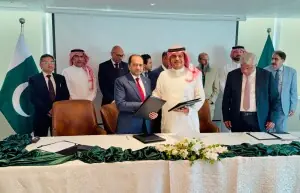
These disclosures have brought into sharp focus the world-wide business links of Prime Minister Nawaz Sharif's family and the varied business interests of his extended family inside the country which in turn has given rise to many questions of conflict of interest. These questions become all the more valid when raised in the context of lucrative trading relations that exist between Pakistan and several Middle Eastern countries in which the PM's family has had intimate business interests. Indeed, it is difficult to believe that private interests were not allowed to interfere with public interests while clinching official trade deals with these countries.
And it is even more difficult to believe that public interests were not sacrificed at the altar of private interests while cutting business deals inside the country by the extended families of the Prime Minister and Punjab Chief Minister Shahbaz Sharif.
There are others as well in this country that are politically as powerful as the Sharifs and equally wealthy. They also use tainted money to buy political power and then make more money using this power. In place of the so-called 22 families of the 1960s-70s today there have emerged, give or take, about 100 officially favoured and pampered families. Look at the highly lucrative margins enjoyed by the captains of cement and steel sectors and the likes that thrive on cartelization. And most of the tainted money these members of ruling elite make goes into stocks and property inside the country and outside.
The members of the ruling elite who directly or indirectly influence policymaking at the highest levels indulge mostly in white collar corruption which is never easy to detect and even if detected they remain unpunished because of their political power.
These white collar crimes include making of short- or long-term public policies to ensure unencumbered private profits, allocation of lucrative government contracts to favourites or selling profit making public sector entities to the politically influentials or 'gifting' public land to buy loyalty to undeserving people and passing it off as unknown 'constitutional' obligations.
Here is an interesting example of how the money earned through all kinds of illegal means is put to 'profitable' use: Over the last six months or so land prices in Pakistan, especially in Karachi, Lahore and Islamabad have been seen to be mounting. The property market is said to be in a state of real boom particularly in Karachi where one can, it is believed, recover investment in real estate in a matter of, as they say, three years with a lucrative margin of profit as well.
The immediate reason for the upsurge in the urban real estate market is said to be some kind of panic withdrawal of investment in Dubai real estate by Pakistanis because the UAE government is said to have furnished to Federal Bureau of Revenue (FBR) full details of Pakistanis' investment along with their names and the amount invested.
Also, due to declining income of oil producer, Abu Dhabi (the virtual investment banker of Dubai), the authorities in Dubai are said to be mulling imposing at least a one per cent tax on such investments and on all bank accounts.
In 2015, Indian nationals had topped the list of foreign investors in Dubai property at 20 billion dirhams from 8,756 investors. Britons were second on the list with a total of 10 billion dirhams worth of property transactions from 4,889 investors while Pakistanis ranked third with 8 billion dirhams from 6,106 investors.
In 2014, Pakistanis were at the second position with 5,079 transactions with a total of 7.59-dirham investment. Indians had topped the list then as well with purchase of 18.1 billion dirhams worth of property on 7,353 transactions, whereas Britons were third with an investment of 9.32bn dirhams.
Our politicians, bureaucrats and some genuine buyers had lifted properties in Dubai during the last about 10 years, mostly using tainted money. Last year, many Pakistani businessmen too had pulled out their money from banks after introduction of 0.3 to 0.6 per cent withholding tax on filers and non-filers of tax returns and parked their money mostly in the Dubai properties.
The Dubai Land Department (DLD) records show a hefty 42. 8 per cent decline in the share of Pakistani investors in the Dubai property market following what is regarded as panic sale by Pakistani property owners. The latest DLD records show Pakistani investment in Dubai real estate market has declined to AED 4.4 billion ($1.2 billion) compared to AED 28.4bn ($7.73 billion) that was invested by them in the three years leading up to last year.
Those who know how such transactions are made and unmade opined that most of the time the transacted money does not move. What happens is, you exchange your earnings at one per cent discount in the country you 'earned' the resources and are paid the amount minus one per cent in the country where you need it. So, most of the tainted money that is earned through corrupt dealings in Pakistan is paid to you at one per cent discount in Dubai to make your investment in property or wherever you wish to make the investment. On its way back home these resources follow the same route and same one per cent discount system.
Those who get the one per cent discount or the so-called service charges on the back-and-forth transactions are said to be clandestine currency dealers dealing in money mostly 'earned' from drug trafficking, gun running as well as all kinds of smuggling and black marketing plus the money which oils the terror financing networks.
The Pakistani real estate market had quieted down considerably some months back when the government had tried to replace the real estate sale-purchase rate from the one fixed by the Deputy Commissioner, first with the rate fixed by the State Bank of Pakistan (SBP) and then by the Federal Bureau of Revenue (FBR) which was almost in line with the prevailing market rate.
However, blackmailed and pressured by the real estate tycoons many of whom belong to the ruling elite the government relented and according to the new formula agreed between the FBR and the real estate tycoons the former's fixed rate in any given locality would not be more than 35 per cent of the prevailing market rate.
So, right about the time when panic selling was taking place in Dubai the real estate market in Pakistan was very much back in business and the Dubai sale proceeds went into domestic property market assured of margins not very different from the ones enjoyed in Dubai in recent years.
Meanwhile, the Pakistan Stock Market had also acquired a boom mode with the index shooting through the ceiling, almost. A good portion of the Dubai sale proceeds, therefore, also went into the PSE adding to the boom which camouflaged the withdrawal meanwhile of most of the foreign portfolio investors.
ADVERTISEMENT Now it seems that at least most of the amount making up the expanding sea of black money in the country is finding its way into the real estate sector of Pakistan and the Pakistan Stock Exchange. These two sectors need to be disciplined so as to deny the corrupt the two major avenues that help them launder their ill-gotten 'earnings' which has been eating into the very vitals of the national economy and which in turn is being burdened with mounting debts adversely compromising the very sovereignty of the country.

















Comments
Comments are closed for this article.