


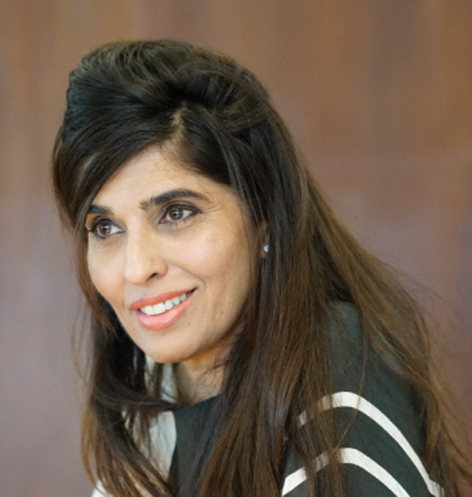
'We need to harness our human resource capacity to engage, and create linkages with, investors,' says Naheed Memon, Chairperson of the Sindh Board of Investment
Naheed Memon is the Chairperson of the Sindh Board of Investment (SBI) and an adjunct faculty of Institute of Business Administration (IBA), teaching Economics and Strategy. She was the CEO of Manzil Pakistan, a think tank based in Karachi before she took over responsibilities as Chair at SBI.
She has worked in London at the Bank of America Merrill Lynch and has run her own management consultancy firm based out of London. She holds an MSc in Economics from Birkbeck College, and an MBA from Imperial College, London. She sat down with BR Research for a candid conversation on investment activities in Sindh; the piloting of new industrial projects; challenges Pakistan faces in creating a flourishing investment climate; and the legacy she wants to leave behind.
<B>BR Research: What role is SBI playing in getting and facilitating foreign and domestic investors, and what sectors are being focused on?</B>
<B>Naheed Memon:</B> SBI is the only investment business facilitation department of the Government of Sindh formed after the 18th amendment because policy in some sectors became autonomous. Provinces now have autonomy over developing, prioritising, attracting, and facilitating businesses and investments in their own regions.
In the energy sector, the Sindh government is very focused on encouraging energy development of smaller power projects (20MW-50MW). There is interest in the renewable energy space which we are prioritizing. We have 300MW already on the grid with wind power. Then, Thar coal mining power generation is a big priority - we have a project of $2 billion for Thar Coal which is a private sector deal between Yankuang Mining and Shanghai Electric Power Construction (SEPCO).
We are focusing on the development of industrial parks, and setting up Special Economic Zones (SEZs). We have one industrial park that is being done with China over 1,000 acres in Dhabeji. We are also developing a port at KT Bandar, which is a $5 billion project. This will include a port, rail-links, coal-fired power generation and a hybrid solar-wind 1GW power project, including an industrial park.
We are considered an agency for foreign investments, but now we are working on guiding and channelling domestic investments as well because there are so many opportunities, particularly in our SEZs and industrial parks, and not just CPEC-supported.
Another major sector where we are pushing domestic investment is the agri-food sector, whereas traditionally, we have been focused on textiles. Due to the lack of infrastructure, a lot of sectors could not take off earlier. Now, because we have support to build the fundamental infrastructure-road networks, highways, and energy-opportunities are cropping up.
<B>BRR: Do you focus primary sector then agri-based development?</B>
<B>NM:</B> Agri business development is our tomorrow. We have not been able to add value and reach export markets. About 40-60 percent of our horticulture is wasted and we are unable to convert it into processed industrial products like pulp or concentrate, so I am really focused on doing a few pilot projects of this sort in the agri business space. There is a lot of interest from investors. We just need to get the linkages in place.
The Sindh government has established a fund called the Sindh Enterprise Development Fund, which is a properly innovated fund like none other in the country and it supports the development of agri businesses in the rural economy of Sindh. In the SME sector, we are supporting businesses - for between Rs 200 million to Rs 300 million, to financially support them by taking on their interest rates.
For the first time, we have facilitated PMEX - the commodity exchange to trade agriculture - so red chillies grown in Sindh are now being traded on PMEX platform; and SBI, via its Sindh Enterprise Development Fund, has taken on the trading fee for PMEX (which is Rs 2.5 per kiloton for the red chillies) as well as the KIBOR subsidy. We have put together a consortium - National Foods is buying the red chillies, SGS is doing the quality assurance, Agility is doing the logistics and PMEX is doing the contracting, while we also have 3-4 banks including Meezan, Zarai Taraqiati Bank, and Sindh Bank that are lending to the farmers.
<B>BRR: What other projects are in the pipeline?</B>
<B>NM:</B> We have a Marble City project - a 300acre land allocated to the development of a marble city which is a public private partnership. The investment, if it takes off the ground, is a $40 million investment. The idea is to bring the many marble processors and refiners in the informal sector to this special zone and set up a state-of-the-art refining facility. We have interest from Italians and Chinese investors. We are in the process of tendering for the development of the project.
Another big project is the Karachi Education City. It is a 9,000 acre land dedicated to the development of a specialized education city, within which there is a 200 acre IT city. When the feasibility was done years ago, the whole development was estimated at $800 million including development of roads, infrastructure, and power. Agha Khan University Hospital is building a liberal arts college on 1,000 acres land. We also have awarded 23 institutions with land already and by June 2017 we will go into brick and mortar phase.
<B>BRR: If you compare Sindh development with Punjab, there is a stark difference. Punjab is growing so much faster. Karachi has so many challenges with massive urbanisation on the cards. Do you think the region is prepared for the demographic changes?</B>
<B>NM:</B> Karachi is a very complex story but the security situation is better. We have removed encroachments on roads for the first time since 2008. In six months, we will see the green line to facilitate public transport. We have also signed on Chinese companies to handle solid waste management in two districts, South and East, worth $30 million. Plus traffic management, roads, and inner city accessibility are all being worked on.
We need to do proper town planning. I have suggested that we set up a think tank just dedicated to the provincial government that would look at industrial policy, town planning, environment and business facilitation since the government is busy governing; we need strategy and planning from objective sources to guide and feed in intelligence to the parliament and governments in the center and provinces.
<B>BRR: Currently, we are mostly attracting interest of Chinese investors but overall FDIs have been coming down and non-Chinese investment is almost non-existent. What are the challenges you face in getting non-Chinese investors on board? And are there any specific requirements for them that are different from Chinese investors.</B>
<B>NM:</B> First of all, Pakistan was almost an insignificant player in the global supply chain, but now we are becoming a game for investors because of the potential; incomes are rising and markets are becoming lucrative. With the CPEC connectivity, Pakistan can actually become a relevant player in the global supply chain. I'm seeing interest from everywhere - Dutch to Italian to even American interest.
In the context where we are now developing infrastructure and are also resource constrained, we want the cheapest, most economical, most viable options. Chinese are just that. It's not so much us who have pushed any foreign investors out but that they are unable to compete in terms of price with the Chinese. What the Chinese do for us is so much cheaper that they push the interest from other investors out. For example, German companies like Siemens are now divesting because they can no longer compete with Chinese transformers and switches which are cheaper.
<B>BRR: Is quality not a major concern at all?</B>
<B>NM:</B> You know, for sectors such as infrastructure and machinery, Chinese have really mastered the whole manufacturing process, and foreign companies have been shifting operations to China because of their mastery and competitiveness. But there are other areas such as military and defence, or the automotive, tractor, pharmaceutical machinery and other sectors where Chinese have not established a credibility or quality, so they are unable to get a foot in but where they are good, you can't beat them price-wise.
<B>BRR: Do you see new players entering the automotive field after the new auto policy? Some have shown interest.</B>
<B>NM:</B> Audi is the first European manufacturer given an LOI from its Principal to set up assembly in Pakistan, but they have issues with the auto policy and want some exemptions. They are bringing luxury cars, and want concessions in a way they have to do less here on ground. Renault and Kia have also signed up. We will see in the next six months who will be able to put the show on the road, as they say. These companies have to bring the muscle and managerial ability on ground as well as handle distributorships; have spare parts across the country, bring experience from their principal company. It depends how the government will be able to support these initiatives.
<B>BRR: Do you feel that the government is doing enough to encourage local private sector investors to enter? We have seen some hurdles in the energy sector for domestic investors. Even in CPEC, the role of local players is missing.</B>
<B>NM:</B> Well, the local players will have to find the opportunities while it is our job to guide them. There are traditional energy and power projects and then there are opportunities in industrial parks. The industrialisation that will happen through CPEC-there can be joint ventures, in so many different areas be it food, spare-part manufacturing, rubber and tyre, steel, logistics, warehousing, cold storage facilities, and so on. This will all happen and domestic players will do it, and the Chinese are willing to supply the capital for a decent return. The domestic players will just have to take the big step and have the gumption to stick it out.
<B>BRR: Do you think Pakistan has an image problem when it comes to foreign investors?</B>
<B>NM:</B> I think security-wise, we are better off and I hope we are able to maintain that. But I feel that our diplomatic relations are very poor. Business relationships start off on personal grounds also, so we have to become more open-minded, and engage more with people abroad on different levels; be it business, culture, or people to people. These lay the foundation for trust and future business but without engagement on a person-to-person level, we cannot take it to the investment or business level. We have to bridge that gap. The mistrust, political instability, and insecurity together have damaged our image and we have to develop linkages to salvage it.
<B>BRR: But don't you think bureaucracy and corruption have also tarnished our image?</B>
<B>NM:</B> Yes. And the biggest problem here is of human resource capacity. Our resource is very mediocre. People cannot keep up. And we haven't really equipped them to keep up. This is also not just a government problem but even in the private sector, we have not provided adequate education and training to our people who can work efficiently.
We do not have the ability to keep investors interested and engage with them. There are institutional complexities, yes. For instance, ease of doing business is really poor so we are working with the World Bank to improve our ranking, but that too is not very simple. Even after the 18th amendment, the devolution process has been incomplete so many of the procedures, for example, time spent or number of documents required to get permits, cannot be shortened. This is where engagement comes in. We need the institutional strength and the human resource to engage with investors and keep them on board despite slower processes. If we are effectively able to do so whilst we set our house in order, they will come.
<B>BRR: What are your top three agendas for your time here, and what parameters have you set for yourself?</B>
<B>NM:</B> I have very tangible goals. I want my Education City project to take some concrete shape, while I want the development at the Marble City to also start. Meanwhile, I am also working to get more businesses for the agri-based sector including multi-food processing units on board. All within next year.
My second goal is to enhance, improve, and modernise this department so I am able to make it a stronger and a better equipped institution. When I am not here, I want there to be some continuity. I am also going to hire a research team and will bring on 20 or more people to broaden the scope of the work we do here.
My third goal is all-encompassing, which is that I want to improve the perception of my party, and communicate the work we are doing effectively that not only lays the foundation for more work but also allows us to gain trust of the people.
















Comments
Comments are closed for this article.