


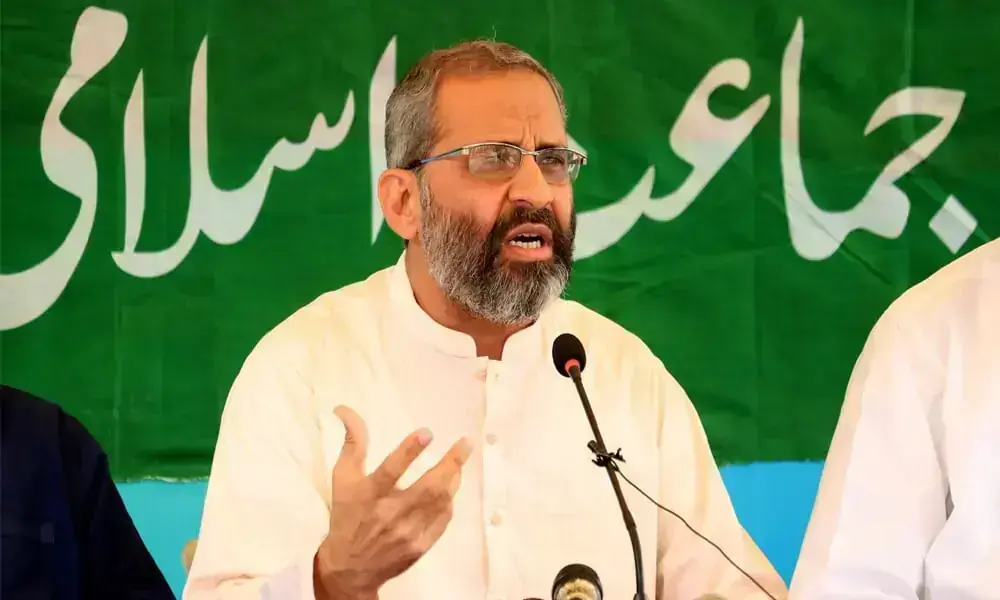
KARACHI: Jamaat-e-Islami (JI) on Sunday demanded an immediate end to prolonged and unannounced loadshedding in Lyari, a forensic audit of K-Electric, and accountability for funds announced to rehabilitate the area’s municipal infrastructure.
Addressing a press conference at Aath Chowk in Lyari Town, JI Karachi chief Monem Zafar along with JI District South chief Sufyan Dilawar, he said the people of Lyari must be given their right to live through a proper supply of electricity, water and other basic amenities.
He said a Rs25.28 billion project had been announced as the Lyari Transformation Project, yet Lyari remained in ruins. “The Sindh government should tell where this huge amount was spent and what change has come in Lyari under this project,” he said. “Just as the people of Karachi were deceived in the name of the Greater Plan, the people of Lyari are also deprived of basic facilities despite promises and announcements.”
He referred to a recently built road in Hyderabad that was dubbed the “road of poles” because electricity poles stand in its middle. A Sindh government spokesman apologised for it, he said, but Chief Minister Murad Ali Shah described it as part of his Greater Plan. “If Lyari has become a ruin today, is it also part of the Sindh government’s Greater Plan?” he asked.
He pointed out that the PPP, MQM and PML-N are all part of the government at the Centre, while the PPP has ruled Sindh for the last 18 years. “The rulers are enjoying power, but the people of Karachi, especially Lyari, are suffering,” the JI leader recalled that before the general elections, PPP chairman had announced 300 units of free electricity if the party came to power, while Maryam Nawaz had promised 200 free units in Punjab.
“Today the people of Lyari are asking these rulers what happened to their promises and claims,” Monem Zafar objected to entire neighbourhoods being punished with announced and unannounced loadshedding. “Where is the justice in this? If some people in an area steal electricity or do not pay bills, the entire population cannot be punished for it,” he said. A large number of citizens pay their bills regularly, he added, and depriving them of electricity was cruelty. He said K-Electric was being given a subsidy of Rs164 billion this year and had received Rs1,500 billion since privatisation.
Privatisation was meant to improve supply and end loadshedding, but prolonged outages continue in several parts of the city. “K-Electric should be made accountable and its performance should be fully audited,” he said and added that Lyari was facing 18 to 20 hours of the worst loadshedding, forcing residents to live in severe agony. In some areas, people get electricity for only four to six hours out of 24. Karachi, Pakistan’s largest city, contributes significantly to the national economy and revenue, he said, yet it is deprived of basic civic facilities, with labour-class areas like Lyari particularly neglected.
“Lyari was known for sports and hardworking people, but today this area is known for prolonged loadshedding, drug peddling, activities of armed groups and dilapidated infrastructure,” he said that Lyari is home to labourers who work hard to feed their children, and that it was once known for its sports and playgrounds. Drug peddling under official patronage and the activities of various armed groups have added to the area’s problems, he said.
Copyright Business Recorder, 2026





















Comments