



The National Income Accounts Committee has recently finalized the quarterly and annual estimates of the growth rate of the GDP in 2025-26. The special significance is of the performance of the economy in the fourth quarter of 2025-26. This was the first quarter after the onset of the war in the Middle East, and it is necessary to see the impact of this large negative shock on the domestic economy.
More recent estimates for the first quarter of 2026-27 are available on the rate of inflation, quantum index of manufacturing, FBR revenues, and on the external balance of payments of the country.
We first take up a review of the GDP growth in the fourth quarter of 2025-26. The growth rate achieved during the quarter was only 2 percent. This is a quantum decline from the growth rate in the third quarter of 2025-26 of 4.4 percent and in the fourth quarter of 2024-25 of 6.1 percent. Clearly, there are indications of the negative impact of the Middle East war on Pakistan.
Which sectors and sub-sectors saw a plummet in the growth rate of value added at constant prices during the fourth quarter of 2025–26? The most visible case is the industrial sector. The growth process has been retarded, resulting thereby in a big negative growth rate of 4.7 percent of 2025-26. This is in comparison to the growth rate of 14.9 percent in the third quarter of 2025-26 and 20 percent in the fourth quarter of 2024-25.
Two sub-sectors have led to this negative growth rate. The large-scale manufacturing sector grew by only 0.4 percent, compared to 9.6 percent in the previous quarter. There has also been a quantum decline of value-added in the electricity and gas sector of 33.2 percent. Prior to this, there was a fall of 18.9 percent in the third quarter.
The lack of growth in large-scale manufacturing in the fourth quarter of 2025-26 has been accompanied by a very low growth rate of 1.8 percent in the first two months of 2026-27. The big decline of almost 8 percent is in fertilizer output, probably due to the shortage of import of LNG with restrictions on movement of supplies through the Strait of Hormuz. There are clear indications of a decline in construction activity in the initial months of 2026-27. Cement output has shown little growth, and iron and steel output is down by as much as 11.5 percent. Part of this decline can be attributed to the quantum jump in transport costs since the start of the war in the Middle East.
The colossal decline in the electricity and gas sub-sector during the final quarter of 2025–26 reflects two main factors: first, a shortage of imported fuel, especially LNG; and second, a consequent decline in power generation and gas consumption. Evidence of this shortage includes the emergence of power load-shedding and outages in recent months across the country, particularly in Karachi.
We turn now to what has been happening to the rate of inflation since February 2026. There has been a visible spiralling in the rate of inflation from 7 percent in February to 10.9 percent by April and to 11.1 percent by August 2026 in the Consumer Price Index.
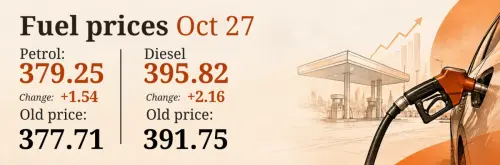
The weekly Sensitive Price Index has reached a peak of almost 12 percent in the third week of October 2026. It was 10.6 percent in September 2026 and 9.1 percent in August 2026. A large part of this increase is due to the continuing increase in fuel prices and the consequential jump in transport costs. A substantial increase in the price of wheat flour of 36 percent has also contributed to the higher rate of inflation and impacted on food security of the people.
Overall, there is no doubt that the ongoing war in the Middle East is constraining GDP growth and unleashing high double-digit inflation in Pakistan. These developments stand in sharp contrast to the optimistic projections made by the government and the IMF for 2026–27.
The government has projected a GDP growth rate of 4 percent and an inflation rate of 8.2 percent for 2026-27. Similarly, the IMF expects the GDP growth rate to be 3.5 percent and the inflation rate to be 9.9 percent. Both of these projections appear optimistic now in light of recent trends.
We shift focus to the key indicators of stabilization of the economy, the external balance of payments and the budgetary position.
The first quarter of 2026-27 outcome of the balance of payments has been released recently by the SBP. The outcome is positive and the surplus in the balance of payments is of USD 3.1 billion, leading thereby to an all-time peak level of USD 21.5 billion in the foreign exchange reserves.
However, this is not due to any big improvement in the current account or in foreign investment. The primary reason is the successful flotation of a bond of USD 3 billion. This is a reflection of the improvement in the credit ratings of Pakistan.
The current account deficit has marginally worsened from USD 755 million in the first quarter of 2025-26 to USD 874 million in the first quarter of 2026-27. However, this has been the consequence of an over 21 percent decline in the volume of imports of petroleum products and 7 percent fall in crude imports, due to the supply constraint created by the closure of the Strait of Hormuz. Further, there were no LNG imports.
Consequently, the current account deficit is artificially smaller. In normal circumstances, imports of petroleum products and LNG would have been higher by over USD 800 million, doubling thereby the current account deficit. As shortages increase, Pakistan will have to find ways to increase the crude, petroleum products and LNG imports.
Finally, we come to the position of public finances. The information on fiscal operations has not yet been released by the Federal Ministry of Finance for the first quarter.
The monthly Economic Outlook and Update of the Ministry of Finance has, however, been released. Apparently, a primary surplus has been achieved in July 2026. This may be sustained by the attainment of the revenue target by the FBR of Rs 3,053 billion in the first quarter of 2026-27. However, there was only a modest growth of 7 percent. This implies that with the rate of inflation operating at over 10 percent, the various tax bases have shrunk in real terms by 3 percent. This tends to confirm the likelihood of a relatively low GDP growth rate in the first quarter of 2026-27.
Overall, the state of the economy since the start of the Middle East war is of a reduction in the GDP growth rate and a significant rise in the rate of inflation. The balance of payments has improved because of access to large financing by flotation of bonds. There is not enough information yet on the state of public finances in the first quarter of 2026-27.
Copyright Business Recorder, 2026
The writer is Professor Emeritus at BNU and former Federal Minister
















Comments