



KARACHI: The Pakistan Stock Exchange (PSX) extended its losing streak to a fourth consecutive week, with the benchmark KSE-100 Index declining 670.56 points, or 0.4 percent, week-on-week to close at 166,419.72 points, as persistent geopolitical tensions, elevated international crude oil prices and domestic economic uncertainties kept investors cautious.
The index fell from the previous week’s closing level of 167,089.28 points, with losses in technology, exploration, power and other major sectors outweighing gains in refinery and selected cyclical stocks.
The latest decline followed three consecutive weekly setbacks, extending the market’s downward trajectory amid continued uncertainty over the geopolitical and domestic economic outlook.
On the international commodities front, Brent crude oil prices came under renewed upward pressure, rising to close the week comfortably above US$106 per barrel, compared with the previous week’s average of US$102 per barrel. The increase in the reported benchmark price added to concerns about the potential implications of higher international energy costs for Pakistan’s economy, particularly given its exposure to imported energy and the possible effects on inflation and the external account.
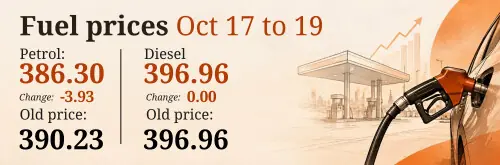
Domestic petroleum prices, however, moved in opposite directions during the week. The price of motor spirit, commonly known as petrol, declined by Rs. 8.73 per litre to Rs. 390.23 per litre, while high-speed diesel (HSD) increased by Rs. 1.24 per litre to Rs. 396.96 per litre.
Pakistan’s external account received support from strong workers’ remittances during September 2026. Overseas Pakistani workers sent US$3.59 billion, during the month, representing a 13 percent increase year-on-year. The inflows lifted cumulative remittances for the first quarter of fiscal year 2027 (1QFY27) to US$10.86 billion, up 14 percent compared with the corresponding period a year earlier.
On the fiscal front, the Federal Board of Revenue (FBR) exceeded its tax collection target for the first quarter of FY27 by Rs. 30.50 billion. Total collections reached Rs. 3.0835 trillion, reported in rounded terms as Rs. 3.08 trillion.
Industrial production data presented a mixed picture. Large-Scale Manufacturing (LSM) expanded by 0.66 percent year-on-year in August 2026 but contracted by 5 percent month-on-month. The annual increase indicated that output was higher than in August 2025, while the monthly decline showed a substantial contraction compared with July 2026.
The International Monetary Fund revised its inflation forecast for Pakistan for FY27 upward to 9.9 percent, above the government’s official target of 8.2 percent. The Fund maintained its gross domestic product growth projection at 3.5 percent, below the government’s official target of 4.0 percent.
In a development related to external debt management, Pakistan formally sought a 15-year extension for the US$1.2 billion annual deferred oil facility provided by the Saudi Fund for Development.
In the domestic debt market, the federal government raised Rs. 660 billion through the latest Treasury bill auction, against a target of Rs. 550 billion. The amount raised exceeded the target by Rs. 110 billion, representing a collection approximately 20 percent above the targeted amount.
Foreign exchange reserves held directly by the State Bank of Pakistan remained stable week-on-week at approximately US$21.5 billion. The unchanged reserve position provided continuity in the reported external buffer during the week.
Trading participation across listed sectors showed that Technology and Communication, Refinery and Investment Banks each accounted for 14 percent of total market volume during the week. Food and Personal Care represented 7 percent, while Power Generation and Distribution accounted for 6 percent. All other sectors combined contributed the remaining 44 percent.
Sectoral equity performance was mixed, but losses across several major industries contributed to the benchmark’s decline. The Refinery sector led the gainers, advancing 4.5 percent week-on-week. Fertilizer and Pharmaceuticals each gained 1.0 percent, while Food and Personal Care rose 0.6 percent. Engineering advanced 0.4 percent, and Automobiles edged up 0.1 percent.
Technology and Communication led the sectoral losses, falling 2.8 percent week-on-week. Oil and Gas Exploration Companies declined 2.3 percent, while Power Generation and Distribution fell 1.9 percent. Cement stocks lost 1.0 percent, and Commercial Banks slipped 0.5 percent.
At the individual-stock level, Bannu Woollen Mills Limited (BNWM) led the gainers, surging 8.7 percent week-on-week to close at Rs. 66.19 per share. AGP Limited (AGP) advanced 8.3 percent to Rs. 168.38, while JDW Sugar Mills Limited (JDWS) rose 4.2 percent to Rs. 871.09 per share.
Pak-Gulf Leasing Company Limited (PGLC) gained 3.8 percent to Rs. 15.00, while Cnergyico PK Limited (CNERGY) increased 2.6 percent to Rs. 12.85. Standard Chartered Bank Pakistan Limited (SCBPL) advanced 2.5 percent to Rs. 59.91, and Fatima Fertilizer Company Limited (FATIMA) appreciated 2.3 percent to finish at Rs. 138.57 per share.
On the declining side, Pakistan Telecommunication Company Limited (PTC) recorded the steepest loss among the reported stocks, plunging 8.9 percent week-on-week to close at Rs. 53.60 per share. Attock Petroleum Limited (APL) dropped 6.3 percent to Rs. 534.84, while Citi Pharma Limited (CPHL) lost 4.8 percent to Rs. 61.66 per share.
Mehmood Textile Mills Limited (MEHT) fell 3.7 percent to Rs. 127.60, and Lotte Chemical Pakistan Limited (LOTCHEM) also declined 3.7 percent, closing at Rs. 25.41. Pakistan Aluminium Beverage Cans Limited (PABC) slid 3.6 percent to Rs. 95.48, while The Hub Power Company Limited (HUBC) declined 3.4 percent to settle at Rs. 193.43 per share.
Total PSX market capitalization contracted by 0.5 percent in rupee terms during the week to Rs. 18.480 trillion, equivalent to US$66.74 billion. In the preceding week, market capitalisation stood at Rs. 18.569 trillion. The local-currency value therefore declined by approximately Rs. 89.46 billion, while the reported US-dollar valuation fell by US$0.30 billion.
Readyboard trading activity recorded mixed movements in volume and value. Average daily turnover in the readyboard spot market increased by 5.2 percent week-on-week to 449.42 million shares, compared with 427.21 million shares in the previous week.
Despite the rise in the number of shares traded, readyboard average daily trade value declined by 1.6 percent to Rs. 17.99 billion, equivalent to US$64.95 million, from Rs. 18.27 billion, or US$65.97 million, previously. The divergence between higher share turnover and lower trade value indicated that the volume increase did not translate into a corresponding increase in the value of ready-market transactions.
The Business Recorder’s benchmark indices also closed lower during the week. The BRIndex100 opened at 18,382.20 points and ended at 18,321.13 points, registering a decline of 61.07 points. Its total weekly turnover stood at 1.626 billion shares.
The BRIndex30 opened at 65,876.08 points and closed at 65,436.82 points, shedding 439.26 points over the week. Total weekly turnover in the BRIndex30 amounted to 896.087 million shares.
Looking ahead, analysts foresee market sentiment is expected to remain cautiously range-bound. The upward movement in oil prices, continued geopolitical uncertainty and the IMF’s revised inflation forecast remain important considerations for investors, while strong remittance inflows, tax collection above the first-quarter target and stable foreign exchange reserves provide supportive elements in the domestic economic picture.
Copyright Business Recorder, 2026
















Comments