


Education without learning
- Pakistan's education crisis stems from deep-seated over-regulation and political control, stifling school autonomy and hindering the nation's ability to build an AI-ready workforce
Pakistan's education crisis stems from over-regulation, political control, and administrative fragmentation, stifling school autonomy and hindering the development of a future-ready workforce for an AI-driven economy.
- Political influence on appointments, transfers, and curriculum.
- Bureaucratic fragmentation and its impact on learning outcomes.
- Proposed reforms for school autonomy and accountability.
- Preparing Pakistan's workforce for an AI-driven economy.
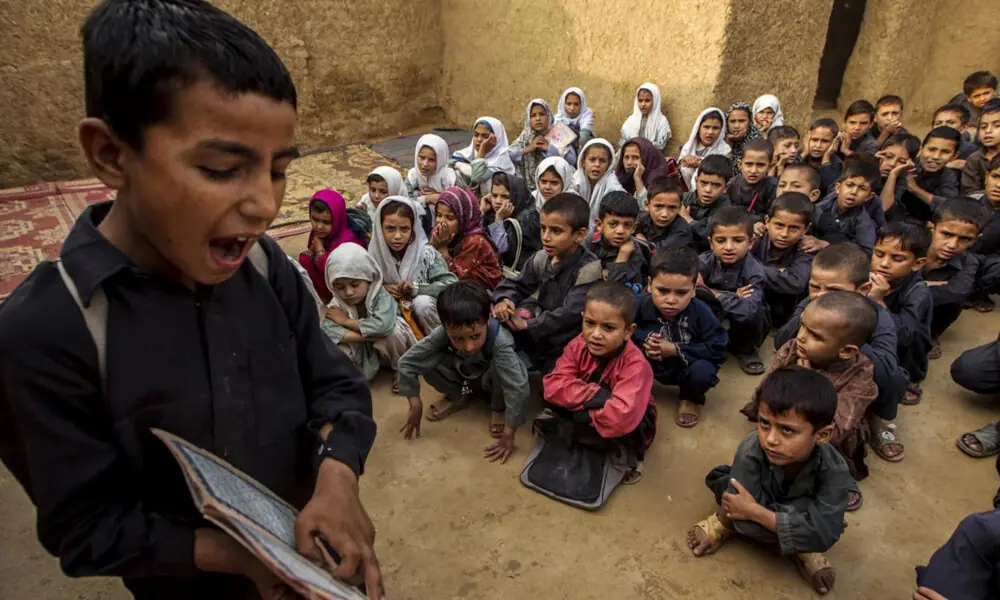
Pakistan’s education crisis is usually described as a crisis of funding, access, teacher shortages and poor learning outcomes. These problems are real, but they do not explain the whole failure. Pakistan also has an education system that is over-regulated, politically controlled and administratively fragmented. Authority has accumulated in ministries, provincial departments, textbook boards, examination boards, accreditation bodies, monitoring units and professional councils, while schools, principals and teachers have too little independence to decide how learning should take place.
This is not only an education story. It is a story about power, productivity and Pakistan’s place in the next economy. The country cannot build an AI-ready workforce on schools designed for obedience, memorisation and clerical routine. The problem is not only money, buildings or enrolment. It is also who controls schools, how decisions are made and whether principals and teachers are trusted to do their work.
The article first explains how political control over appointments, transfers, curriculum and examinations weakens schools. It then uses Islamabad’s federal system to show how overlapping bureaucracies can add supervision without improving learning. Finally, it proposes a clearer division of roles: evidence and standards at the federal level, financing and support at the provincial level, school management at the local level, and professional autonomy for principals and teachers.
The central problem is not simply the existence of a Ministry of Education, but the concentration of policy, finance, regulation, appointments, transfers, curriculum, examinations and school management inside politically controlled departments. Once politicians can influence school locations, staffing decisions and contracts, education becomes part of the patronage state. Schools become employment offices and political constituencies rather than institutions for learning.
Teachers may be appointed because of political connections rather than merit; transfers may reward supporters or punish independent teachers; ineffective or absent teachers may be protected by local influence; and schools may be opened where they generate political benefit rather than where children most need access. When these practices become common, the result is the worst of both worlds: a large public payroll without a professional teaching service.
The 18th Amendment devolved education largely to the provinces, but devolution did not automatically create local autonomy or professional administration. It often transferred control from Islamabad to provincial capitals, while provincial departments reproduced the same hierarchy through directorates, district offices, monitoring units and textbook boards. Decentralization without institutional safeguards can simply move patronage closer to the ground without making schools more independent.
This pattern matters because bureaucratic control can survive even when authority is relocated. A system can be formally devolved while leaving schools dependent on distant administrators for staffing, procurement, textbooks, inspections and routine decisions. Islamabad illustrates this problem in a compact form because its federal institutions are visible, concentrated and easier to trace.
Islamabad provides a useful case study. The Federal Directorate of Education (FDE) operates approximately 432 schools and colleges serving more than 240,000 students. It manages teachers, budgets, buildings, textbooks, examinations, training, procurement and daily administration. The Pakistan Institute of Education (PIE), created in 2022, is intended to provide education data, research, assessment and policy analysis. Its mandate includes student assessment, teacher evaluation, school evaluation and system evaluation.
In principle, FDE should operate schools while PIE independently evaluates them. In practice, the distinction is blurring. FDE has begun developing its own monitoring and evaluation capacity, even though PIE already has a mandate to evaluate schools and systems. The Ministry has acknowledged that FDE previously lacked a formal monitoring and evaluation cell and has now deployed full-time monitoring staff across its institutions. Islamabad therefore risks creating two overlapping supervisory bureaucracies: more visits, forms and reporting requirements for schools, but no single institution clearly responsible for learning.
It would be unfair to describe FDE schools as uniformly unsuccessful. They educate large numbers of students, and many pupils perform reasonably well in reported examinations. FDE has also introduced new textbooks with stories, activities, project work, QR codes and digital resources, along with ICT laboratories, STEM initiatives, school meals and AI-related programs.
But these achievements do not constitute a full evaluation. Enrolment, buildings, textbooks and examination results are visible outputs. They do not adequately measure foundational reading, mathematical reasoning, creativity or independent learning. Islamabad also has a comparatively educated population. Children entering FDE schools may have more educated parents, greater exposure to books and language, better nutrition, more digital access and more help with homework than children entering schools in poor rural districts. Their final results therefore reflect both family background and school quality.
A proper evaluation must measure value added by testing students when they enter the system and following them over time, while controlling for parental education, household income, preschool experience, language, nutrition, gender and prior learning. Without that baseline, strong examination results cannot tell us whether schools are improving learning or merely enrolling students who already had advantages before they entered the classroom.
The same caution applies to the private sector. Private schools now educate a large share of Pakistani children – approximately 44 percent of total enrolment in 2017–18, with private primary enrolment estimated at about 47 percent nationally in 2024. In Islamabad, the best-known schools are overwhelmingly private, and families often choose them for discipline, English instruction, teacher attention, examination preparation, communication with parents and continuity of management.
Private schools often attract more affluent families, charge fees and may exclude children with learning difficulties, so their better results cannot automatically be attributed to superior teaching. Still, their growth sends a clear institutional signal: families look for schools that seem more responsive, accountable and consistently managed. If public schools have government buildings, public salaries and extensive administrative support but are still not considered competitive, the problem cannot be explained only by resources. It must also include governance, incentives and regulation.
Schools need autonomy, but autonomy requires protection from political interference and a clear accountability framework. Principals should have predictable budgets and authority over minor repairs, local procurement, remedial teaching, teacher collaboration, timetables and enrichment activities. Teachers should be able to adapt lessons, use local examples, ask questions and respond to different levels of student understanding, while being judged by evidence of student learning rather than by compliance with paperwork alone.
A curriculum should define what students must learn, not dictate every aspect of how teachers teach. The OECD’s comparative evidence indicates that teachers with greater autonomy over lesson design, instructional methods and curriculum implementation are better able to adapt teaching to student needs.
Yet autonomy cannot work if politicians continue to control appointments and transfers. Teacher recruitment should be conducted through independent merit-based commissions, with transparent tests, verified qualifications and publicly declared vacancies. Transfers should follow objective rules and digital records. Principals should be selected competitively and given authority over school management. Politicians should determine broad priorities and budgets, not individual appointments.
The regulatory problem is particularly visible in textbooks and examinations. Textbook boards often become monopolistic suppliers, prescribing the books they produce or sponsor. Pakistan also has approximately 28 public examination boards, many of which reward memorization and coaching rather than understanding and application. Schools then teach to the examination, while regulators mistake compliance for quality.
The regional comparison is instructive. India’s education system is also vast, political and uneven, but its reform debate has increasingly been disciplined by independent learning evidence. ASER India shifted public discussion from buildings and enrolment to whether children can actually read and do arithmetic, while the National Education Policy 2020 places foundational literacy, early childhood education and assessment reform at the centre of the agenda. Bangladesh offers a different lesson: it has made visible gains in access and gender parity, especially at lower secondary level, yet recent sector analyses still point to weak foundational learning, high dropout and coordination problems. The lesson from both neighbours is not that Pakistan should copy either model. It is that education systems improve when the argument moves from control to learning: measure what children know, give schools room to respond, and hold institutions accountable for outcomes rather than paperwork.
Artificial intelligence makes this reform urgent because it exposes the cost of bad schooling. AI will not wait for Pakistan’s school system to become orderly; it is already changing how students search, write, translate, calculate, practice and prepare for examinations. In such a world, a system built around textbook monopoly, memorisation and bureaucratic compliance will fall further behind. The public school of the future must teach children how to question, reason, verify information, use digital tools responsibly and solve problems that cannot be answered by copying a model response. That requires capable teachers, flexible classrooms, better assessment and trust in professional judgment. If Pakistan keeps regulating schools as if learning were a clerical process, AI will widen the gap between children who can use new tools intelligently and those who are merely exposed to them without guidance.
This is where education failure becomes economic failure. Pakistan has repeatedly struggled to move workers from low-productivity into higher-value services, manufacturing and technology. Weak schooling is central to that failure. Too many young people leave school without strong numeracy, English, scientific reasoning, coding ability or the confidence to learn independently. The loss is not abstract: it is the programmer who was never trained, the data analyst who never mastered mathematics, the technician who never entered a lab, the entrepreneur who never learned to solve problems. Pakistan has millions of young people who could power a computing revolution, but inadequate schooling narrows that pipeline before it forms. India’s experience is imperfect, but it shows what scale can achieve when technical education, English-medium professional training and globally connected technology services create a deep pool of trainable graduates. Its software and IT-services success did not emerge from office towers alone; it rested on human capital. Pakistan cannot compete in an AI-driven economy if its schools continue to prepare students for clerical recall rather than computational thinking, problem solving and continuous learning.
That is why Pakistan needs a serious regulatory review of education. Every approval, inspection, reporting requirement, textbook rule, examination procedure and staffing process should be assessed for its purpose, cost and effect on learning. Rules that protect children, assure minimum standards and prevent abuse should remain. Rules that merely preserve administrative control should be withdrawn. Schools should be allowed to choose among approved textbooks, and private institutions should be regulated for safety, transparency and minimum learning standards – not micromanaged in every operational detail.
Pakistan may need federal education capacity, but not a large Ministry that attempts to manage schools across the country. Canada has no federal education ministry; education is managed by provinces and territories. Switzerland has no federal ministry of education, while in the United States education is primarily a state and local responsibility. Pakistan’s federal role should focus on national statistics, assessment, research, equalization and coordination.
The principle should be simple: the federal government should provide standards, evidence and equalization; provinces should finance and support education; local authorities should manage schools; principals should lead them; and teachers should teach. Pakistan’s education reform should therefore begin not with another layer of control, but with a disciplined reduction of political discretion over schools. Without that shift, each new reform will become another instruction from above rather than a real improvement in the classroom.
The writer served as the Deputy Chairman of the Planning Commission and is now Director, Socioeconomic Insights and Analytics (SIA) X: @nadeemhaque; YouTube: @SiaLytics and Substack: Aid, Policy and Growth

PUBLIC SECTOR EXPERIENCE: He has served as Member Energy of the Planning Commission of Pakistan & has also been an advisor at: Ministry of Finance Ministry of Petroleum Ministry of Water & Power
PRIVATE SECTOR EXPERIENCE: He has held senior management positions with various energy sector entities and has worked with the World Bank, USAID and DFID since 1988. Mr. Shahid Sattar joined All Pakistan Textile Mills Association in 2017 and holds the office of Executive Director and Secretary General of APTMA.
He has many international publications and has been regularly writing articles in Pakistani newspapers on the industry and economic issues which can be viewed in Articles & Blogs Section of this website.



















Comments