


What’s up with McDonald’s latest ad campaign in Pakistan?
- If consumers increasingly associate an international brand with a political controversy, reminding them that its local operations support Pakistani farmers and workers offers an alternative way to think about the business.
McDonald's Pakistan's new campaign highlights its local sourcing and economic contributions, likely a strategic response to boycotts and growing local competition.
- McDonald's new campaign emphasizing local sourcing and economic impact.
- The campaign's link to recent boycott calls and sales pressure.
- McDonald's substantial economic contribution to Pakistan.
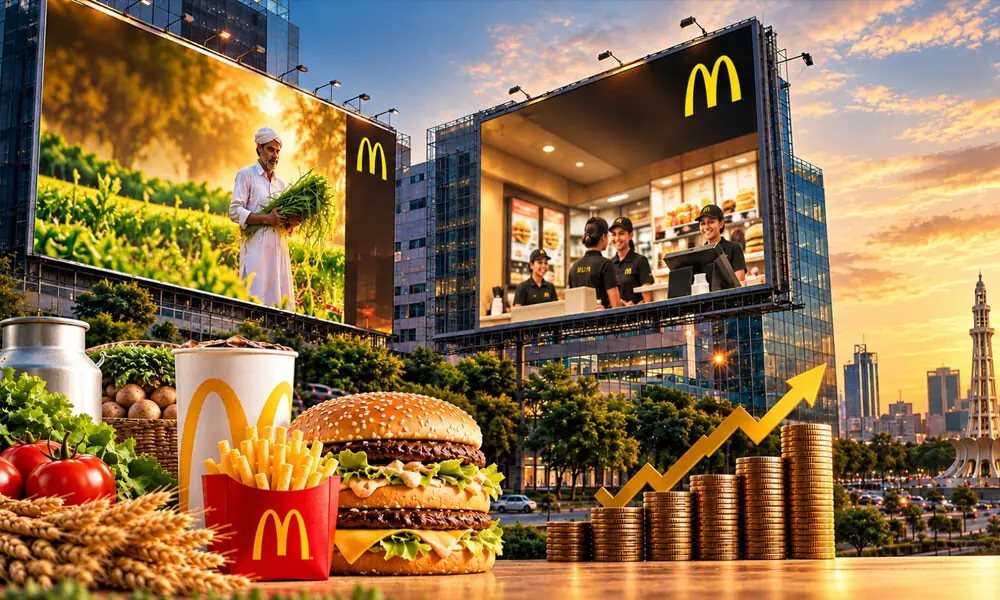
The giant billboards as part of McDonald’s latest ad campaign featuring host/actor/comedian Tabish Hashmi front and centre showing how the fast food giant uses local ingredients and contributes billions to Pakistan’s economy had me thinking: what’s up with that?
McDonald’s Pakistan is making a concerted pitch about its local roots. Is it simply celebrating 28 years in the country, or is there a bigger reason the brand wants consumers to look beyond the burgers? And could the boycott have something to do with it?
The brand wants customers to think about the farmers growing its potatoes and fresh greens, the poultry and dairy partners supplying ingredients, and the network of local businesses that help keep its restaurants running.
It is an interesting shift in emphasis. Rather than simply selling the familiar appeal of burgers, fries and Happy Meals, McDonald’s is selling a bigger story: that buying from the brand also supports Pakistani businesses, workers and communities.
And it has numbers to back up that argument.
The economic contribution pitch
According to an Oxford Economics study highlighted on McDonald’s Pakistan’s Shana Bashana campaign page, the company contributed Rs22.6 billion to Pakistan’s gross domestic product (GDP) and supported an estimated 13,900 jobs. Between July 2024 and June 2025, it spent Rs15.1 billion with Pakistan-based suppliers, representing 91% of its total supplier spend. The company also reports Rs5.9 billion in sustained tax contributions.
Its local network includes 55 vendors, covering 29 food suppliers and 26 non-food partners. The local sourcing message is particularly important. McDonald’s is pointing out that its fries do not simply arrive from some distant global supply chain: Pakistani agricultural partners help grow the potatoes used in them. Its campaign also highlights locally sourced greens, poultry and dairy.
There is a distinction worth making, however. The 91% figure refers to spending with Pakistan-based suppliers, not to 91% of all ingredients being locally produced. Still, the figures offer a substantive case for the brand’s economic footprint.
Is the boycott behind the campaign?
McDonald’s has faced boycott calls in Pakistan and other Muslim-majority markets. Images of Israel Defense Forces (IDF) soldiers receiving McDonald’s meals became a major source of controversy. The global company subsequently faced reputational pressure across several markets.
Pakistan was no exception. A 2024 news report cited market sources who said McDonald’s and other international fast-food brands had experienced noticeable business declines amid boycott-related consumer sentiment. A 2025 news report also described significant initial sales pressure on McDonald’s and KFC, with some franchises reportedly seeing sales fall by as much as 40%.
That is evidence that the boycott had a real commercial impact at the time. It is not evidence that McDonald’s Pakistan is currently experiencing falling sales, though. The company has not publicly provided current local sales figures that would establish whether its business is still suffering.
So, is the new campaign an attempt to win customers back? It is a plausible interpretation. If consumers increasingly associate an international brand with a political controversy, reminding them that its local operations support Pakistani farmers and workers offers an alternative way to think about the business.
It also gives customers a different consideration: boycotting the brand may affect not only the franchise operator but also local suppliers and employees who depend on its business. That does not settle the ethical debate, but it changes the terms of the conversation.
Why emphasise local ingredients now?
The local sourcing message may also be a response to a broader change in consumer sentiment. The boycott encouraged some Pakistanis to explore domestic alternatives, from soft drinks to fast food. For an international chain, demonstrating local roots could help counter the perception that choosing a Pakistani alternative is necessarily the more patriotic decision.
McDonald’s is effectively arguing that a global brand and a local economic footprint are not mutually exclusive. Its restaurants are locally operated, and its supply chain includes Pakistani businesses. The campaign asks consumers to see those connections as part of the value of the brand.
There is also a straightforward marketing explanation. Marking 28 years in Pakistan provides a natural occasion to celebrate suppliers and highlight economic impact. The campaign may be intended to strengthen brand affinity, distinguish McDonald’s from competitors and remind customers why the chain has remained part of the market for nearly three decades.
These explanations are not mutually exclusive. A campaign can celebrate genuine local partnerships while also trying to repair a brand’s image and encourage customers to return.
The competition is no longer just the other global chains
There is another factor McDonald’s cannot ignore: Pakistan has developed a much more diverse fast-food market, with local burger businesses offering compelling alternatives.
Home-grown chains have helped build a market where consumers have more choices than the familiar international franchises. Independent burger joints and newer local operators can compete through distinctive flavours, generous portions, localised menus, pricing and delivery offers. Reporting during the boycott also documented consumers shifting towards local food businesses.
This is not necessarily a story of local brands replacing McDonald’s outright. Global chains retain advantages in brand recognition, consistency, established supply chains and promotions. But the local competition gives customers more reasons to experiment — and more alternatives if they decide not to visit McDonald’s.
The result is a tougher question for the brand: what makes it worth choosing over a Pakistani competitor?
Its answer appears to be a combination of familiarity, product consistency and now, a stronger story about its contribution to the country.
A new story for an old favourite
Still, the timing invites speculation. The boycott may have weakened some consumers’ attachment to the brand, while a stronger local fast-food sector has given them more alternatives. Both could make it more important for McDonald’s to demonstrate why it belongs in Pakistan.
What is clear is that McDonald’s wants customers to see more than a global logo: it wants them to see Pakistani farmers, suppliers, employees and businesses behind the meal.
Whether that is enough to win back customers who have moved on — for political reasons, better local options or simply changing tastes — remains to be seen.
The writer is Head of Digital Content at Business Recorder






















Comments