


Selling continues at PSX, KSE-100 Index closes 348 points lower
- Benchmark index ends day at 164,776.44
The Pakistan Stock Exchange's KSE-100 Index fell 348 points due to persistent selling pressure and cautious investor sentiment, amidst rising inflation projections and global market volatility.
- IMF's inflation and economic growth projections for Pakistan.
- Pakistan's plans for diversifying international borrowing.
- Global market downturn and geopolitical tensions.
- Pakistani rupee's marginal gain against the US dollar.
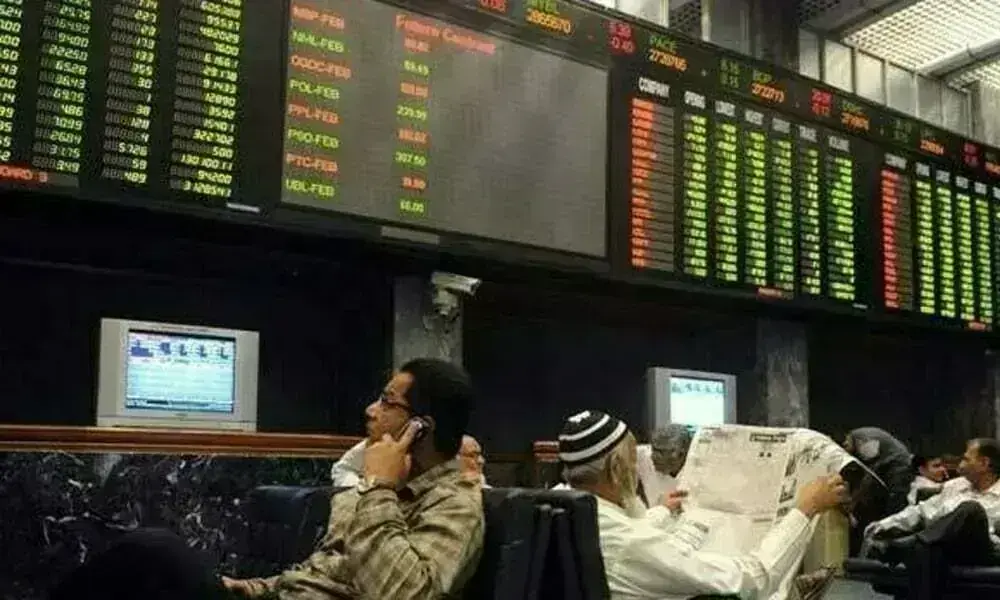
Selling pressure continued at the Pakistan Stock Exchange (PSX) on Tuesday, with the benchmark KSE-100 Index closing 348 points lower amid bearish sentiment.
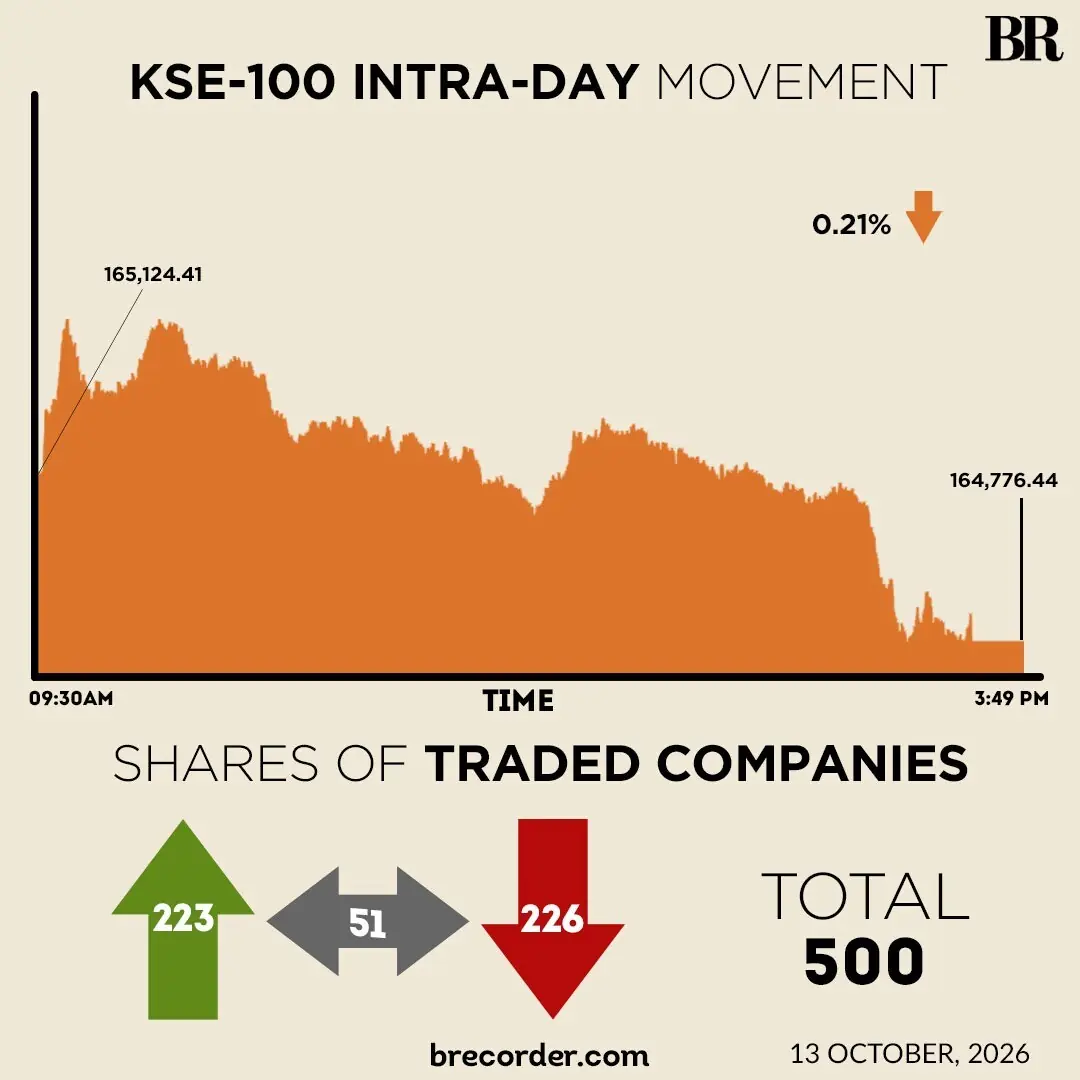
The KSE-100 Index witnessed some buying in the first half, hitting an intra-day high of 166,070.48. However, selling returned to the bourse, pushing the benchmark index to an intra-day low of 164,773.67.
At close, the KSE-100 Index settled at 164,776.44, down 347.97 points or 0.21%.
“The benchmark remained range-bound throughout the session, trading between 164,774 and 166,070, reflecting cautious investor sentiment and persistent selling pressure in index-heavy stocks,” brokerage house Topline Securities said in its post-market report.
“Investor sentiment is likely to remain cautious amid ongoing market volatility. Near-term market direction will depend on developments in key economic indicators, institutional activity, and investor positioning. Selective opportunities may emerge in fundamentally sound stocks, while a prudent investment approach remains advisable.”
Index-heavy stocks remained under pressure, with PTC, UBL, HBL, LUCK, and MARI emerging as the major laggards. Collectively, these stocks contributed approximately 343 points to the index’s decline, weighing on overall market performance, Topline said.
Pakistan’s inflation rate is projected to rise to 9.9% in 2027, while economic growth is expected to ease to 3.5%, according to data released by the International Monetary Fund’s (IMF) World Economic Outlook (WEO) released on Tuesday.
The IMF data showed inflation at 7.1% in 2026, up from 4.5% in 2025. Pakistan’s gross domestic product (GDP) growth is projected at 3.6% in 2026, compared with 3.2% in 2025, before moderating to 3.5% in 2027.
As the government seeks to diversify its funding sources, Pakistan plans to return to China’s domestic bond market for further yuan-denominated borrowing and is exploring the possibility of issuing yen-denominated bonds in Japan, Finance Minister Muhammad Aurangzeb said in an interview to Nikkie Asia.
Pakistan issued its first panda bond worth 1.75 billion yuan ($261 million) in mid-May under a 7.2-billion-yuan programme, with partial guarantees from the Asian Development Bank and the Asian Infrastructure Investment Bank.
SE Fruits and Vegetable Limited will withdraw its existing initial public offering (IPO) application and submit a fresh one with additional disclosures about the transition of its underlying business from a partnership to a public limited company, the company said.
“The Board of Directors of SE Fruits and Vegetable Limited has decided to withdraw the Company’s current IPO application and submit a fresh application after incorporating additional disclosures into the prospectus,” the company said in a statement.
On Monday, the PSX witnessed heavy selling as domestic political uncertainty following the imposition of emergency and governor rule in Khyber Pakhtunkhwa, coupled with regional geopolitical tensions involving Saudi Arabia, the Houthis, the United States and Iran, prompted investors to reduce their equity exposure. The KSE-100 Index plunged by 1,964.87 points, or 1.18%, to close at 165,124.41 points.
Internationally, Asian equities fell sharply on Tuesday led by technology shares as a widening conflict in the Middle East kept oil prices elevated, supporting the dollar ahead of an earnings season that will set the tone for the rest of the year.
Energy prices are back driving global markets as investors weigh the geopolitical developments in the Middle East and Russia-Ukraine, with Brent crude futures at $105.9 per barrel, near a two-week high.
In stocks, MSCI’s broadest index of Asia-Pacific shares outside Japan fell 2% in early trading, with tech-heavy South Korea’s KOSPI sliding 6%. Japan’s Nikkei sank 2.6% after returning from a holiday.
Overnight, the tech-heavy Nasdaq fell 0.5%, dragged by chipmakers as investors fret about the durability of the rally in AI stocks amid higher competition between the US and China.
The cautious sentiment helped keep the US dollar near an 18-month high. The euro last bought $1.1157, while the Japanese yen was at 158.50 per US dollar.
Investors’ attention will be on the slew of US bank earnings this week to get a gauge on the impact of the recent surge in Treasury yields on dealmaking, lending growth and funding costs across the industry.
A toxic mix of inflationary pressure from elevated energy prices and worries about ballooning government debt have triggered several bouts of bond selloffs in recent weeks, pushing borrowing costs to multi-decade highs across the globe.
Four of the six largest US lenders, JPMorgan Chase, Goldman Sachs, Citigroup and Wells Fargo will report results later in the day.
Meanwhile, the Pakistani rupee extended its marginal gains against the US dollar in the inter-bank market on Tuesday. The local unit closed the day at 276.96, a gain of Re0.01 against the greenback.
Volume on the all-share index increased to 383.75 million from 362.95 million recorded in the previous close.
The value of shares declined to Rs13.10 billion from Rs14.51 billion in the previous session.
LSE Financial(R) was the volume leader with 32.28 million shares, followed by Waves Home App with 21.85 million shares, and WorldCall Telecom with 19.53 million shares.
Shares of 500 companies were traded on Tuesday, of which 223 registered an increase, 226 recorded a fall, and 51 remained unchanged.





















Comments