


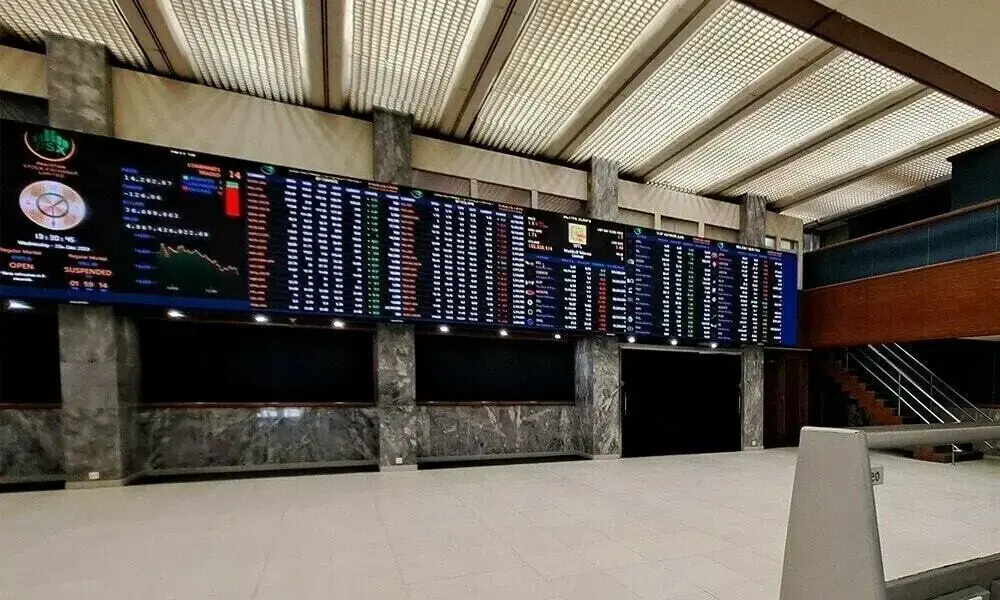
KARACHI: The Pakistan Stock Exchange (PSX) closed lower during the week ended October 9, 2026, as persistent US-Iran tensions, escalating military clashes between Saudi Arabia and Yemen’s Houthi forces, and heightened regional security concerns weighed on investor sentiment.
The benchmark KSE-100 Index fell 1,066.20 points, or 0.6 percent week-on-week, to close at 167,089.28 points, as Brent crude remained above USD100 per barrel and uncertainty surrounding developments in the Middle East constrained risk appetite.
The regional security situation remained a key concern for investors during the week, with tensions between the United States and Iran persisting alongside intensifying clashes involving Saudi Arabia and Yemen’s Houthi forces. These developments added to uncertainty over the regional outlook, while the Makkah Defence Alliance’s agreement on rapid force deployment further highlighted the security concerns confronting the region.
Against this backdrop, investors remained cautious, with the benchmark index registering a weekly decline despite gains in selected sectors, particularly refineries, oil and gas marketing companies, power generation and pharmaceuticals.
Brent crude oil prices remained elevated throughout the week, staying firmly above USD100 per barrel. The persistence of high international oil prices kept energy costs and their potential implications for Pakistan’s economy in focus. Domestic petroleum prices, however, moved in different directions during the week. The price of motor spirit, commonly known as petrol, increased by Rs. 6.20 per litre to Rs. 398.96 per litre, while high-speed diesel (HSD) prices declined by Rs. 3.92 per litre to Rs. 395.72 per litre.
On the domestic economic front, Pakistan reached a staff-level agreement with the International Monetary Fund (IMF), paving the way for the release of USD1.2 billion, under the fifth tranche of the Extended Fund Facility (EFF) and the third tranche of the Resilience and Sustainability Facility (RSF). Analysts say the agreement represented a significant development in the country’s engagement with the multilateral lender during a period in which external financing, fiscal management and energy-sector reforms remained important policy considerations.
The IMF, however, called on the government to phase out fuel subsidies, broaden the tax base and ensure timely adjustments in energy tariffs. The Fund also cautioned that economic risks remained elevated because of geopolitical tensions, volatile international energy prices and continuing disruptions to global trade.
Meanwhile, government debt figures also remained in focus during the week. Official data showed that total government debt declined by 0.5 percent month-on-month to Rs. 82.95 trillion in August 2026. Despite the monthly reduction, the debt stock remained 7.1 percent higher than a year earlier, indicating that the decline over the month had not reversed the year-on-year increase.
Separately, debt owed by state-owned enterprises (SOEs) surged to Rs. 10.10 trillion by the end of December 2025, according to disclosures by the Finance Ministry. Analysts say the figures highlighted the scale of outstanding government and state-enterprise liabilities.
In the sovereign debt market, the federal government raised Rs. 352.00 billion, through the latest auction of Pakistan Investment Bonds (PIBs). Investor bidding pushed yields higher by between 26 and 41 basis points across various tenors.
Foreign exchange reserves held directly by the State Bank of Pakistan (SBP) remained stable week-on-week at USD21.50 billion. The unchanged reserve position provided a stable reading for the week, even as Pakistan continued to face external risks associated with high global energy prices, international trade disruptions and geopolitical uncertainty.
Trading activity across listed sectors showed that the Refinery, Technology and Communication, and Textile Spinning sectors each accounted for 12 percent of total market volume during the week. Investment Banks and Miscellaneous companies each represented 8 percent, while all remaining sectors combined contributed 49 percent of market volume.
Sectoral performance remained broadly negative, with only four sectors recording gains. The Refinery sector led the advance, rising 2.0 percent week-on-week, followed by Oil and Gas Marketing Companies (OMCs), which gained 1.1 percent. Power Generation and Distribution increased 0.4 percent, while Pharmaceuticals edged up 0.2 percent.
Textile Composite recorded the steepest decline among the reported sectors, falling 2.0 percent week-on-week. Fertilizer stocks lost 1.9 percent, while Engineering declined 1.8 percent. Automobiles contracted 1.6 percent; Chemicals slipped 1.2 percent and Oil and Gas Exploration Companies (E&Ps) fell 1.1 percent.
Commercial banks declined 1.0 percent, while food and personal care stocks shed 0.9 percent. Cement eased 0.8 percent, and technology and communication declined 0.4 percent.
Individual stock movements also reflected the uneven performance of the market. Pakistan Aluminium Beverage Cans Limited (PABC) led the reported KSE-100 gainers, rising 6.3 percent week-on-week to close at Rs. 99.08 per share. TGL advanced 4.1 percent to Rs. 158.77, while Pakistan State Oil Company Limited (PSO) gained 3.9 percent to Rs. 360.66 per share.
On the declining side, SSOM PA Equity recorded the largest loss among the reported stocks, plunging 20.0 percent week-on-week to close at Rs. 401.75 per share. PGLC fell 12.5 percent to Rs. 14.45, while CPHL lost 9.9 percent to Rs. 64.76 per share.
The combined effect of the market’s movements was reflected in total market capitalisation, which contracted by 0.8 percent during the week to Rs. 18.569 trillion, equivalent to USD67.04 billion. In the previous week, market capitalisation had stood at Rs. 18.726 trillion, or USD67.58 billion.
Trading activity also weakened in the readyboard spot market. Average daily turnover declined 18.6 percent week-on-week to 427.21 million shares, compared with 524.53 million shares in the preceding week. The reduction of 97.32 million shares in average daily turnover indicated a substantial decline in the number of shares traded on an average day in the ready market.
In value terms, readyboard average daily trade value fell by 2.0 percent to Rs. 18.27 billion, equivalent to USD65.97 million, from Rs. 18.66 billion, or USD67.33 million, previously. The local-currency value declined by Rs. 390 million, while the US-dollar value decreased by USD1.36 million.
The Business Recorder’s dedicated equity indices also ended the week lower. The BRIndex100 opened at 18,497.10 points and closed at 18,382.20 points, registering a decline of 114.90 points over the week. Its total turnover amounted to 1.699 billion shares.
The BRIndex30 opened at 66,301.56 points before closing at 65,876.08 points, a fall of 425.48 points. Total turnover in the BRIndex30 stood at approximately 1.044 billion shares.
Looking ahead, market sentiment is expected to remain cautious as investors assess the implications of Pakistan’s staff-level agreement with the IMF, particularly the structural conditions relating to fuel subsidies, tax-base expansion and energy tariff adjustments. Meanwhile, elevated global oil prices, continuing Middle Eastern tensions and international trade disruptions remain potential sources of uncertainty.
Copyright Business Recorder, 2026


















Comments