


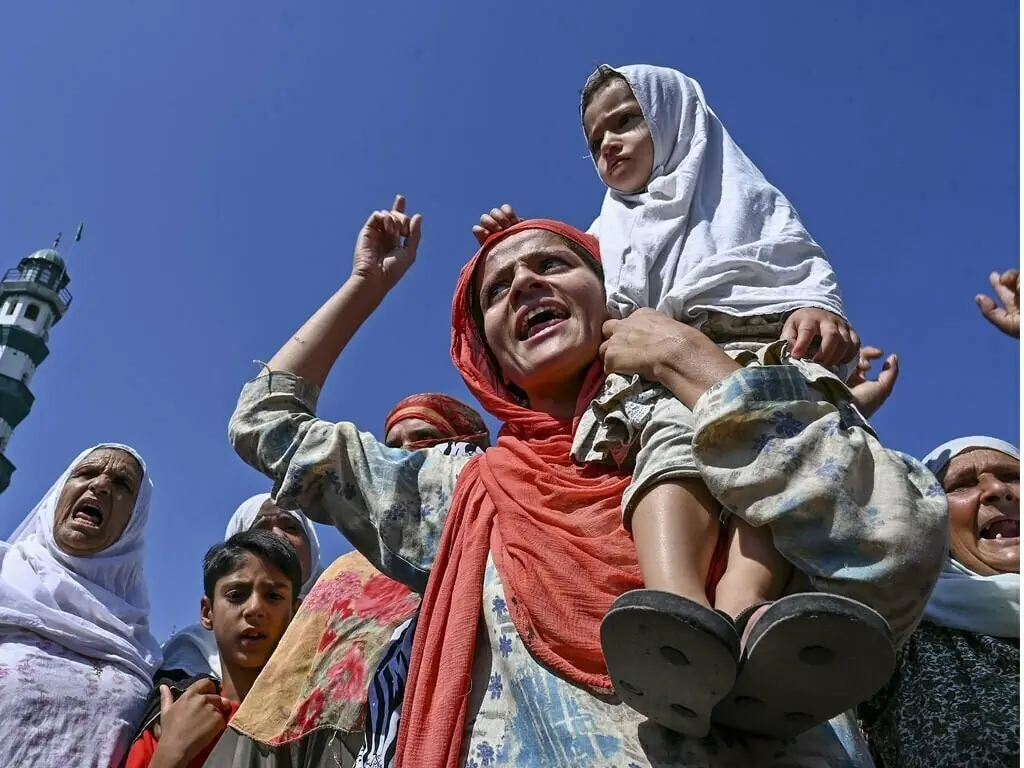
Jammu Kashmir Joint Awami Action Committee (JAAC) was initially implanted by traders, transporters, students and civil society groups of Azad Jammu and Kashmir. It was set up in September 2023, at a time when price for wheat and electricity tariff were high. Eventually it released a charter of 38 points which comprised an end to elite privileges and the abolition of 12 assembly seats for Kashmiri refugees settled in Pakistan. In May 2024, a week of strikes was settled after the government agreed to the demands, which included aRs23 billion grant and reduced prices of wheat and electricity.
A six-day closure came to a violent end in late September 2025. On 4 October 2025, an agreement was signed, and the government claims it has fulfilled 35 to 37 of the 38 demands, a claim that is disputed by the JAAC. Discussions broke down in June 2026. The AJK government banned the group on 5 June under its Anti-Terrorism Act, listed 147 activists under the Fourth Schedule and suspended internet services. JAAC declared a “Black Day” and initiated an indefinite shutdown of all three divisions on 4 October 2026, when the xenophobic violence started again.
Its effects on society have been profound. Everything was disrupted. Transport, shops and schools were shut down by strikes. Students suffered the most. The University of AJK delayed its spring exams and the 48-day internet shutdown disrupted online learning, freelancers and women entrepreneurs and digital payments. Health services also were affected. Due to the inability to reach supplies and the lack of easy transportation of goods, medicine supplies were interrupted. For weeks many families lived in fear and uncertainty. There is division among people, too. Many supported early closures due to their cost savings, but the acceptance of open-ended closures is eroding.
It has been an expensive exercise for a small economy. The government has estimated the losses arising from the un rest of 2026 at Rs15 billion, of which Rs4 billion is from tourism. This is approximately 5 percent of AJK’s annual budget of Rs286 billion or so. The disturbances erupted during the height of summer — when tourists were warned to depart. Hotels, restaurants and transporters suffered the worst months and traders reported that by end of June only 50-70 per cent of businesses in Muzaffarabad had restarted. Whilst the shopkeepers may be able to recover some of the sales, the lost wages of the daily wage earners cannot be recovered and thus the poorest are hardest hit. Islamabad is also an important source of support to AJK. Its own tax revenue is expected to be approximately Rs75 billion with an estimated federal grant of Rs146 billion. Thus each local emergency becomes a burden for the Federal government.
The security cost is a serious one, too. Each round has resulted in the deaths and injuries of law-enforcement officers and the government has blamed the JAAC for attacks on police and public property. Each officer killed or injured is a family in mourning and each road or building damaged takes funds out of schools and hospitals. There is also a growing concern with increasing anti-state sentiment. Slogans calling for resistance to the state are reported — including among young students and children. It is the worst indicator of all because a generation that has been indoctrinated to think that the state is their enemy is a tough generation to win over.
The impact is fiscal, political and strategic for Pakistan. Kashmir is the jugular vein of Pakistan, said Quaid-e-Azam. Pakistan and Kashmir are interwoven, one body. The rivers that supply the Pakistani fields and dams are in Kashmir, as is Mangla. Fiscally, the state paid a grant of Rs23 billion in 2024 and Rs20-25 billion more on the 2025 agreement, which puts strain on an already strained budget. Politically, the protests earlier did have some impact, including reduction in the AJK cabinet from 36 to 20.
India is the only one to benefit from the situation internationally. The media in India has extensively covered the unrest in AJK, frequently referring the territory as “occupied” and the protest on 4 October as a “Black Day”. Every shutdown, the internet and deaths become headline in India and is used to further reduce Pakistan’s voice on Kashmir and to claim that its own people are not happy. But this is one-sided and politically motivated and spreads rapidly since the unrest provides it with material. There, India is getting the benefit without doing anything and Pakistan has to explain itself. This is why it’s not just a problem here in AJK, it’s a gift to Pakistan’s rival.
The message of the past three years is: disturbances assist no one. Human lives, education, health and livelihoods are all affected. Dialogue is the necessary ingredient for a long-term settlement. Demonstrations should be non-violent, the claims should be achievable and the commitments should be fulfilled. Jobs, schools, tourism and peace are needed, not another shutdown, in AJK. The strength of Pakistan lies in a stable, united and confident Kashmir.
KASHMIR BANEY GA PAKISTAN!
Copyright Business Recorder, 2026
The writer is a gold medalist in BS international relations from the University of Azad Jammu and Kashmir. Her academic interests include international security, strategic affairs, geopolitics, and Pakistan’s foreign policy. She has participated in national security-related workshops and completed an internship with theISPR, further strengthening her interest in strategic communication, defence, and national security affairs.













Comments