


Operating room of tomorrow: where human skill meets artificial intelligence
- AI assists, but human judgment, adaptability, and empathy remain paramount for patient care
AI in operating rooms will foster human-machine collaboration, enhancing care while emphasizing human judgment, responsibility, and the evolution of professional skills.
- Evolving role of Operation Theater Technologists in AI-integrated surgery.
- AI's role as an assistant, not a decision-maker, in patient care.
- Addressing automation bias, accountability, and equitable AI implementation.
- Importance of human education and training alongside technological advancements.
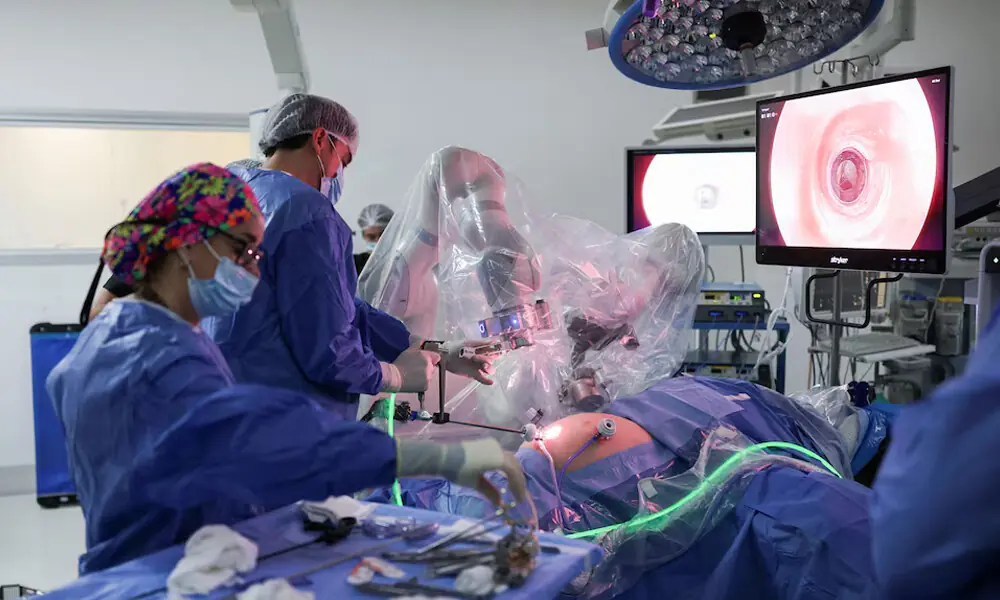

There is a special kind of silence inside an operating room. It is not the silence of an empty place, but the silence of concentration, responsibility and anticipation. A surgeon prepares for the procedure, an anesthetist watches every change in the patient’s vital signs, nurses remain ready for the next requirement, and the operation theatre technologist ensures that instruments, equipment, sterility and the entire surgical environment are prepared for whatever may happen next. Now imagine another presence in that room – one that does not wear a surgical gown, hold an instrument or speak to a worried family waiting outside. It is artificial intelligence.
Artificial intelligence is steadily finding its way into healthcare, supporting areas ranging from medical imaging and clinical care to research and health-system management. Its ability to process enormous amounts of information and recognise patterns in seconds has opened doors that were once unimaginable. Yet the arrival of intelligent technology raises a question that reaches far beyond computers and machines: as technology becomes smarter, what happens to the people who stand at the heart of patient care?
The answer may be very different from the dramatic predictions of machines replacing humans. The future operating room is more likely to be defined by collaboration – humans and intelligent technologies working together, each contributing what the other cannot.
Modern surgery has already undergone a remarkable technological transformation. Advanced imaging, minimally invasive procedures, sophisticated monitoring systems, electrosurgical equipment, robotic platforms and digital technologies have changed the way operations are planned and performed. Artificial intelligence adds another layer to this transformation by helping healthcare professionals process information, identify patterns and, in appropriate applications, support clinical decision-making.
But there is an important line that must never be blurred: assisting is not the same as deciding.
A machine may identify a pattern in an image or generate a prediction, but a human professional must understand what that information means for a particular patient. A patient is not simply a scan, a laboratory report, a vital-sign graph or a collection of numbers. Behind every medical record is a person with a history, fears, expectations, physical characteristics and circumstances that may not fit neatly into a dataset.
That is why the future operating room should not be viewed as a contest between humans and machines. It should be viewed as a partnership.
The surgical team of tomorrow will be larger, more connected and more technologically sophisticated. Alongside surgeons, anesthetists, nurses and other specialists, intelligent systems may become part of the workflow. This will not eliminate the need for skilled healthcare professionals. Instead, it may create new responsibilities and demand new skills.
Someone will have to understand how the technology works. Someone will have to make sure that equipment is functioning properly. Someone will need to recognize when an intelligent system produces an unexpected result. Someone will have to distinguish an algorithmic recommendation from an actual clinical decision. And, above everything else, someone must remain responsible for remembering that there is a human being lying on the operating table.
This is where the role of the operation theatre technologist may become increasingly important.
Traditionally, the OT technologist has been closely associated with surgical instruments, sterilization, aseptic practices, equipment preparation and maintaining the readiness of the operating environment. As operating rooms become increasingly digital, this professional role may evolve into something even broader: a bridge between healthcare professionals and sophisticated medical technology.
Tomorrow’s OT technologist may work in an environment filled with AI-assisted systems, digital displays, advanced imaging, automated documentation and interconnected equipment. Understanding how these systems interact could become just as important as understanding the instruments used during surgery.
What happens if a digital system suddenly stops working? What if an AI-supported device produces an unexpected alert during a critical moment? What if a piece of equipment fails? How does the team safely move from a technology-assisted workflow back to a conventional one?
These questions reveal an important truth. Technology does not eliminate the need for skilled healthcare professionals; it changes the skills they need.
The operating room is also very different from a controlled laboratory. Surgery can change within seconds. A patient’s condition may deteriorate unexpectedly. Equipment may malfunction. An anatomical finding may force the surgical team to change its plan. An instrument that was not anticipated may suddenly become essential.
Human professionals can respond to these situations through experience, communication and judgment. They can recognize when something does not look right. They can communicate with colleagues. They can adapt when circumstances change. They can understand fear and uncertainty.
Artificial intelligence may process information at extraordinary speed, but speed is not the same as wisdom. A prediction is not the same as judgment, and information is not the same as understanding.
There is another danger that comes with sophisticated technology: trusting it too much. When an automated system appears highly advanced, people may be tempted to accept its recommendations simply because they came from a computer. This tendency, often described as automation bias, can become dangerous in healthcare.
The appropriate relationship should therefore be clear. The machine assists. The professional evaluates. The team communicates. The patient remains at the center.
Artificial intelligence should be a tool, not an unquestionable authority.
This principle becomes particularly important because AI systems depend on the data used to develop and evaluate them. A system that performs well in one population or healthcare environment may not perform in exactly the same way elsewhere. Differences in populations, resources, infrastructure and clinical settings matter.
For Pakistan, this issue deserves particular attention.
The introduction of AI into Pakistani operating rooms cannot simply copy the experience of wealthier healthcare systems. Hospitals across the country differ considerably in infrastructure, staffing, training, equipment and access to advanced technologies. Some operating rooms may have sophisticated digital systems, while others continue to function with limited resources.
Therefore, the real question is not simply whether hospitals can purchase advanced technology. The more important question is whether they are developing the human capacity and infrastructure required to use that technology safely.
An expensive machine cannot compensate for inadequate training. Advanced software cannot solve poor maintenance. Digital systems cannot guarantee safer surgery where cybersecurity is weak or responsibility is unclear. Investment in machines must be accompanied by investment in people.
This makes education one of the most important components of the future.
The OT technologist of tomorrow will still need strong knowledge of surgical instruments, sterilization, infection prevention, aseptic technique, patient safety, surgical procedures and equipment management. But alongside these traditional competencies, new areas of knowledge are likely to become increasingly valuable: digital healthcare systems, AI-assisted medical technologies, robotics, data privacy, equipment troubleshooting, human-machine interaction, cybersecurity, technology ethics and digital documentation.
This does not mean that every OT technologist needs to become a computer scientist. It means healthcare professionals must understand emerging technologies well enough to use them responsibly, recognize their limitations and protect patients when technology does not behave as expected.
Yet there is another dimension of surgery that technology can never make irrelevant – the human dimension.
Before an operation, a patient may be frightened. A family may be waiting anxiously outside. A patient may be thinking about children, work, responsibilities or simply whether they will wake up safely after the procedure.
Technology can monitor vital signs, process information and support clinical workflows, but reassurance remains human. Responsibility remains human. Compassion remains human.
The more technology enters healthcare, the more important it may become to protect the human side of medicine.
And then comes one of the most difficult questions of the AI era: who is responsible when artificial intelligence is wrong?
If an AI system produces a recommendation that leads to an unexpected outcome, responsibility cannot simply be transferred to “the machine”. Questions of accountability may involve healthcare institutions, clinicians, technology developers and other responsible parties. Clear governance, appropriate regulation, transparency, oversight, training and system validation will therefore become increasingly important.
Hospitals introducing AI into operating-room workflows will need clear policies and procedures. Healthcare professionals will need appropriate training. Systems will need to be tested and validated in the environments where they are actually used. Their limitations must be understood, and there must be mechanisms for reviewing failures and unexpected outcomes.
There is also a wider social question: who gets access to these technologies?
If advanced AI-assisted healthcare becomes available only in the most expensive hospitals, technological progress could deepen existing inequalities in healthcare. Innovation should therefore be discussed alongside affordability, infrastructure, training and accessibility.
The goal should not simply be to bring artificial intelligence into the operating room. The goal should be to bring it there safely, responsibly and fairly.
Perhaps the operating room of the future will look dramatically different from the one we know today. Surgeons may receive real-time digital assistance. Robotic systems may support selected surgical tasks. AI may analyze vast amounts of information within moments. Monitoring systems may identify patterns that deserve attention. Equipment may communicate with other equipment, while documentation becomes increasingly automated.
But in the center of this technological environment, one thing will remain unchanged: the patient.
Around that patient will still be a team – a surgeon, an anesthetist, nurses, an operation theatre technologist and other healthcare professionals. Intelligent machines may increasingly become part of that team, but the challenge will be to ensure that technology strengthens human teamwork rather than weakens it.
The most useful question is therefore not whether humans or machines will win. The more meaningful question is what healthcare professionals can accomplish with responsible technology that they could not accomplish as effectively without it.
AI may help process information, automate repetitive tasks, support decision-making and improve efficiency in appropriate applications. Human professionals, however, bring responsibility, judgment, communication, adaptability, empathy and accountability.
The future of surgery will depend on combining these strengths.
For operation theatre technologists, this transformation represents not only a challenge but an opportunity. Their profession has always existed at the intersection of people, procedures and technology. As operating rooms become more sophisticated, that position could become even more important.
The OT technologist of the future may not simply prepare instruments and equipment. The role may expand toward helping manage an increasingly intelligent surgical environment – making sure technology is prepared, functional, integrated and used safely.
That transformation must begin with education and curiosity. Healthcare professionals will need to ask not only, “How does this machine work?” but also, “When should we trust it? When should we question it? And what should we do when it fails?”
These questions may define the next generation of surgical care.
At the end of every operation, the instruments are counted, equipment is checked, the procedure is completed and the patient leaves the operating room. In that final moment, technology becomes secondary once again.
The patient is what matters.
Artificial intelligence may become faster. Machines may become smarter. Robots may become more sophisticated. Algorithms may process information beyond the capacity of any individual human mind. Yet the purpose of all this progress remains remarkably simple: to provide better care to a human being.
The future operating room will not necessarily belong to machines. It will belong to teams that know how to combine human judgment with technological intelligence.
The new surgical team, therefore, is not humans versus machines.
It is humans with machines.
And perhaps the most important professional of the future will not be the person who knows how to use the most advanced technology, but the person who knows when technology should be trusted, when it should be questioned, and when the human being must have the final word.
Because no matter how intelligent the operating room becomes, there will always be one thing that technology must never lose sight of: the person lying on the operating table.
The writer is a surgical technologist associated with a private university in Lahore























Comments