


PM says water must not be weaponised
Prime Minister Shehbaz Sharif at SCO urged cooperation over confrontation, emphasizing water security, counter-terrorism, and regional development, while proposing an SCO AI framework.
- Water security and honoring international treaties.
- Pakistan's counter-terrorism record and regional peace.
- Proposed SCO Sovereign AI Infrastructure and Governance Framework.
- Regional connectivity and economic development initiatives.
- UN reform and addressing global challenges.
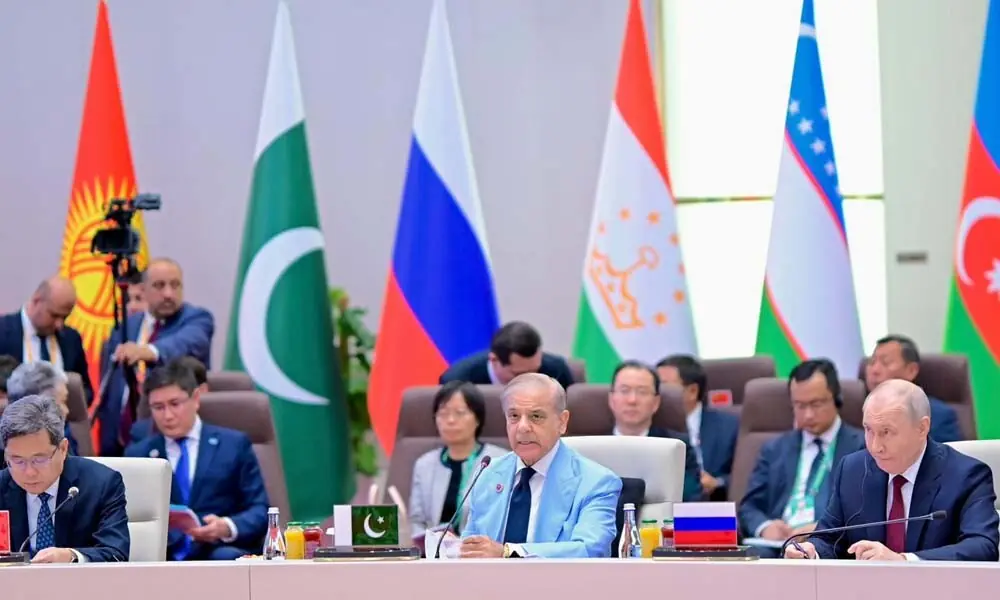
BISHKEK: While addressing the 26th Meeting of the Shanghai Cooperation Organisation (SCO) Council of Heads of State as well as the SCO Plus Format meeting here on Tuesday, Prime Minister Shehbaz Sharif said water was the lifeblood of the region and must never be weaponized or used as an instrument of coercion or political leverage, adding that treaties governing shared waters were binding international commitments that must be honoured unconditionally.
“Water is the lifeblood of our region that sustains millions of lives, nourishes our lands and secures the very future of our coming generations. It must never be weaponized or used for political coercion.
The treaties governing our shared waters are binding commitments that must be honored unconditionally both in letter and spirit,” the prime minister said, a day after the Permanent Court of Arbitration ruled that the 1960 Indus Waters Treaty (IWT) remains in full force and ordered India to limit ongoing hydroelectric construction in Kashmir.
READ MORE: Pakistan welcomes Indus Waters Treaty ruling
Highlighting Pakistan’s counter-terrorism record, Shehbaz Sharif said the country had sacrificed over 90,000 lives and suffered economic losses exceeding USD 150 billion over the past two-and-a-half decades in the fight against terrorism.
As chair of the SCO Regional Anti-Terrorism Structure (SCO RATS), he said Pakistan had worked actively to strengthen regional counter-terrorism cooperation, while reiterating that peace in the region would remain elusive so long as terrorist elements continued to use Afghan soil to attack Pakistan and other neighbouring countries.
Meanwhile, highlighting the extraordinary potential of the SCO region, Prime Minister Shehbaz Sharif called to advance the development agenda through trans-regional connectivity initiatives, energy projects and collaboration in IT and AI, poverty reduction, health, and sports to choose cooperation over confrontation for regional peace and prosperity.
“Together, let us turn the vision of the SCO into action, its promise into progress, and its progress into a better future for all. Let us, therefore, move forward together with the resolve that, in a time of uncertainty, history will record the SCO as having chosen cooperation over confrontation, dialogue over division, bridges over barriers, and hope over fear. Let history record that the SCO did not merely witness a changing world — we helped shape it,” he said.
Shehbaz Sharif said Pakistan would pursue its incoming Shanghai Cooperation Organisation (SCO) chairmanship under an action plan proposing to prioritise aforementioned key priority sectors during Pakistan’s tenure.
He proposed establishing an SCO Sovereign AI Infrastructure and Governance Framework to promote responsible and inclusive AI development, strengthen digital sovereignty, and ensure no member state was left behind. He also announced that Pakistan would host the Global Resilience Expo 2026-2027 in Islamabad to enhance regional disaster management, early warning and response coordination.
Thanking Kyrgyz President Sadyr Zhaparov for hosting the summit and for his country’s successful SCO chairmanship, the prime minister said Pakistan took great pride in being part of the organisation as it marked twenty-five years since its founding. He described the SCO’s growth from a tender sapling into a towering tree that provided security and stability to the region.
He said Pakistan’s sustained diplomatic efforts as an honest and sincere mediator and facilitator had culminated in the signing of the Islamabad Memorandum of Understanding, which he called the most viable and enduring pathway to lasting peace in the region.
The prime minister also referred to the recently signed trilateral Makkah Joint Defence Agreement, describing it as an expression of shared commitment to sovereignty, territorial integrity, collective security and regional peace. He clarified that the agreement was “fundamentally defensive in nature” and was not directed against any state.
The prime minister said the current global landscape was marked by intensifying geopolitical tensions, a fragmenting global economy, escalating climate crises and unprecedented technological change, and that the SCO represented the collective resolve of member states to navigate these challenges together.
Reaffirming Pakistan’s commitment to the UN and SCO charters, he said the country had staunchly advocated peace when the sovereignty and territorial integrity of an SCO member state was violated earlier this year, triggering a major regional crisis whose disruption of energy supply routes had imposed a heavy economic cost on Pakistan and the wider international community.
The prime minister, turning to the situation in the Middle East, said the plight of the people of Gaza and the West Bank continued unabated, causing unimaginable suffering, and called on the international community to help the Palestinian people and other oppressed nations secure their right to self-determination.
On regional connectivity, the prime minister said the China-Pakistan Economic Corridor continued to serve as a gateway linking regional economies to the Arabian Sea, and reaffirmed Pakistan’s commitment to trans-regional railway projects, road connectivity initiatives and regional energy schemes.
He called for full implementation of the SCO Development Strategy until 2035 and said the establishment of the SCO Development Bank would be a critical step in that direction. He noted that Pakistan, as permanent chair of the SCO’s Special Working Group on Poverty Reduction, would continue strengthening social protection and inclusive development across the region.
Prime Minister Muhammad Shehbaz Sharif also signed the joint declaration of SCO Council of Heads of State Summit.
The summit was attended by heads of state and government of SCO member countries along with SCO Secretary General NurlanYermekbayev.
SCO Plus Format meeting
Addressing the event, themed “The UN as a Key Element of the Just World Order: The Contribution of the SCO Plus States to the Formation of a Multipolar World”, the prime minister said that as a non-permanent member of the UN Security Council, Pakistan had been actively contributing to global peacemaking over the past two years.
The prime minister said that having been established 80 years ago, the United Nations adopted collective approaches to deal effectively with poverty, hunger, disease, environment, and many other challenges of our times, and that Pakistan also remained fully committed to its Charter.
He said that the rising multipolar world was an opportunity to build a more equitable, democratic, and just international system.
“But today, the UN is urgently in need of reform. It must become more accountable and responsive.”




















Comments