


The real test of Pakistan’s AI sovereignty
- Pakistan needs selective technological sovereignty
Pakistan's new AI-ready data centre sparks a crucial debate on technological sovereignty. The article argues for selective control over critical systems and capability accumulation to transform foreign dependency into national strength.
- Distinction between data residency and technological sovereignty.
- Strategic categorization of technologies for national investment.
- Developing a national compute balance sheet for informed decisions.
- Prioritizing capability accumulation over project completion.
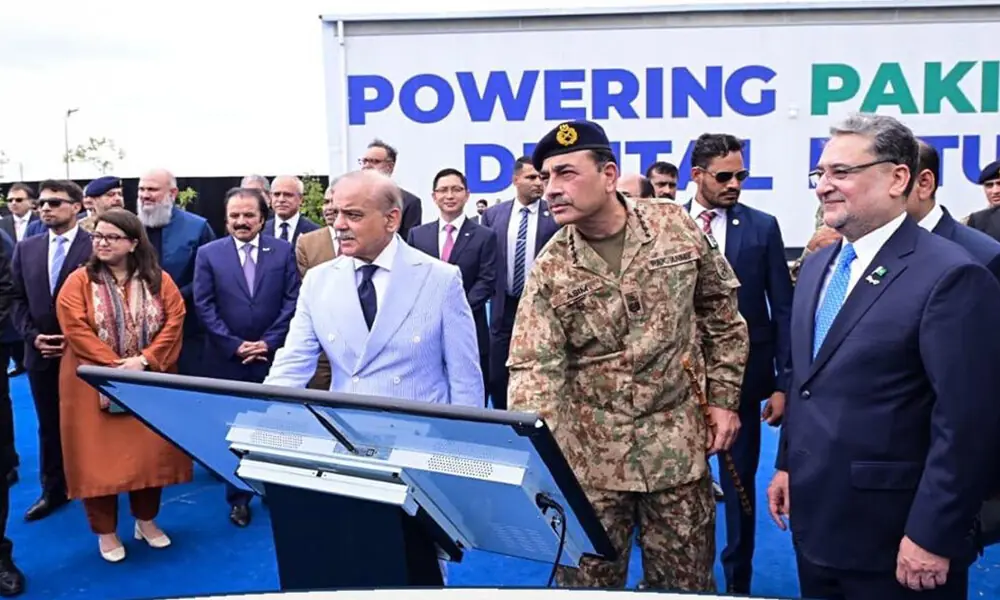

On July 24, Prime Minister Shehbaz Sharif and Field Marshal Asim Munir inaugurated Sky47’s Karakoram-01 near Islamabad, an 8.5MW AI-ready data centre and sovereign-cloud facility. Five days later, the prime minister directed federal institutions to begin integrating with it. The significance went beyond the facility itself: computing infrastructure had entered Pakistan’s strategic conversation.
Pakistan had data centres before Sky47. What is different this time is the political meaning attached to this one. Karakoram-01, like almost every modern technology facility, depends on foreign technologies and suppliers, with ZTE among the project’s technology partners. A data centre can therefore be physically Pakistani while remaining technologically dependent on systems produced elsewhere. That is not necessarily a weakness. Modern economies are built on interdependence. Pakistan cannot sensibly manufacture every chip, cloud platform, model or software component it uses. The real question is not whether dependency exists, but what kind of dependency Pakistan is willing to live with –and what remains in Pakistani hands when that dependency is tested.
It is important to recognise that data residency is not sovereignty. Data residency asks where information is stored. Sovereignty asks who controls access and encryption keys, who can audit the infrastructure, whether workloads can be moved elsewhere, whether suppliers can realistically be replaced, and whether Pakistani engineers can operate and modify the systems themselves. The data may never leave Pakistan. The dependency still might. Pakistan therefore does not need technological self-sufficiency. It needs selective technological sovereignty. That means retaining tight national control where failure or compromise could cause severe national harm: defence systems, national identity, essential payment infrastructure, critical government records and the most sensitive citizen data. These require Pakistani jurisdiction, control over critical access and domestic operating capability.
Beyond that sovereign core lies a second category: technologies where local competence compounds over time. Local-language AI, financial technology, public health, agriculture, research and selected industrial systems matter because working deeply with them can create engineers, companies and intellectual property capable of doing more tomorrow. Pakistan’s opportunity is unlikely to lie in fabricating leading-edge processors or reproducing American and Chinese cloud ecosystems. It lies in moving from consuming technology to integrating it, from integrating it to adapting it and, where economically realistic, from adapting it to creating it. The objective is capability accumulation.
A third category consists of portable, non-sensitive workloads. Temporary development environments, experimentation and many commercial workloads do not need expensive sovereign infrastructure simply because it exists. Where switching is realistic and data is not strategically sensitive, Pakistan should buy the best combination of cost, capability and reliability available. That distinction matters because sovereign compute has a price. At prevailing industrial tariffs, operating an 8.5MW facility continuously could imply electricity costs running into billions of rupees annually, depending on utilisation and facility overheads. The point is not Sky47’s actual bill. It is that domestic compute must justify the premium of operating locally.
The economic test runs in both directions. Build too much, too early, and scarce capital and electricity can be trapped in underutilised capacity. Build too little, and critical systems and future industries remain dependent on infrastructure elsewhere. Pakistan also pays for generation capacity that is not always fully utilised. Properly located and competitively powered compute could turn some of that capacity into productive digital infrastructure and, eventually, export earnings.
The argument is not against domestic compute, but against building it without a clear utilisation and value-creation case. That question is becoming more urgent as the market expands. Industry forecasts cited by Business Recorder put Pakistan’s installed data centre IT load at about 23.5MW in 2025 and project it could exceed 53MW by 2030. But headline capacity tells us little about how much is actually operational and utilised, what workloads it supports, where bottlenecks exist, or what economic value it generates. As investment accelerates, Pakistan needs a much clearer picture of how its compute capacity is being deployed, and what it is ultimately producing.
Pakistan therefore needs a national compute balance sheet: a publicly reported account of capacity, utilisation, effective energy cost, foreign cloud expenditure, critical workloads, domestic skills and – where public support is involved –- the value generated through import substitution, exports, research or new capabilities. It should guide what is built locally, what can be rented internationally and where public support is justified. Before scarce electricity or capital is committed to another megawatt, policymakers should be able to answer: what problem is this infrastructure solving, and what capability will Pakistan possess after the money has been spent? The same discipline should apply to technology contracts. Portability clauses, audit rights and multi-vendor strategies mean little if Pakistani institutions cannot exercise them. A government does not meaningfully possess portability if it cannot move a workload; a supplier is not truly replaceable if years of integration have made switching practically impossible. Sovereignty cannot be created by contract alone. It has to exist operationally.
Pakistan has confronted versions of this problem before. In 2018, it inaugurated an 820km cross-border fibre link between Khunjerab and Rawalpindi under CPEC, developed with Chinese financing. Eight years later, the public record tells us far more about what was built than what Pakistan learnt to build. Can local engineers design comparable systems independently? Can they substantially modify the network without the original supplier? Could major components be replaced without merely exchanging one external dependency for another?
The absence of public answers does not prove technology transfer failed. It exposes a deeper problem in how Pakistan has traditionally judged technology partnerships: we measure project completion far more easily than capability accumulation. Kilometres of fibre can be counted. Servers can be photographed. Investment announcements can be totalled. It is harder to measure whether engineers can redesign a system, suppliers can be replaced, or intellectual property and bargaining power have begun to accumulate locally.
That is the mistake the AI era should not repeat. Sky47 should therefore be judged over years, not at inauguration. Its significance will not depend on whether the hardware inside Karakoram-01 carries Chinese, American or European labels. The real questions are whether Pakistani engineers develop deeper operating capabilities; whether organisations gain practical access to compute; whether workloads remain portable; whether new applications and suppliers emerge; and whether the country becomes more capable of understanding, adapting and eventually creating the technologies on which it depends. Pakistan will remain dependent on foreign technology for many years. That is neither unusual nor inherently undesirable. The strategic choice is whether those dependencies remain passive purchases or become mechanisms through which Pakistan accumulates knowledge, control and options.
Every major data centre, cloud contract, AI platform and foreign technology partnership should therefore face the same test: after the money has been spent, does Pakistan know more, control more and possess more options than it did before? If it does, dependency can become a bridge towards sovereignty. If it does not, the servers may be in Islamabad, but the power will still reside somewhere else.
The writer has worked across banking, public-sector digital initiatives and technology strategy. He can be reached at [email protected]























Comments