


Cement: Local demand holds the fort
Pakistan's cement industry saw domestic demand drive a 6% dispatch increase in July 2026, marking a strong recovery despite declining exports and regional disparities.
- Domestic demand driving Pakistan's cement industry growth.
- Regional disparities in cement dispatch performance.
- Factors supporting the domestic construction recovery.

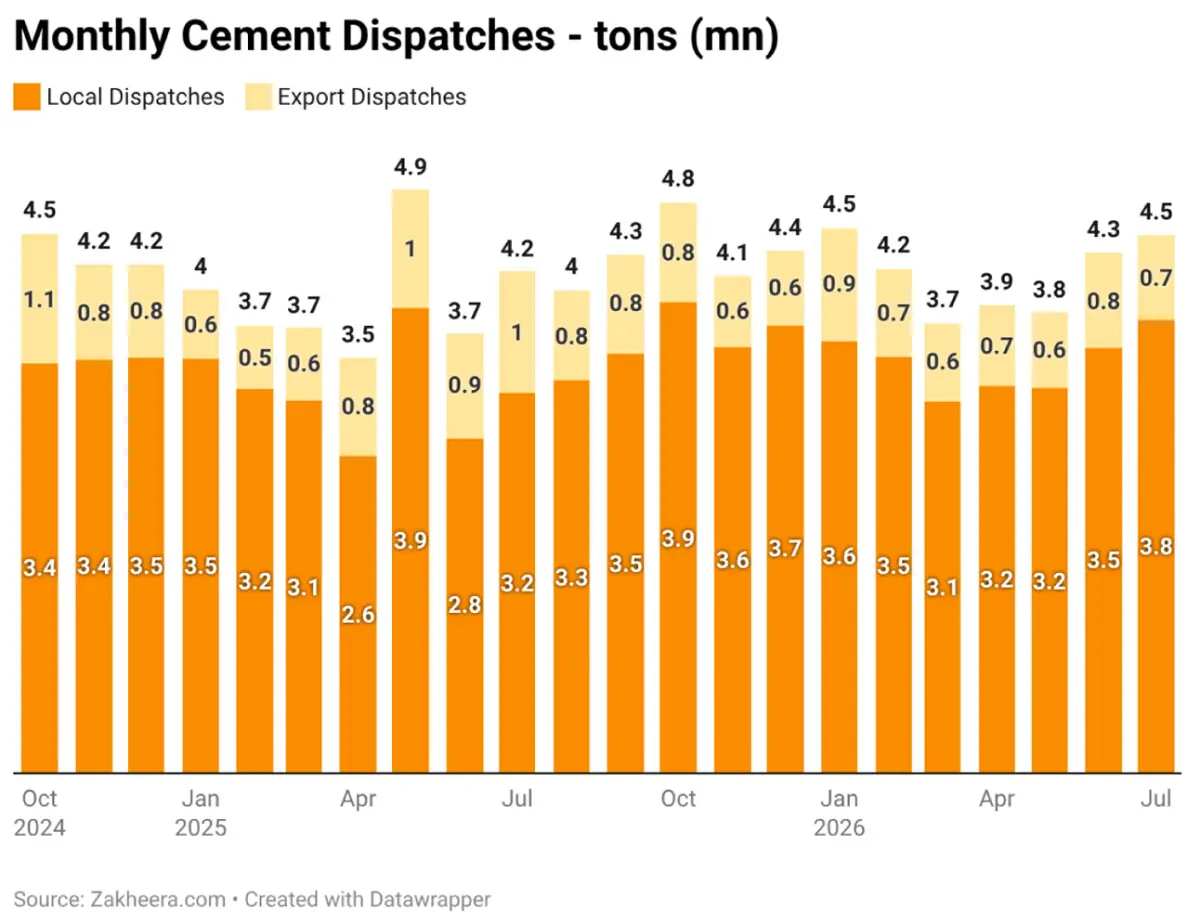
Pakistan’s cement industry entered FY27 with domestic demand doing the heavy lifting. Total dispatches increased 6 percent year-on-year to 4.48 million tons in July 2026, compared to 4.22 million tons in the same month last year. Volumes were also 3.3 percent higher than June, extending the recovery seen toward the end of FY26.
The improvement came entirely from the local market. Domestic dispatches rose 17.3 percent year-on-year to 3.77 million tons—the strongest July performance since 2020. Exports, meanwhile, declined 30 percent to 0.71 million tons. The divergence is becoming increasingly clear: construction activity at home is gradually recovering, but external markets remain uneven.
The northern region led the domestic recovery. Local dispatches increased 19 percent to 3.09 million tons despite monsoon rains and higher cement prices. However, the region recorded no exports, compared to 0.23 million tons last year, due to the continued closure of the Afghanistan border. As a result, total northern dispatches increased by a relatively modest 9.5 percent.
The south had a more mixed month. Domestic sales increased 9 percent year-on-year to 0.68 million tons, but exports declined 9 percent to 0.71 million tons. Total southern dispatches consequently slipped around 1 percent to 1.39 million tons. This reinforces the regional divide: northern producers are increasingly dependent on the local market, while southern plants continue to rely heavily on seaborne exports.
July’s numbers build on the shift already visible in FY26. Local dispatches had increased 10 percent during the year, while exports declined 2.1 percent. Producers had relied on foreign markets during the construction slowdown, even though exports generally offer weaker pricing and involve higher freight and handling costs. The return of the domestic buyer is therefore positive not only for volumes but also for the sector’s sales mix.
There are signs that lower interest rates, improving incomes and government housing initiatives are beginning to support activity. Improved construction financing, tax relief for property transactions, the federal development allocation and the PM Apna Ghar scheme could provide further support, provided implementation follows the announcements.
Pricing has also remained firm. The average cement price stood at around Rs1,530 per 50kg bag in July, up 8 percent from last year. This should help producers absorb some of the pressure from higher coal, fuel and transportation costs. However, sustained increases in international energy prices—particularly if the Middle East conflict escalates—could squeeze margins and weaken construction demand.
The domestic outlook remains cautiously positive. Industry dispatches could grow another 7–8 percent in FY27 if private construction continues to recover and development spending is released as budgeted. But the sector still carries substantial idle capacity, household affordability remains weak, and public development spending is often the first casualty when fiscal pressures emerge.
For exports, the reopening of the Afghan border remains critical. Until then, the sector’s recovery will continue to rest largely on one pillar: domestic demand.




















Comments