




The upbeat momentum in home remittances continues in the new fiscal year despite the government withdrawing the rebate previously given to banks for attracting inflows into the formal sector. There is also no visible impact, in terms of inflows, from GCC countries due to the economic slowdown following the Iran-US war. The GCC’s share stood at 55 percent in July, versus 54 percent in the last fiscal year.
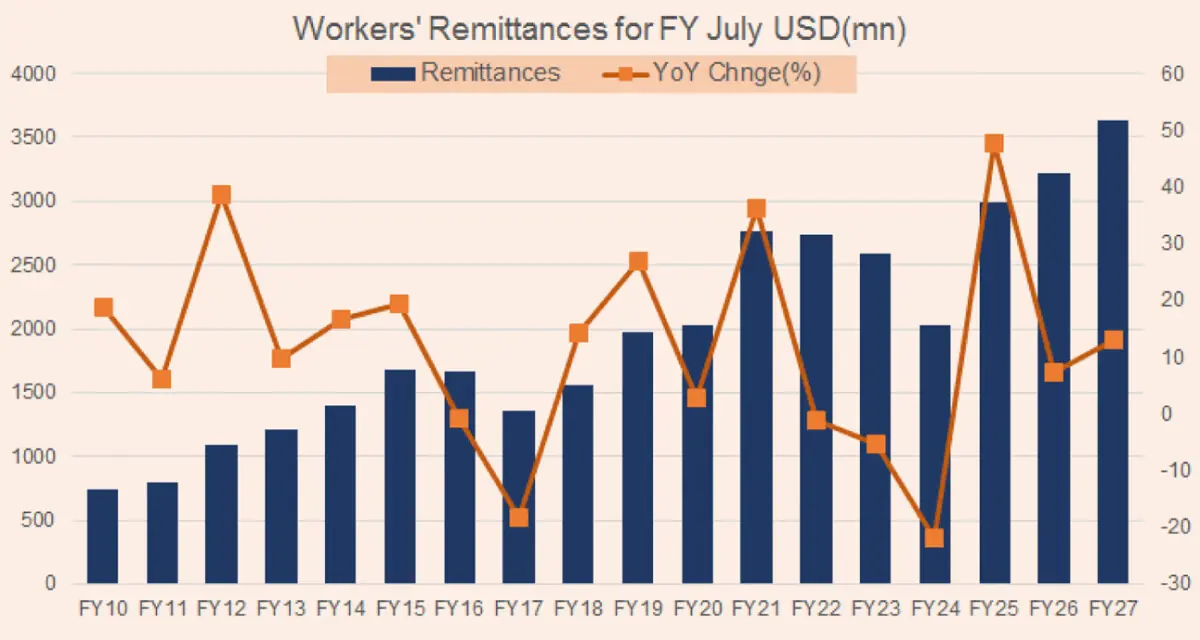
Inward flows stood at $3.6 billion, up 13 percent YoY and 4 percent MoM. At this run rate, allowing for the usual seasonal spikes and lows, FY27 inflows could reach somewhere between $43-45 billion. That is encouraging. Inflows from both Saudi Arabia and the UAE are growing at double-digit rates YoY, with no hiccups so far.
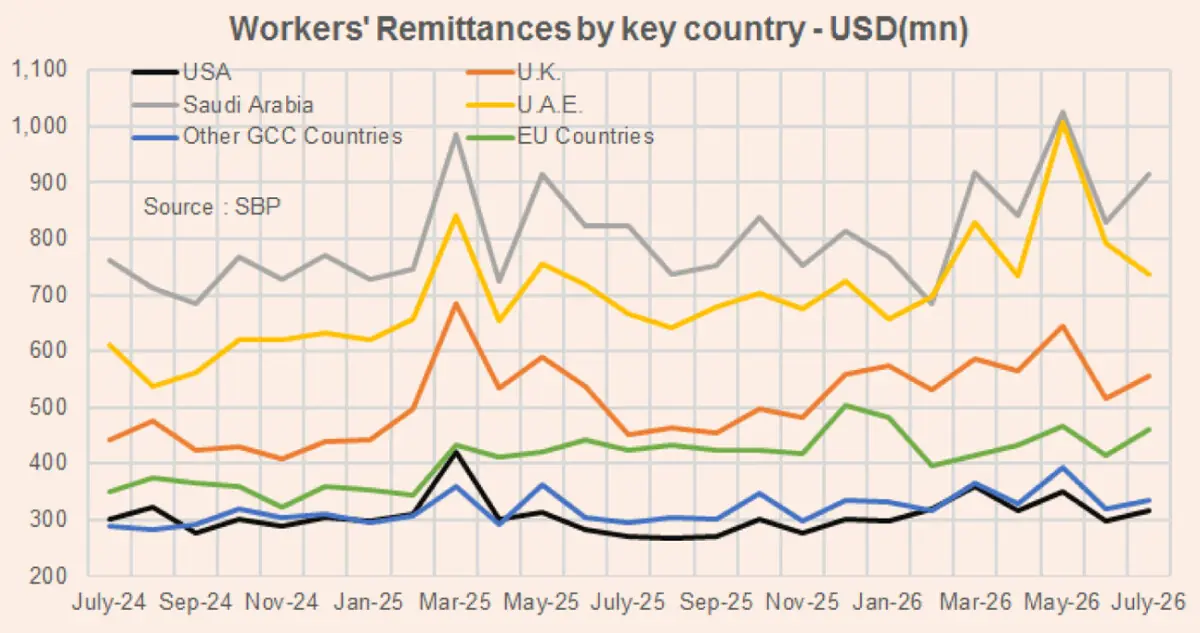
Another interesting element is the number of workers going to the UAE. In Jan-July 2026, around 50,000 workers left for the UAE on work visas, compared with 52,000 in the same period of 2025 and 64,000 in 2024. This is significantly lower than the 230,000 recorded in 2023. The decline was already well underway, and the trend now appears to be stabilising at a much lower base.
On the flip side, there has been some decline in the number of workers going to Saudi Arabia. Meanwhile, the trend of highly qualified workers going abroad remains intact.
So far, there is no visible dent from any possible economic slowdown in the GCC, particularly in the UAE and within Dubai. Market participants speculate that people continue to send back money that had been taken out of the country over the past few years, while some goods exports may also be diverted through the UAE to evade taxation.
Only time will tell how sustainable these trends are. For now, however, things look fine. Medium-term risks to continued growth in remittances are rising, but in the short term, external account stability in FY27 may continue despite stagnating exports.
The question, however, is how sustainable it is for banks to provide incentives to attract inflows through the formal sector. In previous years, the government provided rebates to banks through the SBP for offering discounts to remittance senders, while additional flows were supported through marketing incentives. Last year, the marketing component was closed, and from July, there is no rebate either.
Banks are now, on average, providing around Rs2 per dollar of inflows. At current volumes, that could amount to roughly Rs80 billion a year. The question is how long banks can afford to pay Rs6-7 billion every month to sustain these incentives.
More importantly, one needs to question the economy’s growing reliance on home remittances. Remittances increased from around $4 billion in FY05 to $42 billion in FY26, while goods exports rose from $15 billion to $31 billion. The former grew tenfold, while the latter barely doubled. Imports, meanwhile, increased from $19 billion to $64 billion over the same period.
This trend is unlikely to continue indefinitely. As imports continue to grow, the burden of financing them cannot keep falling disproportionately on remittances. The economy needs stronger contributions from other elements of the external account, particularly goods and services exports.
The government needs to rethink the economic model if the country is to sustain growth, even at its current modest pace. However, no government in Pakistan appears to think that far ahead. Governments tend to fight to live from one day to the next, with the focus largely remaining on the ongoing fiscal year.
For now, at least, remittances have started FY27 on a strong note.























Comments