


Sinopec steps up Russian oil imports to offset Mideast supply cuts, traders and tracker say
- Sinopec has bought a total of 30 to 40 shipments, or about 241,000 to 320,000 barrels per day (bpd)
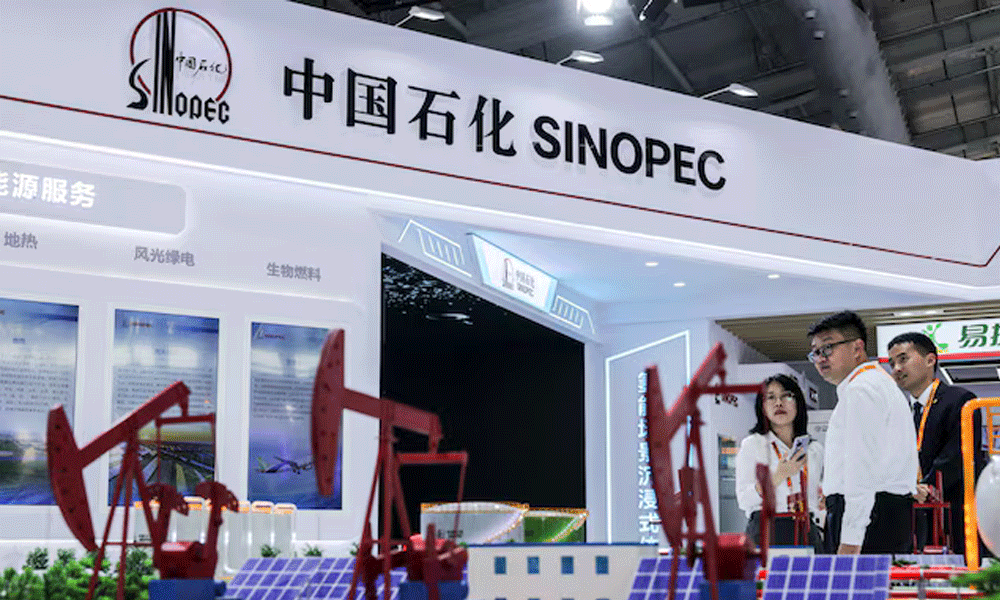

SINGAPORE: China’s state-owned Sinopec Corp, the world’s biggest refiner, has ramped up purchases of Far East Russian oil to compensate for Middle East supplies diminished by the Iran war, according to multiple trade sources and ship tracking data.
Sinopec’s purchases of Russian oil, which is cheaper than rival grades from sources such as Brazil and West Africa, have helped it maintain relatively stable throughput and ship surplus fuel on strong export margins, despite China limiting overseas sales of fuel products from March to protect domestic supply amid the war-related trade disruptions.
Sinopec has bought a total of 30 to 40 shipments, or about 241,000 to 320,000 barrels per day (bpd), of Russia’s Eastern Siberia-Pacific Ocean (ESPO) blend for July to September deliveries, according to several of the sources, who spoke on condition of anonymity. That equates to 5% to 6% of the refiner’s processing capacity of 5.2 million bpd.
A Sinopec representative said the company does not publicly discuss operational matters.
“Sinopec’s crude demand appears to have bottomed out following the easing of fuel export restrictions, but the recovery remains selective,” said Emma Li, lead China analyst with ship tracker Vortexa Analytics.
Top global buyer China has cut its overall crude imports by steep levels since the start of the Iran war, with June purchases plunging 41% from year-earlier levels.
However, it has dialled back its fuel export curbs for July and August.
“Rather than broad-based import growth, demand is shifting towards barrels with greater delivery certainty and lower freight costs - primarily onshore inventories and short-haul Russian Far East cargoes,” Li told Reuters.
Sinopec secured about 7.4 million barrels of ESPO in July, mostly delivered into Rizhao port in the refining hub of Shandong province, according to Li’s tracking of shipments.
The refiner has bought at least 10 cargoes each for August and September, according to Li and four traders who closely follow ESPO trade. ESPO is typically shipped in Aframax vessels capable of carrying 740,000 barrels.
Steep Saudi cuts
China and India have been the biggest Russian oil buyers since the Ukraine war started, but China’s big state refiners, including Sinopec, suspended such purchases in October after Washington imposed sanctions on top Russian producers Rosneft and Lukoil, Reuters reported previously.
Oil gains as investors cautious over Iran-Oman talk progress
Beijing does not recognise what it calls unilateral sanctions, and independent Chinese refiners have continued buying Russian oil.
Sinopec resumed Russian oil purchases in March and April after a temporary U.S. waiver, Reuters reported, buying roughly 10 cargoes and increasing volumes after the waiver expired as the Iran war squeezed supply.
Its recent ESPO purchases have not involved sanctioned entities as counterparties and have been made via intermediaries, four people familiar with the matter said, without providing further details. Since the early days of the Ukraine war, Sinopec has bought Russian oil using Chinese yuan.
Before the Iran war, Sinopec sourced nearly half of its crude from the Middle East and was among Saudi Arabia’s biggest customers.
Sinopec did not buy any Saudi crude for June and July, and took only 2 million barrels in August, according to trade sources. That’s far less than the 20 million Saudi barrels it imported in both March and April, and less than a fifth of the 11 million barrels it took each month on average in the year before the Iran war started.
September-loading ESPO was pegged at discounts of $1 to $2 a barrel to benchmark Brent, about $10 cheaper than rival grades such as Middle Eastern Oman and Brazil’s Tupi, traders said.
Before the Iran war, Russian ESPO crude traded at a discount of about $10 per barrel.

















Comments