



HUBC is Pakistan’s largest Independent Power Producer, operating 3,581 MW across thermal, hydel, and coal projects. Its portfolio includes the Hub and Narowal residual-fuel-oil plants, a majority stake in Laraib’s hydropower facility, and a joint venture with China Power International Holdings in the 1,320 MW CPHGC coal plant.
The company has expanded into Thar coal with majority stakes in Thar Energy Limited and ThalNova Power Thar, both 330 MW mine-mouth lignite plants. To support growth, HUBC operates through two subsidiaries—HPSL for operations and maintenance, and HPHL for new investments—and also holds an 8 percent stake in Sindh Engro Coal Mining Company, which supplies coal to its Thar projects.
Past Performance FY15 was a transformative year for HUBC, with strong shareholder returns and a successful business turnaround. Despite a slight drop in load factors due to boiler maintenance, consolidated earnings rose by 48 percent year-on-year.
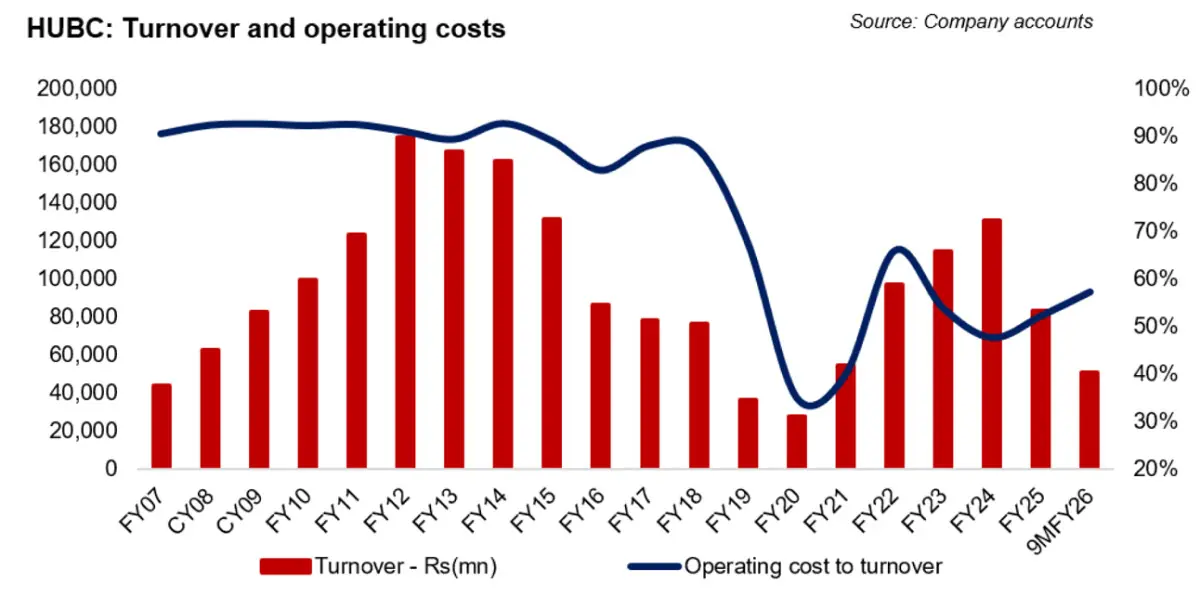
In FY16, earnings grew by 7.5 percent, but revenues fell 34 percent due to lower furnace oil prices, reduced generation bonuses, and lower electricity demand.
FY17 saw a significant drop in earnings, driven by higher maintenance costs at the Hub and Narowal plants, unfavorable exchange rates, and losses from early-stage TEL and CPHGC projects. Increased administrative expenses also contributed to a 9.2 percent decline in profits.
In FY18, earnings rose by 3 percent, despite lower revenues. This modest growth was due to reduced maintenance costs, although profits from Laraib were lower, and financing costs increased. Load factors at the Hub and Narowal plants dropped due to reduced electricity demand and maintenance work.
FY19 was challenging, with furnace oil-based generation falling 60 percent, slashing HUBC’s base plant load factor to 7.87 percent. Revenues dropped by 42 percent, but lower operating costs helped the company maintain flat earnings growth of 2 percent, despite higher finance costs and capital expenditures.
FY20 was impacted by the COVID-19 pandemic and government scrutiny of IPP returns. However, HUBC’s earnings more than doubled, driven by its 1,320 MW coal-fired plant and currency depreciation. Growth was tempered by higher finance costs, increased taxes, and a one-off equity transfer to the Government of Balochistan.
In FY21, HUBC’s revenue grew 13 percent, supported by a 40 percent increase in power dispatches and improved load factors across its plants. Earnings rose by 34 percent due to profits from CPHGC and lower finance costs.
FY22 saw a 15 percent drop in earnings, mainly due to lower profits from associates and higher finance costs. However, revenues increased by 78 percent, driven by higher utilization of the base and Narowal plants. Despite this, gross profits were flat, and no dividends were declared due to high fuel and commodity prices.
HUBC reported its highest-ever profit for FY23, driven by its diversification strategy and a greater share of profits from associates and joint ventures. This growth was fueled by its coal investments, particularly from the China Power Hub Generation Company (CPEC), which has been contributing since FY20, as well as the addition of the ThalNova Power Plant in February 2023 and TEL later in FY23. Consolidated revenue increased by 18 percent, primarily due to higher furnace oil prices, despite a 9 percent decline in electricity dispatches.
HUBC’s bottom line surged by 110 percent year-on-year, thanks to controlled expenses, higher other income, and a significant rise in profits from associates. However, rising finance costs, which increased by 144 percent due to higher interest rates and TEL’s finance costs, partially offset the profitability gains.
In FY24, Hub Power Company Limited delivered a robust financial performance, reporting consolidated earnings of Rs75 billion, reflecting a 22 percent year-on-year increase. This growth was driven by higher dispatches from Thar Energy Limited (TEL), the devaluation of the PKR against the USD, and improved operational efficiencies. Overall revenue growth stood at 14 percent year-on-year. While TEL and ThalNova Power Thar (TNPTL) showed strong performance with increased generation, China Power Hub Generation Company (CPHGC) saw a decline.
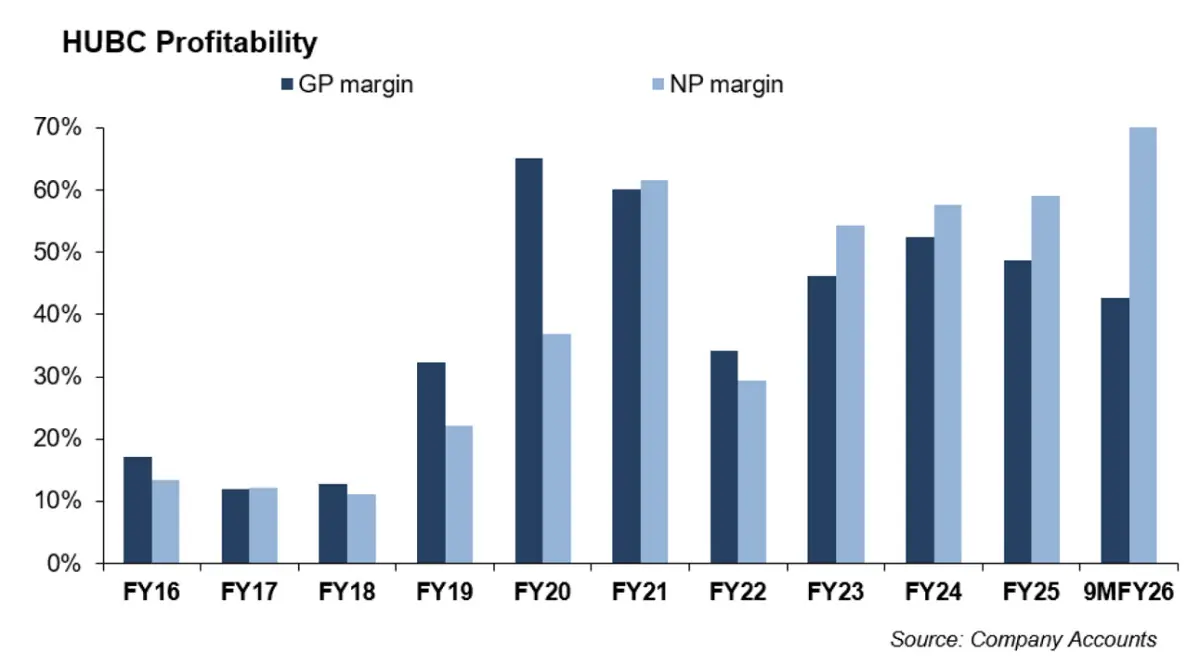
HUBC’s gross margins improved, benefiting from currency devaluation and contributions from new power plants. Despite a 38 percent rise in finance costs, net margins increased, supported by a 44 percent rise in profits from associates due to the commencement of operations at TEL and TNPTL, along with the currency impact.The company announced a total dividend of Rs20 per share for FY24, down from Rs30 in FY23, due to increased capital expenditure and new investments.
HUBC’s performance in FY25 reflected a year of transition, shaped primarily by the expiry of its base plant Power Purchase Agreement, softer load factors, and an ongoing strategic shift toward diversification. The company decline of 34 percent year-on-year. This reduction was largely the result of the termination of the Hub base plant agreement, which removed a major source of stable capacity revenues. Revenues also declined 36 percent year-on-year as the company absorbed the impact of both the base plant’s termination and tariff revisions at Narowal Energy Limited.
Despite these headwinds, HUBC maintained strong operational resilience. Availability across the portfolio remained solid, and the Thar-based plants—Thar Energy Limited and ThalNova Power Thar Limited—delivered approximately $290 million in annual foreign exchange savings. While profits from associates and joint ventures softened due to the appreciation of the rupee and an unusually high base year, the company saw a marked improvement in payment cycles.
HUBC in 9MFY26
In 9MFY26, HUBC’s performance reflected the continuing structural transition in its business model, as weaker earnings from its core power-generation operations were increasingly offset by higher income from associates, lower financing costs, and contributions from its diversification initiatives.
Consolidated revenue declined by 22 percent year-on-year to Rs50.6 billion, largely due to the early termination of the Hub Plant’s Power Purchase Agreement and tariff renegotiations at Narowal Energy Limited. These developments materially reduced the contribution of HUBC’s legacy generation assets and continued to weigh on the company’s topline.
Gross profit fell by 31 percent year-on-year to Rs21.6 billion, while the gross margin declined to 42.7 percent from 48.6 percent in the corresponding period. Lower spreads and reduced capacity utilisation weakened the performance of the core generation business. However, a 67 percent increase in other income to Rs6.6 billion provided partial support. Despite this increase, higher administrative expenses contributed Rs6.6 billion provided partial support. to a 14 percent decline in operating profit to Rs26 billion.
The company’s performance below the operating line remained comparatively strong. Finance costs declined by 45 percent year-on-year to Rs6.9 billion, supported by lower interest rates and continued deleveraging following repayments of CPEC-related debt. Meanwhile, HUBC’s share of profit from associates increased by 6 percent to Rs32.3 billion, remaining the primary driver of consolidated earnings. Contributions from the Thar coal projects and China Power Hub Generation Company continued to anchor profitability, while newer investments gradually increased their contribution.
This change in earnings composition highlights HUBC’s transition from a conventional power-generation company into a broader investment-led platform, with associate income and dividend receipts becoming increasingly important sources of profitability and cash generation. The completion of its major Thar-based projects has generated steady dividend inflows, supporting the company’s strong payout profile. HUBC also announced an interim cash dividend of Rs5 per share for 3QFY26, despite the continuing shift away from its legacy generation business.
Supported by higher associate income and lower finance costs, profit before tax increased by 6 percent year-on-year to Rs51.5 billion. However, taxation rose sharply by 43 percent, likely reflecting higher effective tax rates and the impact of the super tax. Consequently, profit attributable to shareholders declined by 3 percent year-on-year to Rs33 billion, translating into earnings per share of Rs25.49 for 9MFY26.
The company’s margins also reflected its evolving earnings profile. Although the gross margin weakened, the net margin increased to 74.6 percent due to the high-margin nature of associate income and the reduction in financing costs. At the same time, HUBC continued to position itself for future growth through diversification. Its partnership with BYD and investments in electric-vehicle infrastructure mark a strategic expansion into new-energy and mobility businesses, suggesting that an increasing share of future growth will come from outside traditional power generation.



















Comments