


Yuan rises after firmer guidance as investors await policy cues
- The spot yuan is allowed to trade a maximum of 2% on either side of the fixed midpoint each day
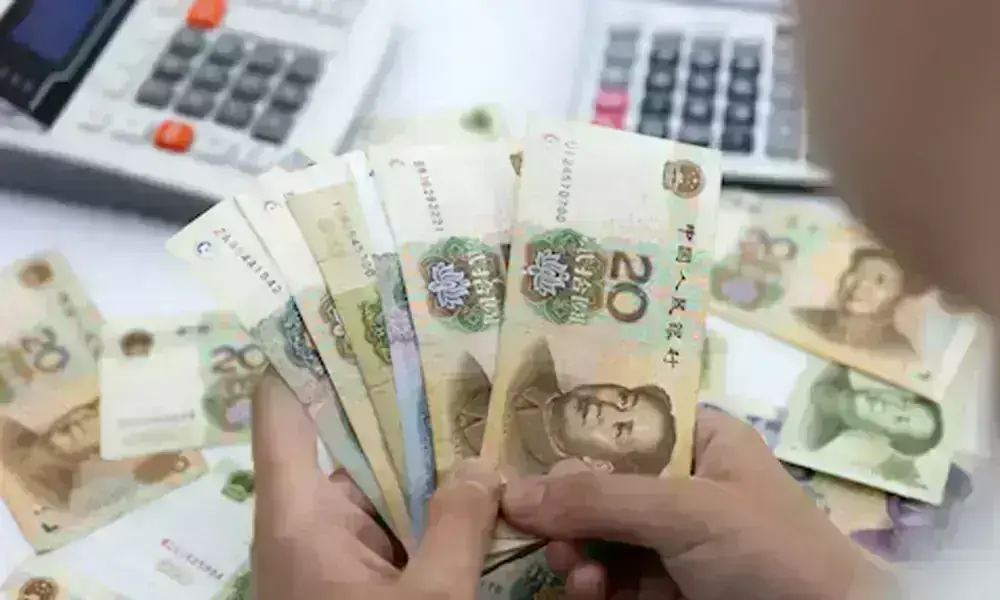

SHANGHAI: China’s yuan rose against the dollar on Tuesday after the central bank set firmer official guidance, while investors turned their attention to a key policy meeting for clues on the currency’s outlook.
The US dollar hovered near a one-week high as markets weighed mixed signals from the Middle East, where escalating hostilities revived concerns over energy supplies and prospects for a ceasefire provided some relief.
Prior to the market opening, the People’s Bank of China (PBOC) set the midpoint rate at 6.7917 per dollar, 31 pips firmer than the previous setting of 6.7948.
The spot yuan is allowed to trade a maximum of 2% on either side of the fixed midpoint each day.
In the spot market, the onshore yuan was 0.05% stronger at 6.7658 per dollar as of 0237 GMT, while its offshore counterpart last fetched 6.7663.
Investors are shifting their attention to an upcoming meeting of the Communist Party’s Politburo, the country’s top decision-making body, expected around the end of July.
Policymakers are expected to set the economic policy agenda for the second half of the year, which could affect the yuan’s outlook, currency traders said.
“We expect a policy response as early as the Politburo meeting in late July,” Helen Qiao, chief Greater China economist at BofA Global Research, said in a research note.
“The first step will likely be a rhetorical shift, with policymakers acknowledging a more challenging macro environment amid rising geopolitical risks and pledging stronger policy support.”
She added that the focus was likely to be on “improving the delivery and effectiveness of existing stimulus measures.”
“The PBOC appears to be comfortable with current levels of USD/CNY in a 6.75-6.80 range,” analysts at Barclays said in a note.
“We continue to see a range-bound pattern for the currency pair in the near term…there is little indication that China’s authorities want to see further strong appreciation from here, in line with our view of a more gradual pace of appreciation ahead.”
The yuan has risen about 3.4% against the dollar year-to-date, lagging the Australian dollar’s 5% gain over the same period, but remains among the top-performing emerging market currencies.
“Looking ahead to the second half of 2026, we do not expect the yuan to replicate the pace of its first-half rally,” analysts at Natixis said in a note.
“A weaker-than-expected second-quarter GDP print of 4.3% year-on-year also tempers near-term growth momentum. We emphasise though, while widening interest rate differentials remain a risk as the PBOC is likely to maintain an easing bias relative to the Federal Reserve, the traditional interest rate differentials may not be the dominant factor driving the USD/CNY move.”


















Comments