


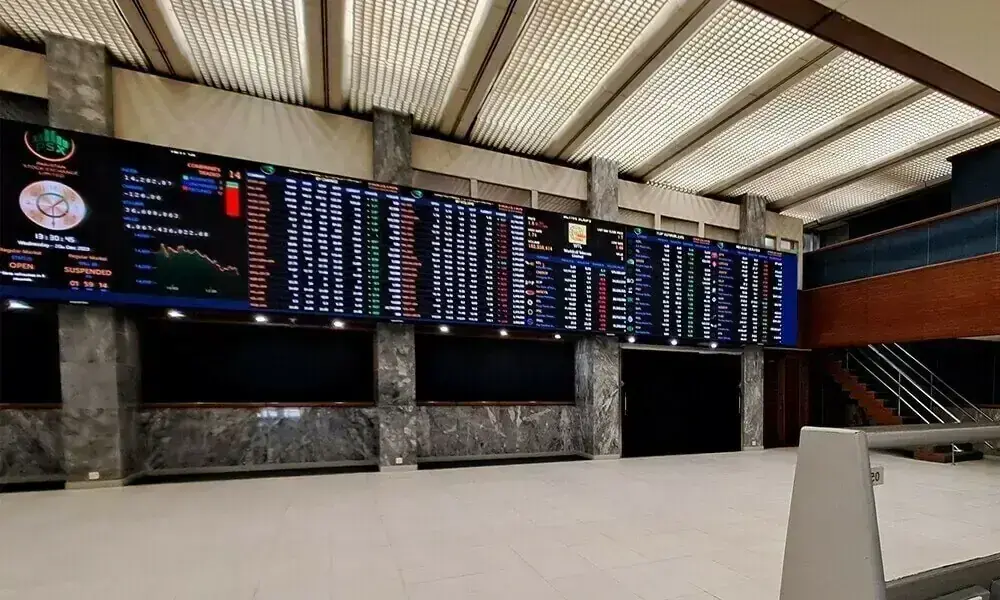

KARACHI: The Pakistan Stock Exchange (PSX) ended marginally higher on Monday after staging a remarkable intraday recovery from an early plunge, as aggressive value hunting in blue-chip stocks offset panic selling triggered by escalating geopolitical tensions in the Middle East and rising international oil prices.
The benchmark KSE-100 Index gained 124.95 points, or 0.07 percent, to close at 175,927.74 points, compared with the previous close of 175,802.79 points. During the session, the index plunged to an intraday low of 173,636.46 points before recovering sharply to touch an intraday high of 176,129.35 points.
Business Recorder indices also reflected the market’s recovery. The BRIndex100 gained 38.50 points, or 0.20 percent, to close at 19,338.22 points, with a total turnover of 580.34 million shares. The BRIndex30 advanced 193.09 points, or 0.28 percent, to 70,060.18 points, with trading volume of 411.25 million shares.
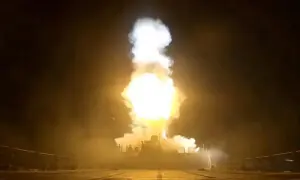
Commenting on the session, Ali Najib, Deputy Head of Trading at Arif Habib Limited, said the PSX witnessed a highly volatile trading day, with the KSE-100 Index recovering from steep early losses to close on a flattish note. He said the market opened the week under pressure amid escalating uncertainty in the Middle East following weekend military developments between the United States and Iran, which weighed heavily on investor sentiment. However, value hunters emerged to accumulate selective blue-chip stocks at attractive valuations, helping stabilize market sentiment and enabling the benchmark index to recover all of its intraday losses before ending slightly in positive territory.
Najib said UBL, Systems Limited (SYS), Engro Holdings (ENGROH), Attock Refinery (ATRL) and Cnergyico PK collectively added 367 points to the benchmark index, while HBL, Millat Tractors (MTL), Engro Fertilizers (EFERT), Pak Suzuki (PSEL) and Service Industries (SRVI) erased 133 points due to selective selling.
Despite the early sell-off, market activity improved. Ready market turnover increased to 675.92 million shares from 621.02 million shares in the previous session, while traded value rose to Rs30.27 billion from Rs29.88 billion.
However, overall ready market capitalization slipped to Rs19.763 trillion from Rs19.790 trillion, reflecting weakness in a number of secondary stocks.
Market breadth remained negative despite the benchmark index’s recovery. Of 492 companies traded on the ready market, 165 advanced, 277 declined, while 50 remained unchanged.
Among actively traded stocks, Cnergyico PK led the volume chart with 166.06 million shares, closing higher at Rs10.61. Pakistan Refinery Limited (PRL) followed with 49.16 million shares, ending at Rs49.05, while TPL Properties traded 38.44 million shares to close at Rs12.51.
Among gainers, Unilever Pakistan Foods Limited posted the largest increase, rising Rs211.00 to close at Rs25,440.00, followed by Baba Farid Sugar Mills, which gained Rs41.86 to settle at Rs460.42.
On the losing side, Khairpur Sugar Mills Limited shed Rs187.15 to close at Rs1,684.32, while Khyber Textile Mills Limited fell Rs128.16 to Rs2,071.22.
Sector-wise, the BR Commercial Banks Index gained 132.33 points or 0.22 percent to close at 61,457.58 points on turnover of 29.71 million shares. The BR Cement Index added 23.09 points or 0.19 percent to 12,399.19 points with 37.22 million shares traded.
The BR Power Generation and Distribution Index remained almost unchanged, easing 0.79 points to 27,819.57 points on turnover of 36.65 million shares, while the BR Oil and Gas Index shed 8.59 points or 0.06 percent to 14,797.54 points with 35.34 million shares changing hands.
The BR Tech & Communication Index declined 9.09 points or 0.25 percent to 3,679.41 points, with turnover of 47.35 million shares, while the BR Automobile Assembler Index fell 81.69 points or 0.35 percent to 23,540.43 points on volume of 2.86 million shares.
Market participants are expected to remain highly sensitive to geopolitical developments in the Middle East. Analysts believe attractive valuations may continue to encourage selective buying, but a sustained recovery will largely depend on any meaningful de-escalation in regional tensions and improved global risk sentiment.
Copyright Business Recorder, 2026










Comments