


FY26 - A fragile external balance
The nation's current account shifted to a deficit in FY26, driven by a worsening goods trade deficit and risks to remittances, despite strong annual remittance growth. This poses challenges for economic stability.
- Shift to current account deficit in FY26.
- Rising imports, particularly food and transport.
- Declining goods exports and risks to remittances.


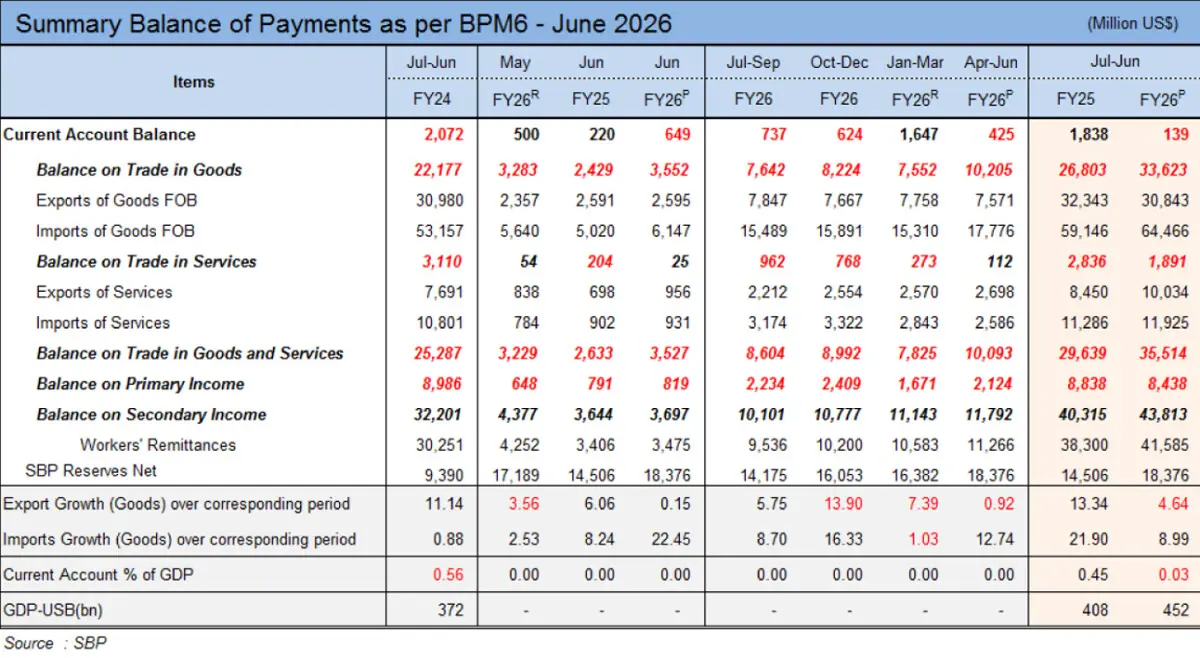
The current account posted a marginal deficit of USD139 million in FY26, compared to a surplus of USD1.8 billion in the previous fiscal year. In June, the deficit stood at USD649 million, compared to a surplus of USD500 million in the previous month.
e reason for slipping into deficit in June was relatively low remittances, which were down 18 percent MoM.
However, remittances recorded decent growth on a high base, rising by 9 percent YoY, which more than offset the impact of the worsening goods trade deficit.
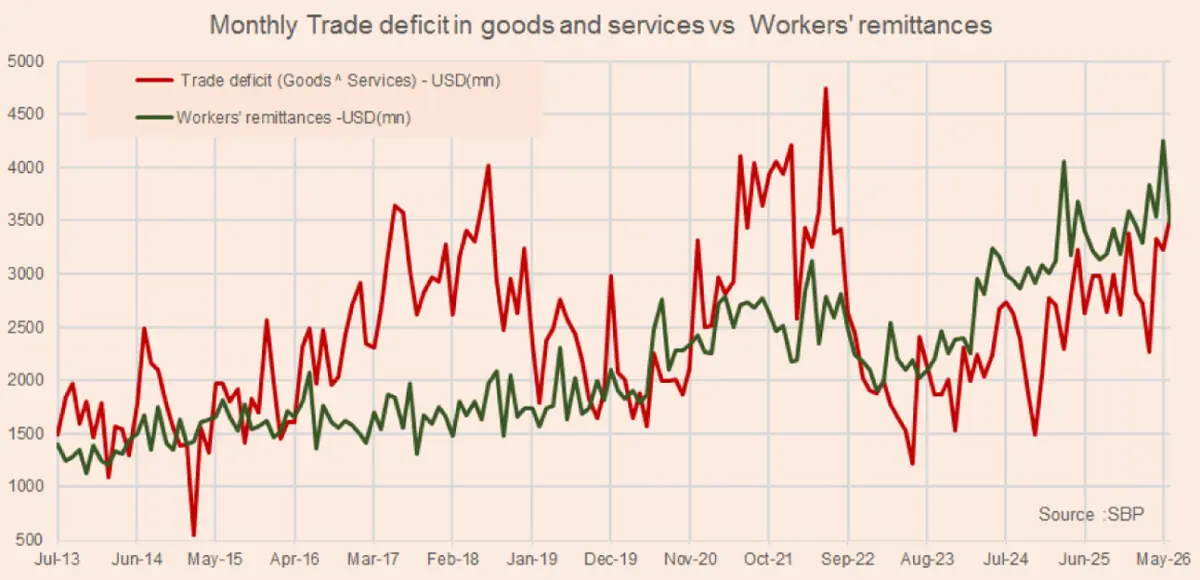
Going forward, keeping the current account deficit in check will be a challenge, as the Iran war is nowhere close to over. This poses risks to remittances coming from GCC countries, which accounted for 55 percent of total remittances in FY26, as well as the possibility of higher oil imports, which in the last quarter were at their highest level since 4QFY22.
In FY26, imports, based on PBS data, stood at USD69.7 billion, the highest annual figure barring FY22, a year marked by a commodity supercycle boom.
Despite such high imports and oil prices averaging USD79 per barrel, economic growth is still shy of 4 percent. That must be a point of concern for an economy where exports are stagnating.
Imports excluding petroleum stood at USD52.9 billion, which is 7 percent lower than the FY22 peak. Food imports are at an all-time high, with almost all items recording growth despite there being no major one-time import. That is a point of concern, especially as food exports are falling, down 30 percent YoY to USD5.0 billion.
The food trade deficit has reached an all-time high of USD4.1 billion, surpassing the FY22 deficit of USD3.6 billion.
The transport sector remained in the limelight, with the import bill reaching USD4.1 billion, representing 66 percent YoY growth. CKD car imports increased by 92 percent to USD2.1 billion and were even higher than in FY22, although a greater number of cars were sold that year. This is despite the SBP keeping the financing limit low and taxes on cars exorbitantly high.
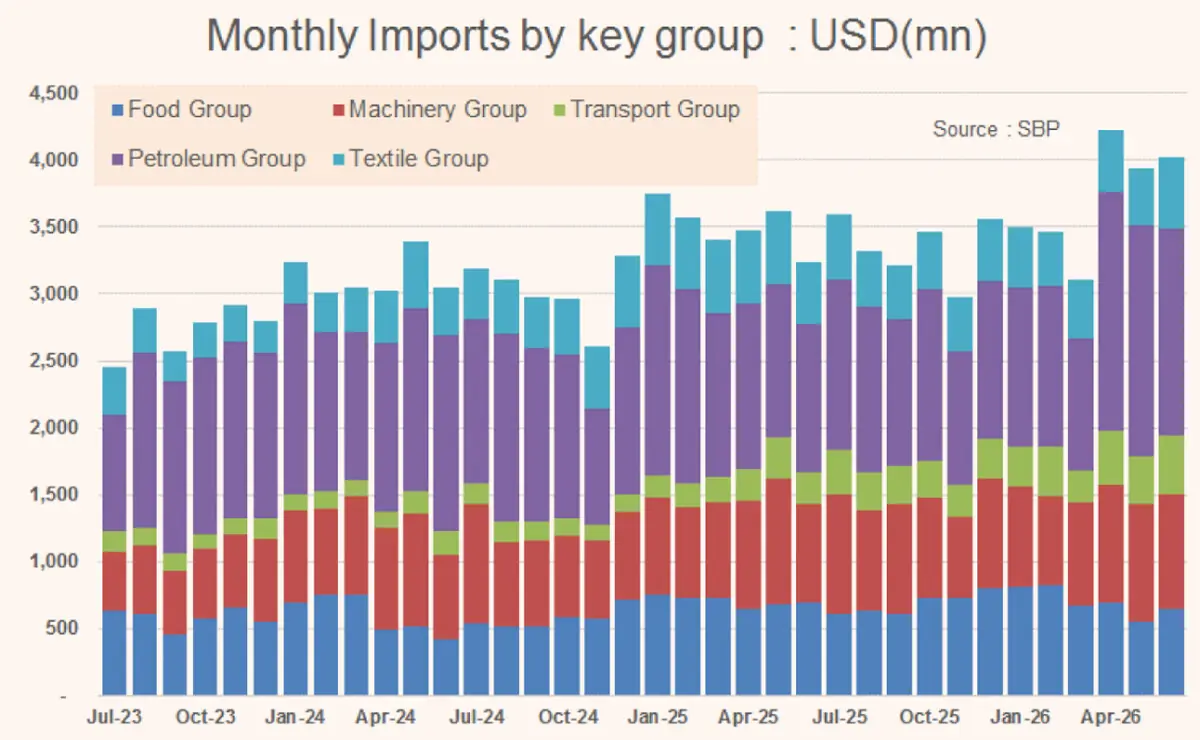
The increase in petroleum imports was restricted to 5 percent, taking the total to USD16.8 billion, which is 28 percent below the FY22 peak. Although oil prices, especially those of petroleum products, increased significantly in the last quarter, the lower availability of RLNG kept growth in check. Nonetheless, petroleum imports jumped by 72 percent QoQ and 40 percent YoY to reach USD5.6 billion in 4QFY26, the highest level since 4QFY22. If oil prices remain high, FY27 will be a challenging year.
There is nothing to be jubilant about in the performance of goods exports, which declined by 6 percent to USD30.1 billion in FY26. The worst-performing category, as mentioned above, was food exports, where border closures and poor agricultural policies are yielding weak results. Textile exports stagnated at USD17.9 billion, while other manufacturing exports declined by 4 percent.
The goods trade deficit worsened by 25 percent to USD33.6 billion. The upbeat performance of services exports partially compensated for this deterioration. ICT and other business services exports combined increased by 22 percent to USD6.8 billion. This limited the increase in the goods and services trade deficit to 20 percent, taking it to USD35.5 billion.
The remaining goods trade deficit was compensated for by the continued strong performance of remittances, which increased by 9 percent on a high base to USD41.6 billion. However, as mentioned above, the risks to the continuation of this momentum are growing.
This will keep the current account recovery fragile. Any slippage in remittances and/or an uptick in oil prices may force the SBP to return to austerity measures by tightening non-essential imports.
However, the focus on enhancing merchandise exports, which are on a gradual decline, is missing. They are now heavily taxed, while all the concessions have been withdrawn. Moreover, the currency is not supporting them. The SBP’s published REER stands at 106.5, its highest level since 2018, and keeping the currency overvalued is detrimental to export growth.
That puts pressure on the SBP to continue buying from the interbank marketand to build reserves, which currently stand at USD17.2 billion. Given the authorities’ fixation with the currency, the chances of any rate cut during this calendar year are close to none.




















Comments