


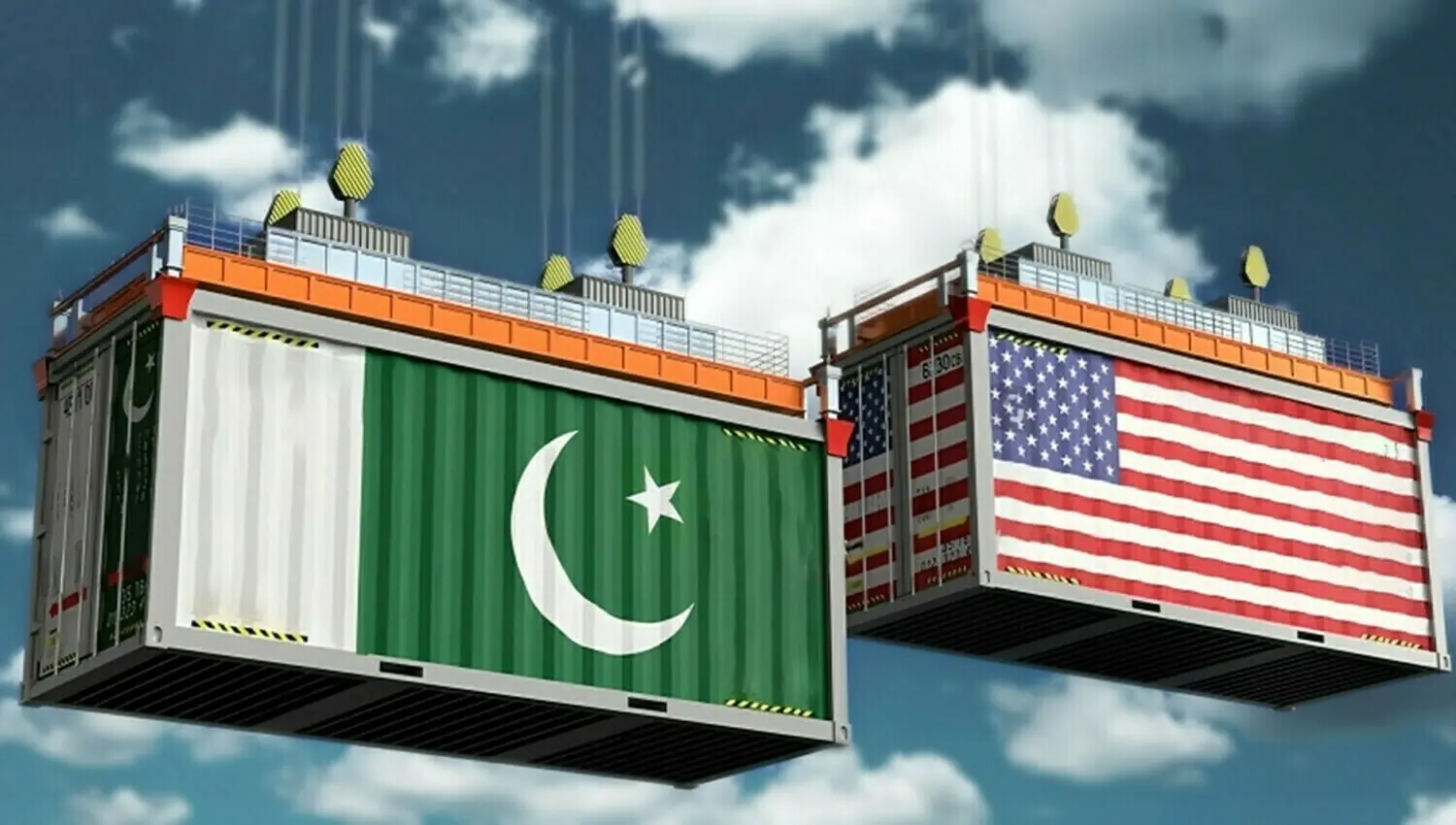

Pakistan and the United States have long shared a mutually beneficial relationship spanning security, economic, and development domains. Yet, despite deepening economic linkages, the two economies have not advanced toward a formal trade agreement.
While Pakistan was previously a beneficiary of the now-suspended US Generalized System of Preferences (GSP), the tariff relief was marginal, while trade flows remained substantial, signalling demand-driven trade between the two economies. For context, Pakistan exports approximately USD6.2 billion annually to the US, of which USD4.7 billion consists of textile and apparel products, and nearly 94 percent, or about USD4.4 billion, is value-added apparel.
In return, Pakistan is the second-largest importer of US cotton after Viet Nam. In FY 2025, it imported about USD877 million worth of US cotton, accounting for 52 percent of its total cotton imports, before declining to USD550 million in FY 2026, or 34 percent (source: PRAL)
Despite this substantial and interdependent trade flow, the absence of a formalized trade arrangement remains striking and may also contribute to a future decline in cotton imports from the U.S., as Pakistan often sources Brazilian cotton at more competitive prices.
This potential decline in bilateral trade is a situation that neither the US nor Pakistan would want.
Against this backdrop, a key concern is that the US is once again proposing additional tariffs of 10 percent on Pakistani goods under forced labour concerns, on top of the existing 10 percent imposed last year and the standard MFN tariffs. The US administration maintains that imported goods may carry embedded risks of forced labour within their supply chains.
While Pakistan is in the process of developing a national forced labour import prohibition framework, it also has an opportunity to engage the US proactively and strategically. In particular, Pakistan can negotiate tariff relief on its value-added textile exports in exchange for increased imports of US cotton - an approach that is both practically feasible and strategically advantageous. I will explain why.
A domestic constraint:
The rationale lies in Pakistan’s own structurally declining domestic cotton production base. Since reaching a peak of around 14 million bales in 2011–12, Pakistan has not been able to recover its cotton output.
One of the primary drivers of this decline is the sharp reduction in the area under cultivation. Cotton acreage has fallen from approximately 2.86 million hectares to nearly 1.7 million hectares, with much of this contraction occurring in Punjab, where the cultivated area has dropped to a 40-year low.
As a result, Pakistan’s cotton production currently stands at around 5.6 million bales in 2025–26, while the textile industry’s annual requirement is close to 16 million bales. This widening gap between domestic supply and industrial demand has made imports structurally inevitable, particularly as US cotton offers superior fiber characteristics and consistency, which are essential for producing value-added textile products such as denim and other high-end apparel.
The US perspective:
In parallel, the US is reorienting global supply chains. Under proposed measures related to forced labour, the Office of the US Trade Representative has introduced a tiered tariff structure, with 10 percent applied to economies that have taken partial steps to restrict imports produced with forced labour, and 12.5 percent applied to those without such frameworks.
Within this framework, the US has also proposed relief through a “Textile Mechanism,” under which countries can import American inputs, including cotton, and in return receive tariff relief proportional to the volume of those imports. If this mechanism is implemented, Pakistan could secure meaningful tariff relief by increasing imports of US cotton and incorporating it into textiles and apparel exported to the US market. The emerging framework suggests that economies integrating US-origin inputs into their exports may be better positioned to negotiate tariff concessions.
Why cotton is the right lever for a trade agreement:
Last year, Bangladesh announced a similar arrangement with the US, under which it exchanged increased imports of US cotton for tariff relief. This year, the USDA and USTR, under the Great American Cotton Plan, secured commitments from Indonesia and Bangladesh to support future purchases of US cotton tied to textile production and exports using American inputs. This is notable given that Bangladesh imports significantly less cotton from the US than Pakistan does, approximately USD235 million, or only about 6 percent of its total cotton imports of USD4 billion.
Pakistan, by contrast, imports on average around 40 percent of its cotton from the US. It is therefore well positioned to expand both its cotton imports and its exports of value-added textiles to the US market simultaneously.
Towards a mutually beneficial trade agreement:
According to APTMA estimates, the area under cotton cultivation is expected to decline further from the current 1.8 million hectares to 1.7 million hectares in 2026–27. Pakistan will therefore need to identify ways to prevent disruptions to its manufacturing base. While reviving domestic cotton production remains essential, the country must also leverage its existing and evolving trade linkages with the US.
In this context, the government should consider pursuing a formal agreement with the US on cotton, structured as follows:
-
The US exports cotton to Pakistan in line with the requirements of Pakistan’s textile industry. Currently, Pakistan accounts for approximately 16 percent of US cotton exports, and this share has the potential to increase.
-
In return, Pakistan secures a tariff waiver, or at least a reduction, on its value-added apparel exports. These exports are currently subject to tariffs of up to 16.3 percent under MFN rates, an additional 10 percent ad valorem duty following the reversal of emergency tariff measures, and a potential 10 percent Section 301 forced labour tariff in the absence of a meaningful bilateral arrangement.
Within the framework of international trade, this represents a mutually reinforcing and economically rational outcome for both Pakistan and the United States. A bilateral agreement of this nature is ultimately preferable to an expanding reliance on unilateral tariff measures.
Copyright Business Recorder, 2026
The writer is Chairman APTMA— North Zone. The views expressed in this article are not necessarily those of the newspaper

















Comments