


Climate tax or fiscal grab?
Pakistan's "green taxes," like the Climate Support Levy, are increasing, but a lack of transparency regarding their use for climate action raises concerns about their true purpose and economic impact.
- Increased Climate Support Levy and its economic burden.
- Lack of transparency in climate revenue utilization.
- Reduced government spending on climate adaptation and mitigation.
- Call for a public Climate Revenue and Expenditure Statement.


That Pakistan is among the world’s most climate-vulnerable countries is well established. So is its need for resources to fund adaptation and accelerate the energy transition. However, given the multitude of levies the government has imposed on citizens - and continues to introduce - it is legitimate to question whether these measures are intended to achieve specific policy objectives or have simply become revenue-generating tools at a time when households and businesses are already under considerable economic strain.
The Climate Support Levy (CSL), a green tax introduced to control carbon emissions and fund environmental projects, is one such toll where the say-do gap at the heart of public policy stands stark.
We need only look at the numbers to see where rhetoric gives way to reality. The CSL, introduced in the Finance Bill 2025-26 and effective from July 1, 2025, was never part of the original budget. It emerged mid-year, without prior consultation, warning, or an adjustment period for consumers or industry, and still collected Rs48 billion in revised estimates, with everyday consumers paying directly at the pump, where the tax is added straight to the retail price of petroleum products per litre.
This month, the CSL on both petrol and high-speed diesel was increased from Rs2.50 per litre to Rs5.00 per litre, while the government aims to collect Rs50 billion in FY2026-27.
Together with the Petroleum Levy, raised to Rs1.68 trillion from Rs1.50 trillion the year before, and the Captive Power Plant Levy, total fuel and energy-related levies are set to exceed Rs1.74 trillion this year, an increase of nearly 12% over FY2025-26.
Originally called the “carbon levy”, the CSL was implemented as part of the country’s commitment to boost climate resilience under agreements with the International Monetary Fund (IMF). Stacked on top of the Petroleum Levy, GST, and dealer margins, it means every litre of fuel carries a growing accumulation of charges. For most people, the distinction between a climate levy and a fuel tax is irrelevant - both raise transport costs, push up food prices, and squeeze household budgets.
As always, the ripple effects spread across the entire economy. Farmers pay more to transport produce, businesses face higher logistics costs, public transport fares rise, and inflation absorbs the rest. The burden is compounded by the Captive Power Plant Levy, introduced to push industry off self-generation and onto the national grid.
Environmental levies derive their legitimacy not simply from being collected, but from how transparently they are used.
Amid resistance from an industrial sector that knows the grid cannot be relied upon, the levy has largely failed on its own terms: the government projected Rs105 billion in collections during FY2025-26 and recovered only Rs14 billion, an 87% shortfall. It has nonetheless been retained at Rs15.7 billion for FY2026-27. Industries are left choosing between paying levies on captive generation and relying on grid electricity, with tariffs a persistent drag on their efficiency and competitiveness either way.
With no meaningful incentives for industrial renewable energy, neither option supports a genuine energy transition, and at a time when Pakistan urgently needs investment-led growth and export expansion, the combined weight of these levies pushes in the opposite direction.
The government’s stated justification for the CSL is climate action, but there is little evidence of what that action is, or what it brings by way of relief. The issue, however, is not whether Pakistan should mobilise climate finance, the real question is whether climate taxation is accompanied by an equally credible system for climate investment, expenditure tracking and public accountability. Without that connection, environmental taxation risks becoming fiscally efficient but environmentally ineffective.
Internationally, environmental levies derive their legitimacy not simply from being collected, but from how transparently they are used. In many countries, carbon pricing revenues are linked - either wholly or partially - to clearly defined objectives such as renewable energy deployment, public transport, climate adaptation, industrial decarbonisation or household compensation. The credibility of such instruments depends on demonstrating a visible connection between the revenue collected and the environmental outcomes delivered.
Pakistan continues to live through severe heatwaves and recurring catastrophic floods, yet the Federal Budget 2026-27 allocates the Climate Change and Environmental Coordination Division just Rs1.315 billion in current expenditure - unchanged from last year - and Rs2.478 billion in development expenditure, down from Rs2.784 billion. That is a combined total of under Rs4 billion against the Rs50 billion collected under the CSL, even as the government has set aside Rs150 million for its participation in climate conferences and international forums.
According to the Green Budget Statement, a fiscal policy framework designed to track, measure, and align government spending with climate and environmental goals, funding for climate adaptation - measures that help communities cope with floods, droughts, heatwaves, and other climate impacts - has been reduced from Rs85.4 billion in FY2025-26 to Rs70.5 billion in FY2026-27.
Climate mitigation spending, which supports efforts to reduce emissions and accelerate the clean energy transition, has seen an even sharper cut, falling from Rs603 billion to Rs124.1 billion. Allocations for other climate-supporting initiatives have also been reduced, from Rs28.3 billion to Rs19.5 billion.
One practical reform would be to establish a publicly reported Climate Revenue and Expenditure Statement alongside each federal budget, detailing how much is collected through climate-related levies, where these resources are allocated, what has actually been spent, and what measurable environmental outcomes have been achieved.
These cuts are difficult to reconcile with the government’s growing collection of climate-related revenues. The same Green Budget Statement reports Rs476 billion in environmentally favourable subsidies, including Rs423 billion linked to mitigation efforts in the energy sector. Alongside Rs1.67 trillion in Petroleum Levy collections and Rs50 billion from CPL, there is a further Rs22.5 billion from the EV Adoption Levy in climate-relevant revenue.
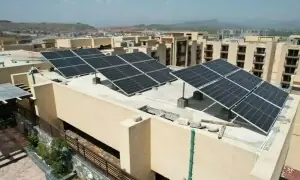
Yet there is little evidence these revenues are being translated into meaningful climate investment. The budget includes no major subsidy programme for electric vehicles, no dedicated allocation for a nationwide charging network, and no significant incentive package to help industries adopt solar or other clean technologies. Nor is there any visible funding earmarked specifically for responding to the growing impacts of climate change - the recurring floods, extreme heatwaves, droughts, and other climate-related disasters that continue to affect millions of Pakistanis every year.
The mismatch between climate-related revenue and climate-related expenditure, with the government collecting more in the name of climate action through taxes on fuel while spending less on it, is a contradiction too stark to ignore.
A serious climate strategy would channel these funds into strengthening flood protection, building climate resilience, expanding renewable energy, supporting electric mobility, and helping businesses transition to cleaner energy sources. Just as importantly, the government should clearly disclose how climate-related revenues are collected, where they are spent, and what results they deliver.
One practical reform would be to establish a publicly reported Climate Revenue and Expenditure Statement alongside each federal budget, detailing how much is collected through climate-related levies, where these resources are allocated, what has actually been spent, and what measurable environmental outcomes have been achieved. Such reporting would strengthen fiscal transparency while helping restore public confidence that climate-related taxes are serving their stated purpose.
Without transparency and visible investment, the Climate Support Levy risks being seen not as a climate solution but as another tax imposed on citizens and businesses under the banner of environmental responsibility. For a country facing some of the world’s most severe climate risks, this distinction matters.
The author works as Research Associate (Energy Transition) at Policy Research Institute for Equitable Development.




















Comments