


Disgruntled salaried group gets some relief as Aurangzeb announces FY27 budget
- Defence expenditure raised to Rs3 trillion for FY27
- Rs1 trillion for federal PSDP
Pakistan's Finance Minister will present the FY2026-27 budget today, outlining fiscal priorities and economic stabilization efforts, following the release of the FY2025-26 Economic Survey.
- Government's fiscal priorities and expenditure plans.
- Key findings from the Pakistan Economic Survey.
- GDP growth figures and economic stabilization efforts.

Finance Minister Muhammad Aurangzeb unveiled Pakistan’s federal budget for fiscal year 2026-27 on Friday, with the government seeking to achieve GDP growth of 4% and inflation at 8.2%.
Notably, the salaried group that had been at the receiving end of higher taxation for a number of years saw some relief. However, the income tax threshold of Rs50,000 per month remained unchanged.
The incumbent government’s third federal budget carries a total outlay of around Rs18.77 trillion ($67 billion), reflecting a moderate increase from Rs17.6 trillion in the previous year’s budget, as policymakers attempt to maintain macroeconomic stability while navigating a challenging external environment marred by the Middle East crisis.
Interestingly, inflation target has been set slightly higher at 8.2%, largely attributed to the ongoing Middle East war that has rattled energy markets.
Meanwhile, as per the budget documents, Rs8,054 billion has been earmarked for interest payments in FY27. While Rs17,495 billion has been allocated for the government’s current expenditure in FY27.
According to budget estimates, the government targets GDP growth of 4% in FY27, compared to an estimated 3.7% in the outgoing fiscal year. Sector-wise, agriculture, industrial and services are expected to post growth of 3.6%, 4.5% and 4.2%, respectively, in FY27.
The budget deficit is projected to be 3.6% of the GDP, and a primary surplus of 2% of GDP.
The budget projects a federal deficit of Rs7.02 trillion.
In his opening statement, the finance minister lauded the role of Pakistan’s armed forces, saying that the defence sector has emerged as a source of earning valuable foreign exchange.
He said the strategic defence agreement between Pakistan and Saudi Arabia is a moment of pride. “Pakistan will always steadfastly stand alongside KSA,” said Aurangzeb.
FBR tax target raised
The FBR has a tax collection target of approximately Rs15.26 trillion for FY27, representing an increase of over 8% compared to Rs14.13 trillion in the outgoing fiscal year.
An amount of Rs8,848 billion has been allocated for provinces from federal revenue.
Meanwhile, non-tax revenues are projected to exceed Rs5.34 trillion in FY27, supported by profits from the State Bank of Pakistan, petroleum levy collections, and proceeds from state-owned enterprises.
The government expects enhanced documentation, increased use of digital invoicing systems, and tighter monitoring of retail and wholesale sectors to contribute significantly towards achieving the target.
Minimum wage up 10%
Aurangzeb admitted inflation has increased the difficulties faced by salaried individuals.
“Recognising these challenges, the government is proposing a 7% increase in the salaries of public sector employees,” he said.
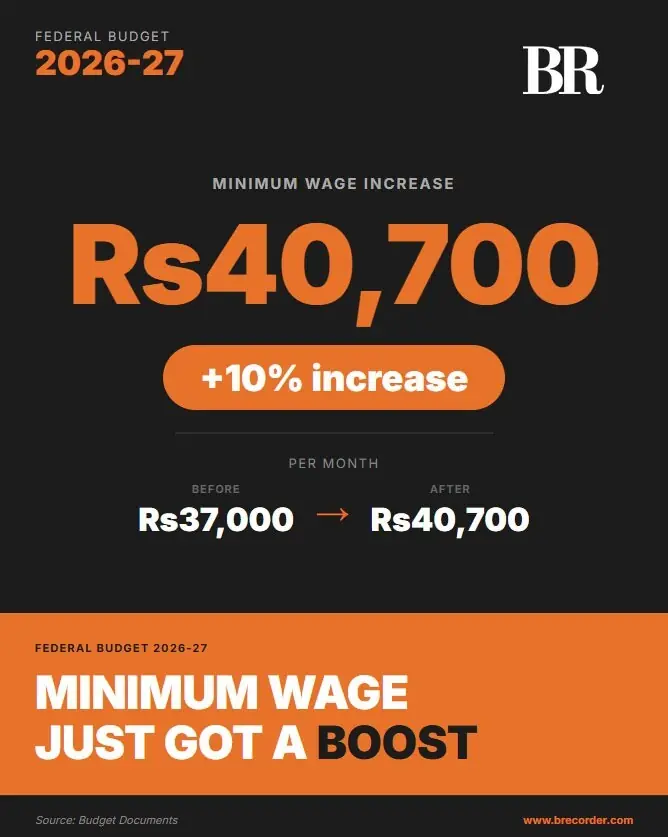
Moreover, a 7% increase in pensions for retired employees is also being proposed. Likewise, it is proposed the minimum monthly wage be increased by 10%.
Relief for the salaried class
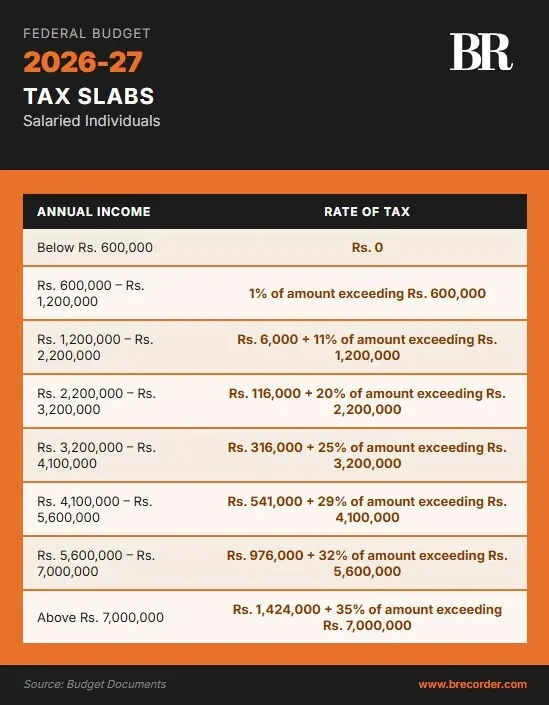
The government announced some tax relief for salaried individuals, particularly those in middle- and high-income brackets, amid concerns over the high tax burden on documented income earners.
Under the new measures, the tax rate for individuals earning between Rs2.2 million and Rs3.2 million annually falls from 23% to 20%, while those in the Rs3.2 million to Rs4.1 million bracket receive a reduction from 30% to 25%.
For high-income individuals, earning between Rs4.1 million and Rs5.6 million will now pay 29% income tax, as compared to 35% last year. Similarly, individuals earning between Rs5.6 million and Rs70 million annually will now pay 32% in taxes, as compared to 35%.
Moreover, the government has abolished the 9% surcharge on high-income individuals. “These measures will reduce the burden on the salaried class,” said Aurangzeb.
The government has proposed the removal of the first six super tax slabs. Furthermore, income exceeding Rs500mn will now be subject to a super tax rate of 8%, compared to the previous rate of 10%.
Relief for the construction sector
To support construction activity, the government has proposed reducing withholding tax rates on property transactions. For filers, the tax on property purchases has been reduced from 2.5% to 1.5%, said Aurangzeb, while the tax on property sales has been reduced from 5.5% to 2.75%.
“We believe that construction activity will boost from this measure,” said Aurangzeb.
Moreover, the government has abolished the Capital Value Tax (CVT) on the holding of foreign assets.
PSDP
The government allocated around Rs1 trillion under the Public Sector Development Programme (PSDP), with priority areas including water infrastructure, transport connectivity, energy transmission projects, digital transformation, and climate resilience initiatives.
Defence spending rises
In light of evolving regional security dynamics and heightened geopolitical tensions, defence spending registered another increase.
“Defence spending has been increased considerably to make the country invincible due to the uncertainty in the region,” Aurangzeb said.
The government allocated more than Rs3 trillion for defence in FY27, compared to Rs2.56 trillion in the previous fiscal year, reflecting a continued focus on military preparedness amid an increasingly uncertain regional environment.
Defence as a percentage of GDP stands at 2.1% in FY27E compared to the FY26 revised estimate of 2.03% of GDP.
The government has allocated Rs1,169 billion for pension expenses in FY27.
BISP allocation increased
The government raises the allocation for the Benazir Income Support Programme (BISP) to around Rs838 billion for FY27, up 17% as compared to last year, reflecting efforts to shield vulnerable segments of society from inflationary pressures.
The government has allocated Rs365 billion for the transport sector, including Rs100 billion for the N-25 expressway.
The government has earmarked Rs116.2 billion for the power sector.
Talking about climate change, the finance minister noted that last year’s floods dented Pakistan’s economy with losses to the tune of Rs822 billion. The government has allocated Rs103.1 billion for 43 hydro projects, including Rs14 billion for Diamer Bhasha and Rs10 billion for the K-IV project in Karachi.
Education and health
The government has earmarked Rs25.1 billion for the health sector under the Annual Development Programme 2026-27 (ADP), including tertiary healthcare and critical care. Meanwhile, under the ADP, Rs46 billion has been allocated for higher education and research, which is higher than the Rs34.9 billion allocated last year.
Exemption for the IT sector
The government has announced to extend the income tax exemption for the IT sector until June 2029.
Meanwhile, the government has decided to lower the tax collection on export proceeds from the existing 2% to 1.25%.
Taxes on contraceptives eliminated
In a bid to control population, which has crossed the 250 million mark, the government has decided to abolish taxes on contraceptives, announced Aurangzeb.
It has also eliminated the Federal Excise Duty (FED) on international business-class travel. “This measure will help in attracting foreign investment,” said Aurangzeb.
FED imposed on POL solvents
The government, in a bid to curb adulteration, has imposed a Federal Excise Duty (FED) of Rs80 per litre on petroleum-based solvents, particularly petroleum naphtha, which are primarily used in paints and thinners.
“These petroleum-based solvents are widely used for the illegal adulteration of petrol. The objective of this measure is not only to discourage such unlawful activities but also to deter those who harm the national economy by producing adulterated fuel at a lower cost and selling it in the market,” said Aurangzeb.
FEDs on SUVs
The government has imposed Federal Excise Duty on imported SUVs with engine capacities exceeding 2,000cc and up to 3,000cc. It has also proposed to increase the duty on vehicles above 3,000cc.
The tax will be imposed on luxury EVs worth over Rs20 million.
Aurangzeb said through telecom digital wallets, the government is easing public investment in government schemes. “In a week or two, we are inaugurating a project in this regard,” he said.
He said tax compliance and enforcement would ensure an increase in tax revenue collection instead of an increase in taxes.
The finance minister said that the government has provided the enablers “towards that journey from stabilisation to sustainable growth”.
He said the government that achieving stability is “is just the start of the journey”, expressing hope that the announced measures will put Pakistan towards a path of sustainable growth.
The government had earlier indicated that the announcement would be made on June 10 after revising the schedule from its initial plan.
The budget comes at a time when Pakistan remains under a multi-billion-dollar IMF programme, requiring the government to sustain fiscal discipline, broaden the tax base, reduce untargeted subsidies, and improve revenue collection.
At the same time, escalating tensions between the United States and Iran continue to add uncertainty to global energy markets, raising concerns over oil prices and import costs for Pakistan, a major energy-importing nation.
The government says it is closely monitoring developments in the Middle East amid fears that any prolonged disruption in regional trade routes could adversely impact Pakistan’s external account and inflation outlook.
Pakistan’s financial markets had also anticipated a friendlier, growth-oriented budget, talks suggested, with the KSE-100 ending the session up by nearly 2,700 points. Additionally, with the economy now having stabilised according to government officials, many also believed Islamabad will look towards faster GDP growth in the coming fiscal year.
On Thursday, the government unveiled the Pakistan Economic Survey (PES) for FY2025-26, according to which GDP growth was recorded at 3.7% in the outgoing fiscal year.
The growth was higher than the previous year’s figure of 3.18% but well short of its target of 4.2% announced in last year’s budget.
“The improvement owes to effective macroeconomic management, better fiscal account, growth in the large-scale manufacturing (LSM) sector, resilience of the agriculture sector to floods of 2025, exchange rate stability and reforms under the IMF Extended Fund Facility (EFF) Programme,” the survey stated.



















Comments