


Pakistan doesn’t need more schools, it needs better school system
Pakistan faces an education emergency with millions out of school and underfunded systems. Practical reforms focusing on governance, foundational learning, and teacher quality are crucial to unlock national potential.
- Pakistan's education crisis and its staggering statistics.
- Lessons from Finland, Singapore, and Vietnam's education systems.
- Four practical and affordable reforms for Pakistan.
- The importance of political continuity in education policy.
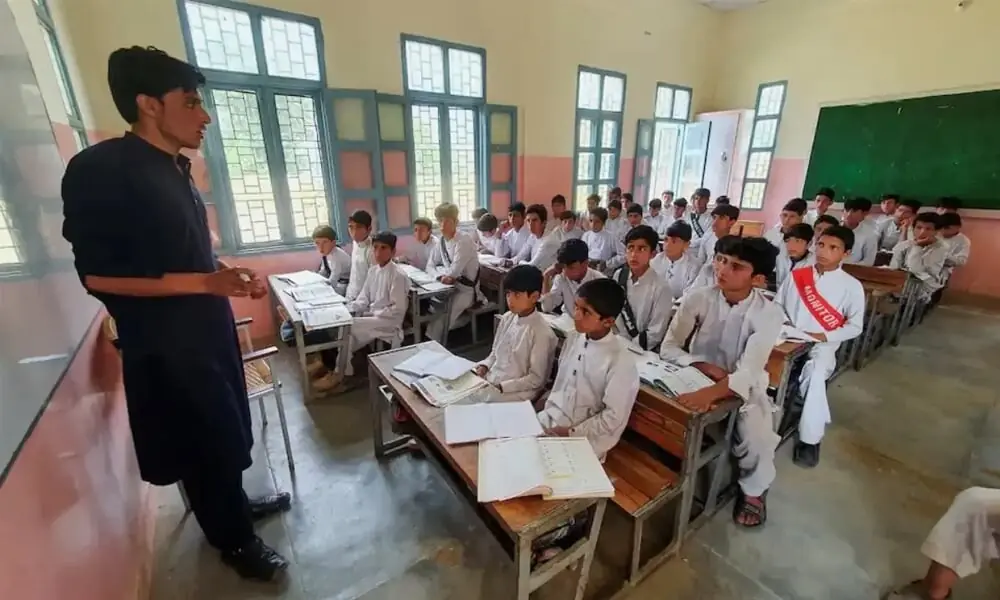

Every election cycle promises an “education revolution”, yet Pakistan’s classrooms tell a different story. A new Civil Services Academy review, released this month, confirms what parents and teachers have long suspected; Pakistan’s education emergency which was declared in May 2024 has produced roadmaps but little else.
Between 25.1 million and 26 million school-age children remain out of school, the second-highest number in the world. Public spending on education has fallen to around 0.8% of gross domestic product (GDP), well below the United Nations Educational, Scientific and Cultural Organisation’s (UNESCO) recommended 4–6%, down from 2% as recently as 2018. In Sindh, nearly 90% of the education budget goes to salaries and administration, in Balochistan, the figure is 81%. Little is left for teacher training, materials, or infrastructure.
The numbers behind the headline number are worse than the number itself. In Balochistan, girls make up 78% of out-of-school children, and children in some districts travel long distances to reach a secondary school. In South Punjab, Rajanpur’s out-of-school rate stands at 48%. These are not gaps to be closed by building more schools, they are symptoms of a system that has never been designed to reach the children it is failing. The temptation is to look for miracle solutions, but successful education systems share a common principle - they improve quality before quantity.
Every child who leaves school without basic skills represents lower productivity, weaker growth, and lost national potential.
Finland is perhaps the most cited example. Children begin formal schooling at age seven, receive minimal homework during their early years, spend fewer hours in classrooms than students in many countries, and yet consistently rank among the world’s best in reading, mathematics, and science. Finland’s success does not come from shorter school days alone, it comes from investing in highly trained teachers, prioritising foundational learning, reducing unnecessary examinations, and giving schools the flexibility to teach rather than merely prepare students for tests and focusing on rote-memorisation.
Singapore took a different route, continuously updating its curriculum toward analytical thinking and problem-solving as its economy evolved, rather than chasing enrollment numbers alone. Closer to home, Vietnam demonstrates that wealth is not a prerequisite for educational success. Despite having a far lower income than many developed nations, it focused relentlessly on teacher quality, foundational literacy, accountability, and curriculum reform. The lesson is very clear. Effective governance often matters more than simply increasing expenditure.
The common thread amongst all success stories is governance, not GDP.
Pakistan cannot simply copy Finland or Singapore. Its fiscal space is limited, provincial governments have varying capacities, and millions of children remain outside the education system altogether. Reform must therefore be practical and affordable.
The following four reforms could deliver outsized returns at manageable cost:
- First, foundational learning must come before everything else. Every child should master reading, writing, and mathematics by Year 3. International evidence shows these gaps compound and become far costlier to close later.
- Second, teacher recruitment should be merit-based, with continuous professional development replacing one-off training workshops. Better teaching has a higher return than repeated curriculum overhauls.
- Third, secondary education should shift away from board-exam memorisation toward project-based assessment, digital and financial literacy, and vocational and technical training integrated into mainstream schools rather than siloed off for “weaker” students, as Germany’s apprenticeship model shows is possible.
- Fourth, better data, building on the CSA report’s call for a National Student Registry linked to NADRA’s B-Form system, would let resources go to the districts and children who need them most, rather than being spread uniformly and thinly.
Technology also offers realistic opportunities. Instead of attempting expensive nationwide laptop schemes, Pakistan can expand low-cost digital learning platforms, teacher support applications, and offline educational content for underserved districts. Provinces can build on existing public-private partnerships with organisations that have already demonstrated improvements in learning outcomes, particularly in low-income communities. Better data systems should identify where out-of-school children live so resources can be targeted efficiently rather than distributed uniformly across districts.
Education reforms must survive politics. Pakistan has repeatedly changed policies with every new government, preventing long-term progress. Parliament should establish a cross-party national education framework with measurable ten-year targets for literacy, teacher quality, school attendance, and employability, allowing provinces flexibility in implementation while ensuring continuity regardless of political change.
The debate should no longer be about whether Pakistan can afford to reform education, it is whether it can afford not to.
Every child who leaves school without basic skills represents lower productivity, weaker economic growth, greater dependence on social support, and lost national potential. Finland shows that more hours do not mean better learning. Singapore shows that education should evolve with the economy. Vietnam shows that governance can outperform wealth. Pakistan’s task is not to imitate any of them, but to adopt what made them work. Invest in teachers, prioritise foundational learning, modernise the curriculum, and put education beyond the reach of short-term politics.
Dr. Ajaz Ali is a British-Pakistani academic and education reform advocate who leads Higher Education at a Birmingham-based institution. Holding an MBA and PhD, he is recognised for promoting meaningful education for success in an AI-powered world. He tweets at @DrAjazUK




















Comments