


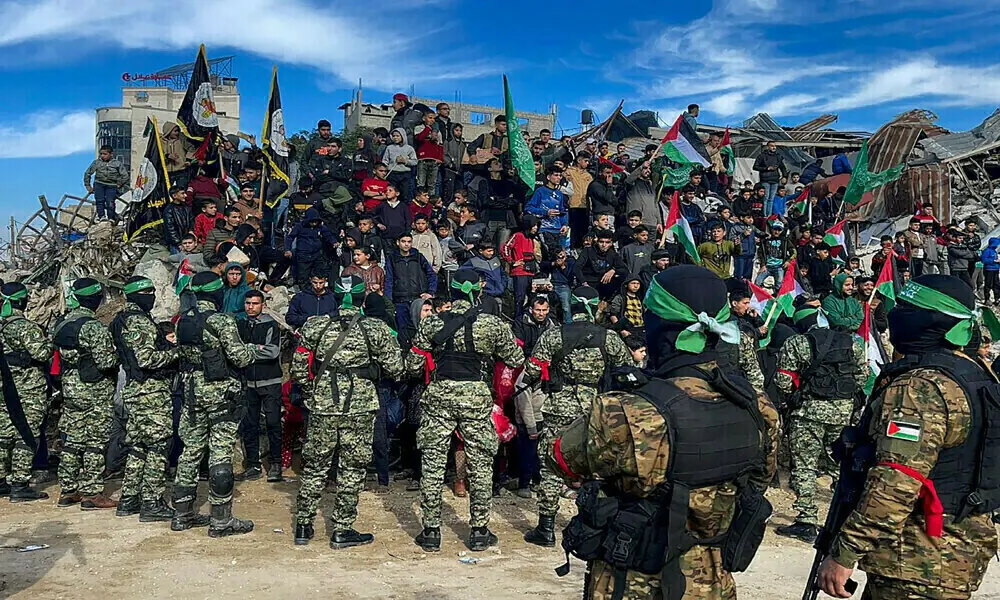
EDITORIAL: Hamas’ decision to dissolve the governing body that has administered Gaza for nearly two decades represents a significant political development, though it falls well short of a comprehensive breakthrough in the long-running Israeli-Palestinian conflict.
The move is intended to facilitate the transfer of civilian administration to the National Committee for the Administration of Gaza (NCAG), a technocratic body established as part of a US-brokered peace framework. As Hamas spokesman Hazem Qassem explained, the movement has taken this step “to remove any pretexts for the occupation,” which, he said, continues its aggression and “war of extermination”. The decision comes after months of devastating warfare that has left much of Gaza’s infrastructure in ruins, crippled essential services, and plunged more than two million Palestinians into a humanitarian catastrophe marked by acute shortages of food, water, healthcare, and shelter.
From Hamas’ perspective, dissolving its governing body is intended to move the political process forward while placing the spotlight on Israel’s failure to honour its commitments under the ceasefire framework. Israel has made abundantly clear that it has no intention of implementing key provisions of the agreement, including those relating to the NCAG, created under the Board of Peace after US President Donald Trump brokered the October 2025 ceasefire. The agreement’s second phase envisaged Hamas’ disarmament alongside a gradual Israeli withdrawal from Gaza.
Instead, Western governments, particularly the United States, have largely shielded Israel from meaningful consequences for repeated ceasefire violations while exerting overwhelming pressure on the Palestinians to comply with its terms. Rather than withdrawing, Israeli forces have expanded their presence, reportedly taking control of nearly 70 percent of Gaza while continuing military operations despite the truce. According to Gaza’s Health Ministry, at least 1,072 Palestinians have been killed since the ceasefire took effect, bringing the death toll since October 2023 to more than 73,000. Against this backdrop, Hamas continues to reject calls for disarmament, rightly arguing that armed resistance cannot end while the Israeli occupation persists.
Equally alarming is the accelerating deterioration of conditions in the occupied West Bank where settlement expansion, the displacement of Palestinian communities, and escalating violence by Israeli forces and extremist settlers have intensified. Notorious Israeli National Security Minister Itamar ben Gvir’s assertion that “Jews are above the law in the West Bank,” coupled with policies facilitating the arming of settlers in occupied East Jerusalem, has deepened concerns over impunity. Human rights organisations and UN experts have repeatedly warned that these policies violate international law and further erode prospects for a viable two-state solution.
Hamas’ move should therefore be viewed as a potential opening rather than a decisive turning point. By relinquishing formal governance of Gaza while refusing to disarm under occupation, the movement has shifted the diplomatic focus to Israel. Any meaningful path to peace depends on Israel implementing the ceasefire, allowing unrestricted humanitarian access, ending policies that perpetuate occupation and settlement expansion, and engaging in credible negotiations in accordance with international law and relevant UN resolutions. Regional mediators and the broader international community must ensure accountability for violations of international humanitarian law. Above all, the Palestinians of Gaza and the West Bank must not be left alone to bear the continuing human cost of a conflict that has inflicted immense suffering on an entire people.
Copyright Business Recorder, 2026















Comments