


Intense selling amid geopolitical tensions, KSE-100 down 2,300 points
- Benchmark index settles at 179,927.04
The Pakistan Stock Exchange's KSE-100 Index plunged due to escalating US-Iran tensions, triggering widespread selling and mirroring declines across global markets amid rising oil prices.
- Escalating US-Iran tensions and global market impact.
- Pakistan Stock Exchange's significant KSE-100 Index decline.
- Surging oil prices and renewed inflation concerns.
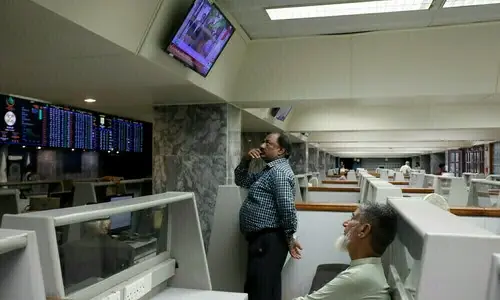

Negative sentiment engulfed the Pakistan Stock Exchange (PSX) amid escalating tensions between the US and Iran, with the benchmark KSE-100 Index shedding over 2,300 points on Monday.
The market opened on a relatively firm note, with the index briefly climbing to an intraday high of 181,148.26. However, the early gains proved short-lived as selling pressure intensified, dragging the benchmark into negative territory.
The benchmark index traded range-bound through the late morning and early afternoon before witnessing a sharp sell-off in the final hours of trading. The benchmark fell from near the 181,000-point level to an intraday low of 179,448.52, erasing more than 1,500 points within a short span.
Although the market recovered modestly from its day’s low, the rebound lacked momentum and settled at 179,927.04, down by 2,314.73 points or 1.27%.
During the previous week, the PSX snapped its winning streak as renewed geopolitical tensions following fresh US-Iran military strikes dampened investor sentiment, prompting widespread selling and dragging the benchmark index lower.
The benchmark KSE-100 Index declined by 1.7% on a week-on-week basis, losing 3,130.43 points to close at 182,241.77 points.
Internationally, share markets slid in Asia on Monday as fighting intensified in the Gulf and Iran claimed to have closed the vital Strait of Hormuz, sending oil prices surging and rekindling inflation risks globally.
The dollar rose with bond yields as investors narrowed the odds of a Federal Reserve interest rate hike, just a day before Chair Kevin Warsh is due to face Congress for the first time in his new role.
Inflation figures for June on Tuesday could show some cooling in the headline rate of 4.2% as petrol prices decline, though some of that will reverse now that oil is rising anew.
Brent crude climbed 4.1% to reach $79.11 a barrel, up from the recent trough of $70.14, while U.S. crude added 4.1% to $74.37 a barrel.
U.S. officials said around 20 vessels had been escorted through the strait in the previous 24 hours, though ship tracking sites showed little traffic moving.
Equity investors will be hoping the earnings season proves as upbeat as forecast, with the major banks kicking off from Tuesday, while Netflix and General Electric are also on the docket.
S&P 500 futures eased 0.4%, while Nasdaq futures lost 0.9%. In Europe, EUROSTOXX 50 futures and DAX futures both fell 0.6%, while FTSE futures dipped 0.1%.
Japan’s Nikkei fell 1.6%, having shed 1.7% last week, while MSCI’s broadest index of Asia-Pacific shares outside Japan dropped 0.9%.
South Korea’s formerly red-hot market shed 5.4%, and will be in focus, having lost almost 8% last week as leveraged bets on semiconductor shares came under pressure. The market has emerged as a key global barometer for chip-sector sentiment, and further losses could ripple out more broadly.
This is an intraday update

















Comments