


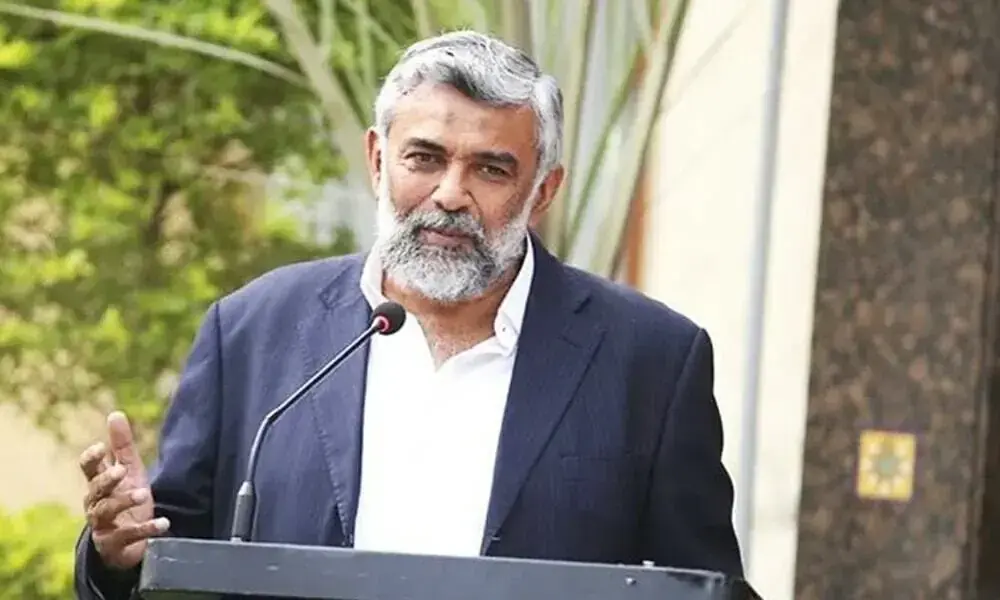

KARACHI: Pasban Democratic Party (PDP) Chairman Altaf Shakoor has said Pakistan’s aspiration to become a US$1 trillion economy is ambitious and achievable but not under its current economic model.
The country could not borrow its way to prosperity. The ballooning debt alone was enough to derail the US$1trn economy dream, he said.
Pakistan could not borrow its way to a US$1 trillion economy, because mounting debt servicing, besides underutilized land and water resources, energy inefficiencies, and weak productivity had been preventing it from achieving sustainable high growth, said Altaf Shakoor here on Sunday.
Altaf Shakoor said sustainable economic transformation requires redirecting national resources from debt servicing to productive investment while unlocking the full potential of Pakistan’s agriculture, energy sector, exports, and human capital.
He said, debt servicing consumes the largest share of the federal budget. In recent years, interest payments have absorbed around two-thirds of the federal government’s net revenues, leaving limited fiscal space for education, healthcare, scientific research, infrastructure, water management, agricultural modernization, industrial development, and innovation.
He said no country has achieved sustained high-income growth while committing such a large share of public resources to servicing debt rather than building productive capacity.
He said the consequences are visible across the economy. Limited development spending weakens productivity.
Low productivity slows economic growth. Slower growth constraints government revenues, forcing greater reliance on borrowing, which in turn raises future debt-servicing obligations. “Unless this cycle is broken, Pakistan’s aspiration of becoming a US$1 trillion economy will remain difficult to realize.”
He said investment in people is equally essential. Public spending on education remains around 1.5–2 percent of GDP, while public healthcare expenditure is approximately 1–1.5 percent of GDP—well below the levels achieved by many rapidly growing emerging economies.
He said millions of young Pakistanis enter the labour market every year, yet many lack the technical, vocational, and digital skills demanded by modern industries. Without a skilled and healthy workforce, sustained economic transformation is impossible.
He said Pakistan’s agricultural sector represents one of its greatest untapped strengths. Agriculture contributes roughly one-fifth of GDP, employs more than one-third of the labour force, and benefits from one of the world’s largest irrigation systems. Yet crop yield for many major commodities remain below international benchmarks. Inefficient flood irrigation, canal seepage, groundwater depletion, and inadequate water storage reduce productivity, while significant post-harvest losses diminish farm incomes and export earnings.
He said modern irrigation systems, laser land levelling, improved seed varieties, mechanization, precision agriculture, scientific water management, stronger agricultural extension services, and greater investment in storage, cold-chain logistics, food processing, and value-added exports can substantially increase agricultural productivity while conserving scarce water resources. Better utilization of Pakistan’s land and water can strengthen food security, increase rural incomes, and generate higher export revenues.
Energy security is another critical pillar of economic growth.
He said Pakistan spends billions of dollars each year importing crude oil and petroleum products. Although energy imports will remain necessary for the foreseeable future, yet the oil supply chain can become significantly more efficient.
He said Thar coal can resolve Pakistan’s energy issue to a large extent.
He said Pakistan must also transform its export base. The country continues to rely heavily on textiles while underperforming in engineering goods, pharmaceuticals, information technology, electronics, processed foods, minerals, and other high-value industries. “A US$1 trillion economy requires diversified, technology-driven exports supported by reliable energy, competitive logistics, stable policies, research, innovation, and investment in advanced manufacturing.”
He said equally important is restoring investor confidence.
Pakistan possesses the population, strategic location, entrepreneurial talent, fertile land, and natural resources needed to become one of Asia’s leading economies, he said.
“The challenge is not a lack of potential – it is the allocation of national resources,” he said.
Copyright Business Recorder, 2026




















Comments