


India clinches agreement for Australian uranium supply
- A joint statement said the arrangement allowed long-term uranium exports for exclusively peaceful purposes
Indian Prime Minister Narendra Modi secured a uranium supply deal with Australia to fuel India's nuclear energy ambitions, receiving a rock-star welcome amidst strengthening bilateral ties.
- India's plans to scale up nuclear power generation.
- Australia's significant uranium resources and export agreements.
- The growing influence of the Indian diaspora in Australia.
- Enhanced defence cooperation and critical minerals supply chains.
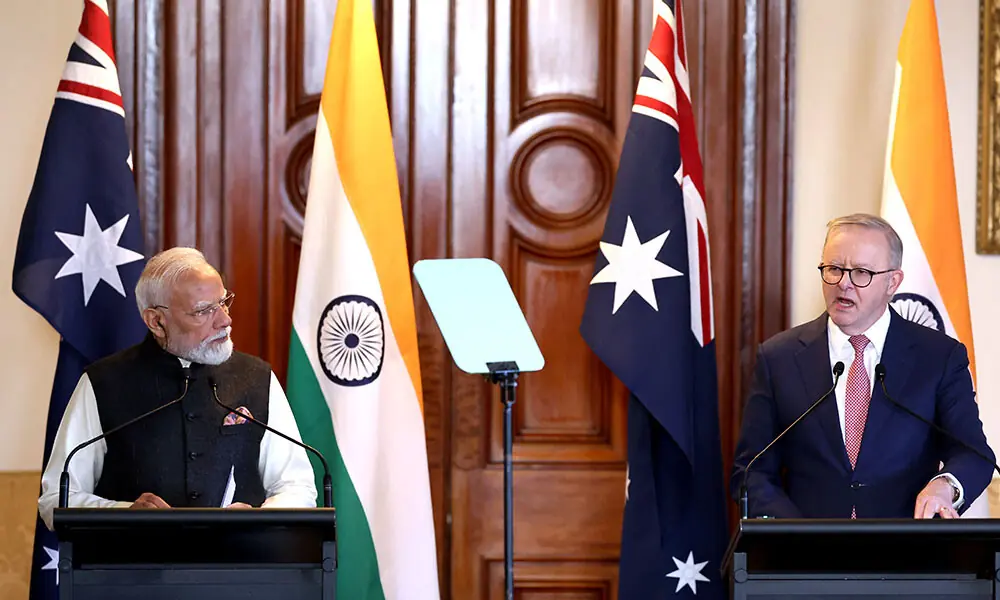

MELBOURNE: Indian Prime Minister Narendra Modi clinched a uranium supply deal for his country’s nuclear energy future on Thursday while visiting Australia, where he fronted tens of thousands of cheering supporters in a stadium.
Faced with an almost-insatiable appetite for electricity in the world’s most populous nation, Modi has outlined plans to substantially scale up nuclear power generation in coming years.
Australia lays claim to around 28 percent of the world’s uranium resource, but legal hurdles and political sensitivities have hindered exports to India.
“We have signed an important agreement today on nuclear energy,” Modi said after talks with his Australian counterpart Anthony Albanese in Melbourne.
“This will pave the way for uranium supplies from Australia to India and give our clean energy objectives fresh momentum.”
A joint statement said the arrangement allowed long-term uranium exports for “exclusively peaceful purposes”.
The exports would fall under safeguards established by the International Atomic Energy Agency.
“The arrangement facilitates Australian uranium exports to India, to help increase the share of non-fossil fuel power capacity,” Albanese told reporters.
India and Australia entered a nuclear cooperation agreement in 2015 that paved the way for uranium exports.
The two countries have grown considerably closer in recent years, partly driven by a joint desire to keep Beijing’s military ambitions in check while cultivating trading partners outside China.
‘New phase’
In the evening, Modi received a rock-star welcome from nearly 30,000 cheering and applauding fans from the Australian-Indian community who packed into the Marvel Stadium for a “Melbourne Meets Modi” event.
Australia’s prime minister and his “very dear friend” Modi hugged and held their joined hands aloft before addressing spectators.
“Australians of all backgrounds have been enriched by your bringing your culture here and adding it to our multicultural character – we are a better nation because we have you in it,” Albanese told them.
Modi promised the adoring crowd: “A new phase of India and Australia partnership is about to start.”
Australia’s prime minister has previously referred to Modi as “The Boss”, joking that he could pull bigger crowds than US rock icon Bruce Springsteen.
For the first time on record, the biggest group of Australian residents born overseas came from India, statistics for last year showed in June.
“In 2014, the Indian diaspora community in Australia was relatively small,” said Teesta Prakash from the Australia India Institute.
“But in 2026, it is now the largest diaspora community within Australia. It has outstripped the British, which is a huge demographic change,” she told AFP.
Modi’s visit stirred up opposition, too, including criticism that he has fostered a dangerous brand of Hindu nationalism at home.
Australia’s Alliance Against Islamophobia called for a protest outside the stadium event, drawing attention to what it said was the persecution of minority groups in India.
Anti-immigration protesters also gathered ahead of the rally, holding placards calling to “put Australians first”.
In their talks, Modi and Albanese agreed to strengthen defence cooperation and to bolster supply chains for critical minerals.
The two nations would build a “temporary space tracking terminal” on Australia’s Cocos Keeling Islands in the Indian Ocean, which will support Indian space flight projects, according to a joint statement.
Modi is scheduled to fly to New Zealand after Australia.



















Comments