


Pak Leather Crafts Limited: performance and outlook
Pak Leather Crafts (PAKL) has consistently faced net losses and negative equity, with its future as a going concern uncertain due to high costs, demand destruction, and geopolitical tensions.
- Consistent net losses and negative equity.
- Impact of high production costs and global recession.
- Strategic shift to toll manufacturing and asset sales.
- Uncertainty from geopolitical tensions on export sustainability.
- "Gold rated" certification for new export opportunities.
Pak Leather Crafts Limited (PSX: PAKL) is incorporated in Pakistan as a public limited company. It was established in 1971.
The company is engaged in leather tanning, manufacturing of leather garments as well as export of leather and leather garments.
Pattern of Shareholding
As of June 30, 2025, PAKL has a total of 3.4 million shares outstanding which are held by 599 shareholders. Sponsors’ associates & friends have the majority stake of 43.08 percent in the company followed by directors, their spouse and minor children holding 36.18 percent shares of PAKL.
Other individuals account for 18.14 percent shares of the company while financial institutions and joint stock companies collectively hold 2.55 percent shares.
The remaining 0.05 percent shares are held by Investment Corporation of Pakistan.
Historical Performance (2021-25)
PAKL’s topline posted a slump in 2021. It then recovered in the subsequent year followed by a descent thereafter.
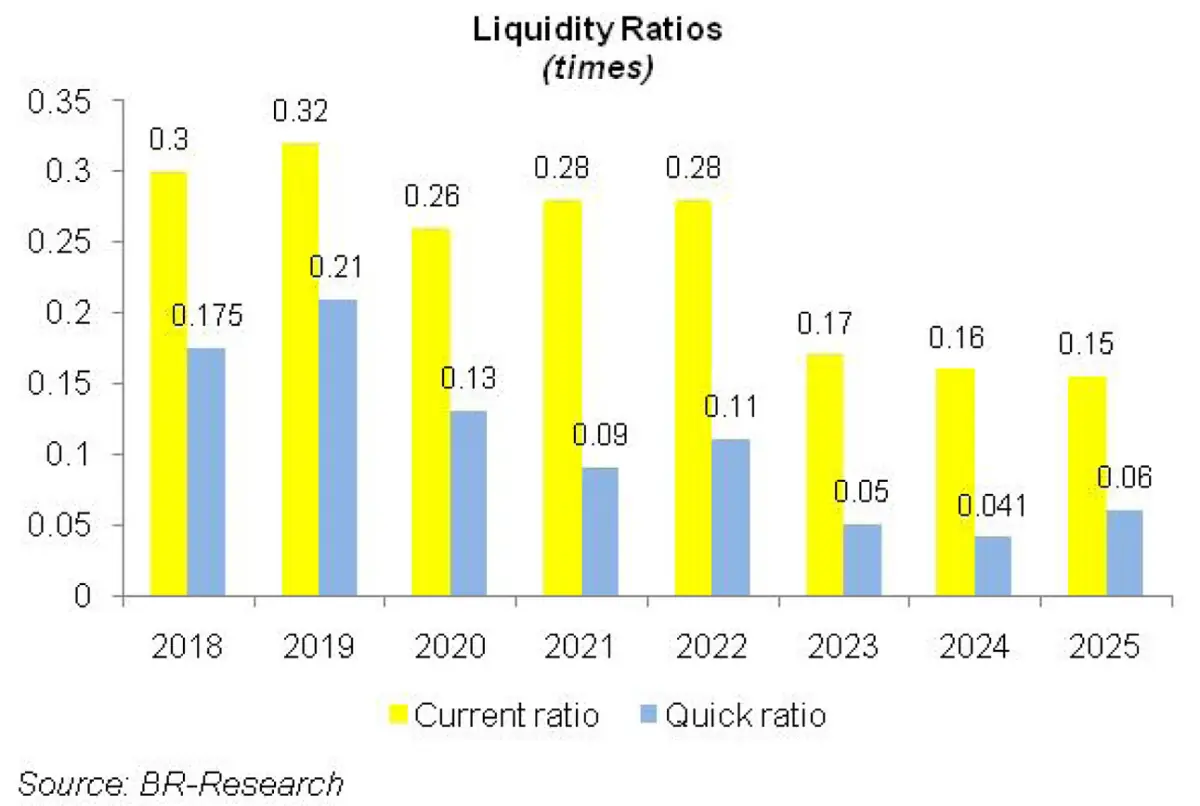
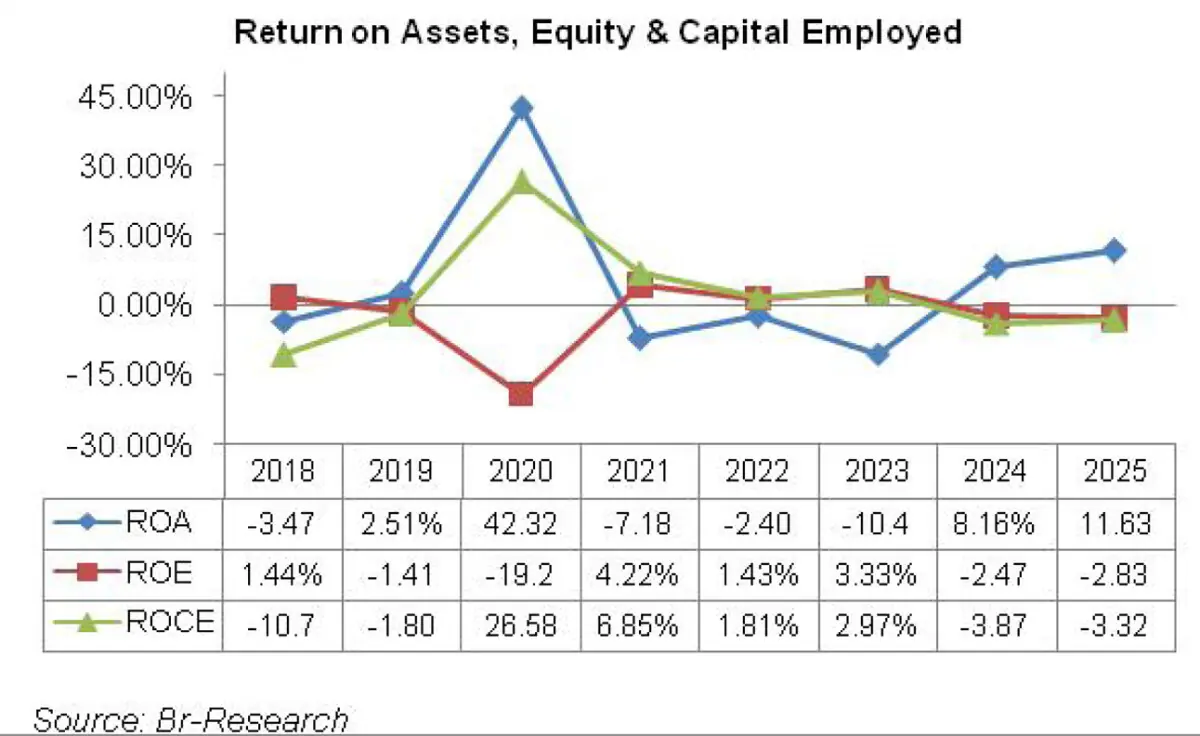
The company posted net loss in 2021, 2022 and 2023. In all the years under consideration, PAKL posted negative equity because of hefty accumulated losses. This was due to the fact that the company has consistently been registering net losses since 2014. PAKL’s liabilities are quite higher than its total assets. Exorbitant level of current liabilities also translates into negative working capital in all the years under consideration.
In 2021 witnessed a freefall of margins with operating and net margins striking the negative zone. In the subsequent two years, gross margin improved while operating and net margins continued to stay in the negative territory. In 2024 and 2025, PAKL’s margins posted phenomenal growth The detailed performance review of the period under consideration is given below.
As against the tremendous year-on-year topline growth of 182.88 percent registered in 2020 on the back of tremendous export orders, PAKL recorded 49.98 percent decline in net sales which clocked in at Rs.108.36 million in 2021. While local sales showed some improvement during the year, the drastic fall of around 61 percent in export sales squeezed the topline in 2021. Thinner export sales were the result of lockdown imposed in various export destinations of PAKL.
Cost of sales plunged by 46.51 percent year-on-year in 2021. Gross profit slipped by 82.11 percent year-on-year in 2021 with GP margin marching down to 3.48 percent.
Operating expense also nosedived by 79.55 percent year-on-year in 2021 as the company didn’t book any provisioning against doubtful debts and also because of lower freight charges because of lower export sales. Other income slumped by 94.35 percent year-on-year in 2021 due to high-base effect as the company got waivers on loan and mark-up in 2020.
PAKL recorded operating loss of Rs.6.43 million in 2021. Bank charges tumbled by 55.89 percent year-on-year in 2021. As a consequence, PAKL posted net loss of Rs.8.70 million in 2021 with loss per share of Rs.2.56. This was against the EPS of Rs.14.35 and NP margin of 22.52 percent recorded in 2020.
PAKL’s topline registered 22.68 percent year-on-year improvement to clock in at Rs.132.94 million in 2022. This was due to rise in both export and local sales during the year. Pak Rupee depreciation proved to be a blessing in disguise for the company and drove its gross profit up by 255.25 percent in 2022.
GP margin also rose to 10.10 percent in 2022. Operating expense stood at almost the same level as of previous year as the company reduced its workforce to 40 employees and also because of lower freight charges. Other income nosedived by 58.80 percent year-on-year in 2022 due to lower balances written back during the year.
PAKL’s operating loss slipped by 89.54 percent to clock in at Rs.0.67 million in 2022. Bank charges also narrowed down by 57.16 percent year-on-year in 2022, translating into 66.68 percent lower net loss to the tune of Rs.2.90 million incurred during the year. Loss per share was recorded at Rs.0.85 in 2022.
In 2023, PAKL’s topline sustained 31.78 percent erosion to clock in at Rs.90.69 million. This was the result of a plunge in both local and export sales during the year. The company couldn’t maintain its growth momentum due to exorbitant increase in the prices of materials which dejected the customers both locally and globally.
Wet blue and chemical prices hiked by 25 percent and 50 percent respectively. Electricity prices also spiked during the year. Moreover, only 50 percent of the company’s gas requirement was met by the gas pipeline.
The thin liquidity of the company and its inability to meet its financial obligations didn’t allow it to obtain more loans from external parties. Hence, it couldn’t afford to switch to LPG and purchase costlier raw materials to continue its operations.
Due to lower sales volume, cost of sales also slid by 32.16 percent in 2023. Gross profit shrank by 28.40 percent year-on-year in 2023, however, GP margin slightly improved to clock in at 10.58 percent.
Operating expense surged by 13.89 percent year-on-year in 2023 which was the consequence of higher freight charges on account of escalated prices of POL products. Legal & professional charges also spiked during the year. Operating loss magnified by 1294.79 percent in 2023 to clock in at Rs.9.37 million.
Bank charges grew by 28.20 percent year-on-year in 2023 resulting in 286.45 percent higher net loss to the tune of Rs. 11.21 million incurred during the year. Loss per share was recorded at Rs.3.30 – the highest among all the years under consideration.
In 2024, PAKL recorded year-on-year topline slide of 1.43 percent. Net sales clocked in at Rs.89.40 million. This was on account of a decline in export sales due to global recession.
Thinner export sales were partially substituted by an uptick in local revenue from leather processing. Cost of sales plummeted by 5.74 percent in 2024 due to lesser raw materials consumed owing to lower export volumes. This resulted in 34.95 percent progress in the company’s gross profit in 2024.
GP margin also jumped up to 14.50 percent in 2024. Operating expense tumbled by 24.53 percent in 2024 predominantly because of lower freight & forwarding charges as well as travelling & conveyance charges incurred during the year. What gave a significant support to the company’s bottomline was a staggering 11457 percent growth in other income. This was on account of waiver of loan liability and mark-up on loan on settlement.
PAKL recorded operating profit of Rs.11.73 million in 2024 with OP margin of 13.12 percent. This was against the operating loss of Rs.9.37 million recorded in 2023.
Bank charges & commission slipped by 5.58 percent in 2024 owing to lesser bank transactions on account of weak export sales volume. After three years of posting net losses, PAKL was able to record net profit of Rs.8.126 million in 2024 with EPS of Rs.2.39 and NP margin of 9.1 percent.
In 2025, PAKL’s topline further deteriorated by 32.78 percent to clock in at Rs.60.09 million. Leather processing income in the home market posted a drastic decline of 77.06 percent to clock in at Rs.8.689 million in 2025. This was due to decline in the demand of leather products in Pakistan due to sustained period of high inflation which took its toll on the purchasing power of consumers.
Global recession also wreaked havoc on the export sales of the company which nosedived by 7.60 percent to clock in at Rs.51.78 million in 2025. Cost of sales plunged by 39.65 percent in 2025 in line with streamlined operations due to lower demand.
PAKL’s ability to have a greater proportion of export sales in its sales mix resulted in 7.77 percent uptick in its gross profit in 2025. GP margin attained its optimum level of 23.23 percent in 2025.
Considerably lower freight charges due to thinner sales volume, no travelling charges and a massive drop in legal & professional charges and fee & subscription charges resulted in 7.84 percent downtick recorded in operating expense in 2025.
Other income also dwindled by 29 percent in 2025 due to high-base effect as the company received waiver of loan liability and mark-up in the previous year. Operating profit diminished by 14.43 percent in 2025, however, OP margin jumped up to 16.70 percent. Bank charges & commission ticked up by 8.28 percent in 2025.
PAK L didn’t pay any mark-up on its loan due to unwinding of related deferred income during the year. Tax adjustment of Rs.1.400 million for prior years resulted in 94.30 percent decline in tax expense for the year. This resulted in net profit of Rs.9.023 million in 2025. NP margin was recorded at 15 percent in 2025 while EPS stood at Rs.2.65.
Recent Performance (9MFY26)
During the nine-month period of the ongoing fiscal year, PAKL posted year-on-year decline of 84.80 percent in its topline which clocked in at Rs.6.55 million. The revenue recognized during the period comprised of export revenue from sale of leather as well as rebate. No local sale (leather processing revenue) was recorded during the period as the contract for third-party leather processing was not restored.
The production for export sales was also conducted on toll manufacturing basis instead of self manufacturing. Due to low capacity utilization, fixed cost couldn’t be absorbed efficiently resulting in gross loss of Rs.2.496 million in 9MFY26 versus gross profit of Rs.8.99 million recognized during the period.
Operating expense ticked up by 4.56 percent in 9MFY26. While selling & distribution expense was low due to petite sales volume, higher operating expense was the consequence of increased payroll expense, power & water charges as well as depreciation expense incurred during the period.
The company recorded rental income of Rs.1 million during the period versus no rental income recognized in 9MFY25. PAKL recorded operating loss of Rs.10.87 million in 9MFY26 versus operating loss of Rs.0.53 million registered in 9MFY25. Finance cost dipped by 81.90 percent in 9MFY26 due to lesser bank charges & commission.
The effect of deferred taxation helped PAKL record net profit of Rs.0.814 million in 9MFY25. However, in 9MFY26, the company posted net loss of Rs.10.949 million. This translated into loss per share of Rs.3.22 in 9MFY26 versus EPS of Rs.0.05 recorded in 9MFY25.
Future Outlook
As of March 30, 2026, PAKL has negative equity of Rs. 330.304 million. Its current liabilities exceed its current assets by Rs.332.511 million. These conditions cast significant doubts on the ability of the company to continue as a going concern. The company has recently sold off its old machinery and rented out its office building to improve its liquidity conditions.
Besides internal concerns, the company is also facing demand destruction owing to shrunken pockets of local customers and the company’s inability to compete in the global market due to high cost of production particularly elevated energy cost in the home market.
The company has recently shifted to toll manufacturing to reduce its cost and stay competitive in the export market. In the recent period discussed, the company solely relied on its exports sales, however, in the wake of the ongoing geo-political tensions including the war imposed on the Gaza strip and other Middle Eastern regions, the sustainability of the company’s exports can’t be guaranteed.
On the positive front, PAKL has been rewarded a certificate of “Gold rated Commissioning Manufacturer” by Leather Working Group Assurance Services, UK. This may help the company to attain export orders in new geographical markets.













Comments