


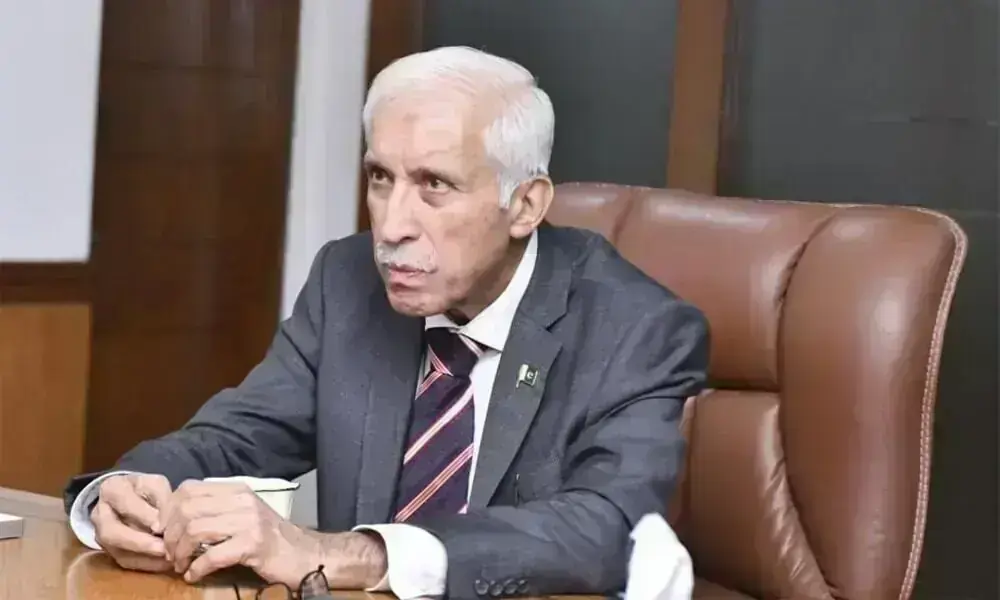

KARACHI: Federal Minister for the Board of Investment (BOI) Qaiser Ahmed Sheikh has said that while Pakistan’s business community is dynamic and highly capable, the country must remove key obstacles including high energy tariffs, delays in sales tax refunds, excessive regulations and other impediments to attract greater domestic and foreign investment.
He made these remarks while addressing industrialists at the Korangi Association of Trade and Industry (KATI).
He said the government’s primary focus is on increasing exports and stressed that achieving sustainable export growth would require special attention to Karachi, the country’s commercial hub.
He announced that a Special Economic Zone (SEZ) would be established on 6,000 acres of land at Pakistan Steel Mills, where investors would be offered a range of incentives, including a 10-year zero-duty regime.
Highlighting regional economic experiences, Sheikh said China had maintained double-digit economic growth for three decades, while policy decisions had played a decisive role in shaping the economic trajectories of both Pakistan and India. He noted that Pakistan had failed to effectively implement the Charter of Economy and the Charter of Democracy, adversely affecting long-term economic stability.
The minister said the Special Investment Facilitation Council (SIFC) was playing an effective role in promoting investment and revealed that the government had decided to merge the SIFC with the Board of Investment to further streamline investment facilitation.
He said the Prime Minister had abolished the super tax on exporters in the latest federal budget, although high energy costs remain a serious concern that the government is actively addressing. He said that Pakistan had secured IMF approval for the Special Economic Zones after extensive negotiations and had signed several investment agreements during a visit to Beijing six months ago.
He further said that progress had also been made on memorandums of understanding with Maersk Line and Abu Dhabi-based partners, urging Pakistani companies to pursue joint ventures with leading international firms.
However, KATI President Muhammad Ikram Rajput said restoring investor confidence had become one of Pakistan’s biggest economic challenges. He pointed out that industries were facing a severe energy crisis, with many manufacturing units having already shut down, while establishing new industries had become increasingly difficult.
Rajput said high energy tariffs, inconsistent policies, rising business costs, a complex tax regime, inadequate incentives for exporters and poor infrastructure in industrial areas were undermining Pakistan’s manufacturing capacity and global competitiveness. He warned that meaningful new investment would remain elusive unless the core issues facing industry were resolved.
He called for a genuinely effective one-window operation for all investment-related government procedures, enabling investors to complete all regulatory requirements through a single platform.
The KATI president also urged the government to align industrial energy tariffs with those of regional competitors, formulate a stable and long-term industrial policy, expand incentives for exporters, ensure timely payment of tax refunds and allocate dedicated resources to improve infrastructure in industrial zones, particularly the Korangi Industrial Area.
Rajput further emphasised that the Board of Investment should serve as an effective coordinating body between federal and provincial institutions to eliminate unnecessary bureaucratic hurdles and simplify regulatory procedures for investors.
Deputy Patron-in-Chief Zubair Chhaya said Pakistan urgently needed to address the challenges of rapid population growth, unemployment, illiteracy and water scarcity. He noted that a growing number of young people were seeking employment abroad, while investors remained willing to invest in Pakistan, provided they were offered a stable and business-friendly environment.
Describing Karachi as Pakistan’s economic engine, Chhaya said the city continued to suffer from chronic infrastructure and civic problems despite contributing the largest share of the country’s national revenue. “Even a ‘sick’ Karachi is still the nation’s biggest contributor to revenue,” he said, adding that Pakistan’s broader economic progress would not be possible without strengthening Karachi’s economy.
Copyright Business Recorder, 2026




















Comments