


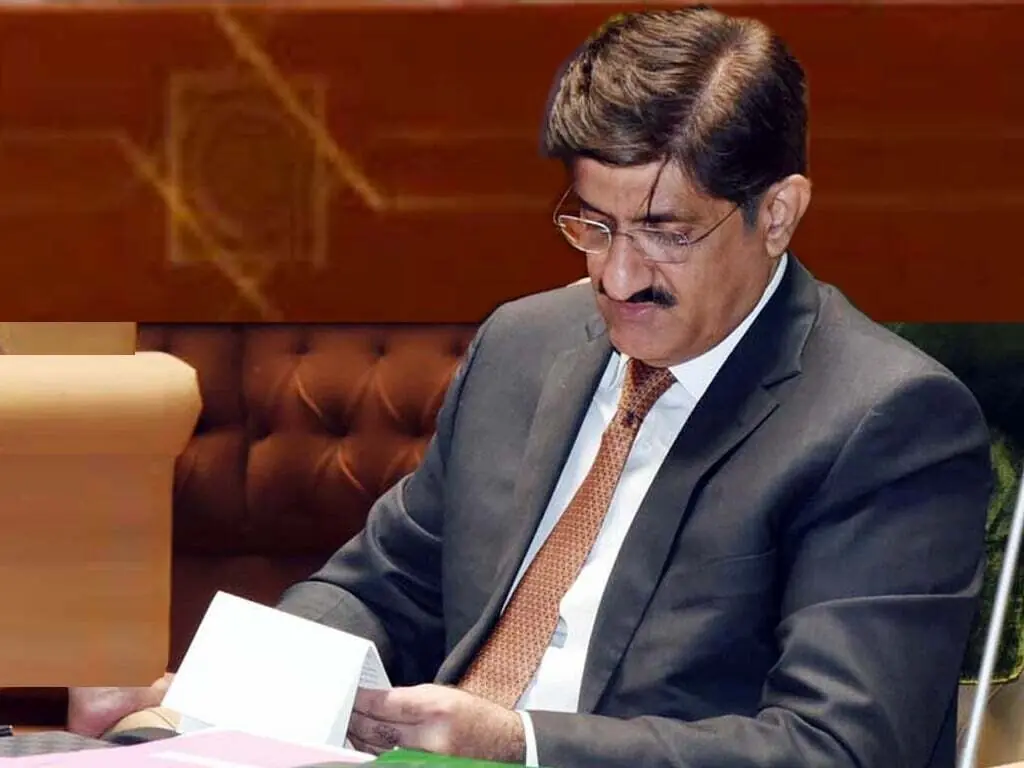

KARACHI: Sindh Chief Minister Syed Murad Ali Shah on Thursday said that for the first time, the provincial government exercised its constitutional authority to contribute funds for national defence and allocated Rs260 billion for this purpose in the 2026–27 budget.
He paid tribute to Zulfikar Ali Bhutto for incorporating this provision into the Constitution, adding that provinces had agreed to support the federation despite facing their own fiscal challenges.
He said that while addressing the post budget 2026-27 conference.
He defended his government’s Rs3.652 trillion budget for 2026–27, saying that it “balances fiscal discipline” with targeted taxation relief and long-term growth plans despite federal revenue shortfalls, rising expenditure pressures and economic uncertainty.
The budget also features a calibrated taxation strategy, with revised targets and reduced excise to support industry and economic activity, alongside an ambitious development agenda centred on large-scale public-private partnership (PPP) projects.
Explaining the province’s financial position, he said that Sindh had received Rs1.644 trillion in federal transfers up to May against projections, leaving a shortfall of Rs441 billion.
Even with an expected additional Rs200 billion before the end of the current fiscal year, a gap of around Rs250 billion would remain. He said the province had set a tax collection target of Rs676 billion for 2025–26 but was likely to collect about Rs624 billion, resulting in Rs52 billion shortfall.
Combined with the federal gap, the overall fiscal deficit was estimated at nearly Rs300 billion.
Despite these constraints, he claimed that the province had maintained a strong development focus. Last year’s Public Sector Development Programme stood at Rs1.018 trillion, of which Rs930 billion had already been released.
For 2026–27, Sindh expects Rs2.263 trillion from the federal divisible pool, while provincial revenue collection is projected at Rs456 billion. He said the excise revenue target had been reduced to provide relief to industry and encourage economic activity.
Total provincial revenues were estimated at Rs3.038 trillion. With federal grants, foreign assistance and loans included, total budgetary receipts were projected at Rs3.525 trillion. Current expenditure has been set at Rs2.560 trillion, including the Rs260 billion constitutional grant for defence.
Excluding this contribution, operational expenditure stands at about Rs2.3 trillion.
Salaries and employee-related costs would total Rs1.264 trillion. Ad hoc relief allowances granted in 2022 and 2025 have been merged into basic pay scales, while the minimum wage has been increased to Rs43,000 per month.
Local governments would receive Rs155 billion, public sector universities Rs48 billion and overall grants to hospitals, universities and other institutions would amount to Rs686 billion. Debt servicing for the coming year has been estimated at Rs54.2 billion.
Highlighting austerity measures, he said non-development expenditure had been reduced from Rs61.87 billion in the current budget to Rs36 billion for 2026–27. Due to limited resources, the Annual Development Programme has been reduced from Rs1.018 trillion to Rs720 billion. The focus, he said, would be on completing existing projects rather than launching new ones.
A total of 2,056 ongoing schemes are to be completed next year, with no new development schemes introduced. District-level development allocations have been limited to Rs15 billion, while Rs109 billion has been earmarked for PPP projects.
Outlining the future development roadmap, he said PPP leadership, including Asif Ali Zardari and Bilawal Bhutto Zardari, had directed the provincial government to prioritise transformative infrastructure.
He identified the proposed Keti Bandar deep-sea port in the coastal district of Thatta as a flagship initiative, saying discussions with Chinese stakeholders and potential investors were under way. The port would be developed under a PPP model, with federal participation also invited. He linked the plan to the strategic thinking behind Port Qasim.
He also announced plans to establish a Sindh International Financial Centre in Karachi, saying three potential sites had been identified and work had begun. The project, he said, would be completed within the current government’s term and would include full financial and digital infrastructure.
In another initiative, he announced a Green Energy Data Centre, inspired by the Thar development model, noting that Sindh’s surplus solar energy could be supplied to international technology companies and data centre operators.
Murad said that free solar home systems were being distributed to the poorest households, while a financing scheme for middle-income families was being developed jointly by Sindh Bank and the Sindh Energy Department.
He also announced legislation for Agricultural Collectives to help small farmers pool land, access larger loans, modern irrigation and mechanised farming, noting that 93 per cent of Sindh’s farmers own less than 25 acres.
He said Sindh’s PPP model had received international recognition, citing projects such as the Mai Bakhtawar International Airport, major Indus River bridges, and mangrove restoration linked to carbon credits.
Federal officials, he added, had suggested that other provinces receive briefings on Sindh’s PPP framework.
On the water situation, he said Sindh was facing a 30 per cent shortage compared to 11 per cent in Punjab and criticised the Indus River System Authority for failing to accurately present the situation.
He urged federal authorities and the media to take notice of the impact on farmers.
The chief minister said traffic on Karachi’s University Road project would be restored by the end of July, adding that progress improved after the project was handed to the Frontier Works Organisation.
He also highlighted the rehabilitation of the Sukkur Barrage, where 44 gates have been replaced, extending its operational life by about 30 years.
He said the government was pursuing anti-corruption measures, cancelling irregular contracts and recovering losses, and dismissed speculation about political change in Sindh.
He expressed confidence in PPP leadership and said the province’s long-term strategy would deliver economic benefits through infrastructure, renewable energy and investment-led growth.
Copyright Business Recorder, 2026




















Comments