


Trump's Iran war weighs on G7 economies, but don't expect hard talk in France
- The US and Iran announced over the weekend that they had reached an agreement to stop the fighting and open the Strait of Hormuz
Global growth is dampened by inflation and high oil prices from the US-Iran war. G7 leaders, avoiding conflict with Trump, are sidestepping direct blame, raising questions about the group's relevance.
- Global economic impact of the US-Iran war.
- G7 leaders' reluctance to confront Trump.
- Questions regarding the G7's current relevance.
- The interim US-Iran peace deal's economic outlook.
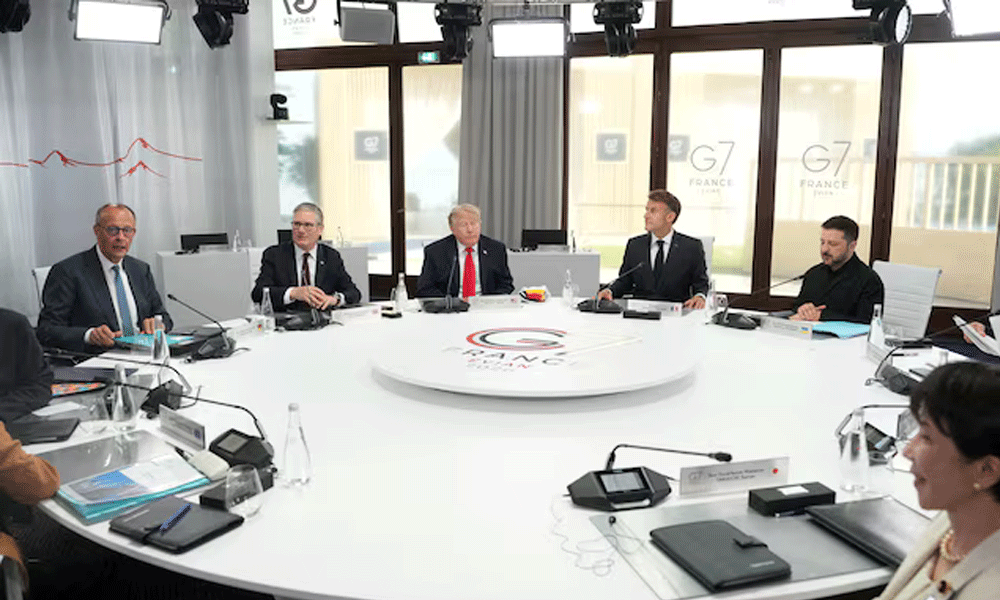

WASHINGTON: Rising inflation and a 30% jump in oil prices are dampening global growth, but leaders of the world’s top economies are unlikely to blame US President Donald Trump for the war-driven slowdown when they meet in France to discuss the economy on Wednesday.
G7 leaders, already bruised by US tariffs and conflicts over NATO and Greenland, have publicly criticized Trump’s decision not to consult them before the US and Israel launched the war with Iran in late February, while they warned about the likely economic fallout.
The US and Iran announced over the weekend that they had reached an agreement to stop the fighting and open the Strait of Hormuz, sending a jolt of optimism through global markets.
But the war’s impact on the global economy is already apparent: It has sent energy prices up sharply, renewed inflationary pressures and sparked concerns about a major food supply crisis in developing countries.
Central bankers have tightened policy, with the European Central Bank and Bank of Japan raising interest rates in the last week to ward off a steeper inflation hit.
British Prime Minister Keir Starmer has said he is “fed up” with the conflict’s impact on energy bills and Italian Prime Minister Giorgia Meloni warned of the war’s economic and social consequences.
Rising prices have also dented approval ratings for Starmer, German Chancellor Friedrich Merz and French President Emmanuel Macron.
But leaders have largely set aside arguments about the war’s economic impact during this week’s G7 gathering, given a desire to avoid a clash with Trump, whose cooperation they need on issues ranging from Ukraine and NATO to trade.
The result, analysts say, is that the G7 — born of the oil shock of 1973 to help manage economic crises — is now ducking the world’s top economic challenge, potentially eroding its own relevance.
“US policymaking has been hurting world economic activity,” said Marcelo Estevao, chief economist at the Institute of International Finance.
“You have a country with the largest economy undermining what could have been a G7 agenda of collaboration,” he said, adding that the G7 leaders need to shore up the G7’s relevance at a time when emerging market economies — which are not part of the grouping — account for a bigger share of the global economy.
A friction-free agenda?
France, keen as this year’s G7 president to avert conflict, preemptively nixed any push to issue a broad, final statement, or communique, and is focused instead on declarations on narrower issues such as global imbalances, critical mineral supply chains and shifting development aid to more investment-driven programs.
But the odds of a showdown have diminished given the interim deal clinched by US and Iranian officials just before Trump left for France. Economists say the deal spells good news for the global economy, but warn of huge risks if the deal falls through and the conflict intensifies.
They add that getting trade flows back to normal will also take months, if not longer, while fuel sector analysts and maritime experts say it could take a year for bunker fuel supplies to return to normal.
International Monetary Fund chief Kristalina Georgieva, who joined G7 leaders in France, shared a more upbeat view in a blog post on Monday after the deal was reached, rowing back her dire warnings from two months ago.
She said the world economy was holding up so far, with no signs yet of a global slowdown despite significant impacts across various regions.
The IMF, whose largest shareholder is the US, will release an updated global forecast on July 8.
Georgieva’s post, which came days after a gloomier forecast by the World Bank, suggested the IMF may settle on the least bad of three scenarios, one of which assumed a short-lived Iran war and projected growth of 3.1% in 2026, down from 3.4% in 2025. Its worst case showed growth slumping to just 2%, with inflation hitting 5.8%.
US officials have noted that oil prices are off their peaks and the US as a fuel exporter was shielded from worse price spikes, arguing that the war’s impact on the world economy should be mitigated quickly once the strait reopens.
The US believes that even Europe, a fuel importer, is likely to avert looming fuel shortages, according to sources familiar with the Trump administration’s thinking.
Doubts about the G7’s relevance
The G7 — whose members include the major European economies plus the US, Canada and Japan — faces questions about its relevance as developing economies such as India, Brazil and China have grown.
The economic group now accounts for just 44.1% of global GDP, down from 60.5% when it started, according to the Center for Strategic and International Studies.
Still, participants say the G7 remains useful when crises arise, such as the global financial crisis of 2008-2009.
“The G7 has always been able, if needed, to come up with some real decisions that still govern half the world economy,” said Martin Muehleisen, a former IMF strategy chief who took part in past summits, including some with Trump.
European leaders would be cautious during highly scripted proceedings, but fireworks were still possible during individual meetings and meals, he said.
Eric LeCompte, executive director of Jubilee USA Network, a development group, said economic issues remained a top priority despite the peace deal and lower fuel prices.
“The economy is in deep turmoil and you don’t have to be in a developing country to see it. You can just go to a grocery store and feel it,” he said.




















Comments