


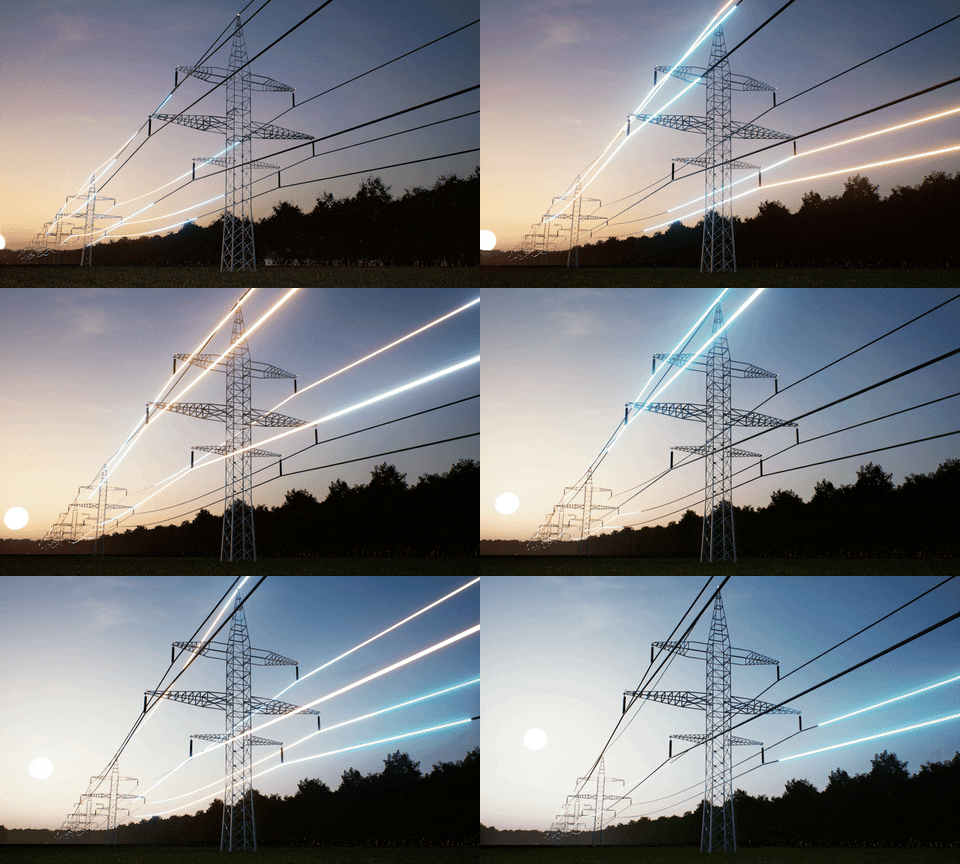

Pakistan politically decentralized after the 18th Amendment, but the institutional framework governing electricity was never fully redesigned in line with that constitutional change. While provincial autonomy expanded through devolution and the NFC Award, the power sector remained tied to a centralized framework inherited from the 1990s.
Today, Pakistan’s electricity sector is caught between two competing systems: a centralized model built around federal control along with associated liabilities, and an emerging decentralized order driven by provincial autonomy under the respective provincial regulatory framework.
This unresolved charter of functional regulatory space is now turning into structural fault lines with potential to hamper attainment of national objectives of secure, sustainable and affordable electricity sector.
Pakistan’s electricity governance structure was originally designed within a centralized political economy framework. The Regulation of Generation, Transmission and Distribution of Electric Power Act 1997 (NEPRA Act) established a single national regulator responsible for licensing, tariff determination and oversight of electricity generation, transmission and distribution. The framework reflected the institutional realities of the 1990s: centralized planning, a single-buyer regime and institutional autonomy under the uniform regulatory regime.
The constitutional landscape, however, changed fundamentally after the 18th Amendment. Although electricity remained on the Federal Legislative List, Article 157 granted provinces certain powers relating to electricity generation and distribution within their provincial boundaries. As a result, political authority became decentralized, while the institutional structure governing electricity remained largely centralized. The federation retained control over regulatory coordination, whereas provinces gradually developed stronger constitutional and political claims over energy governance and administration.
Pakistan never fully resolved this institutional transition. Instead, overlapping mandates and inconsistent policy signals created an institutional grey zone. The Council of Common Interests acknowledged that provinces retained powers relating to electricity despite electricity remaining on the Federal Legislative List. Similarly, the Power Generation Policy 2015 recognized tariff determination through “NEPRA’s or Provincial Regulator’s Mechanism”, thereby implicitly acknowledging the possibility of provincial regulation. However, the National Electricity Policy 2021 shifted back toward centralization and did not explicitly provide a role for provincial regulators.
This policy inconsistency is now evolving into a regulatory conflict. The emergence of the provincial regulatory authorities across Sindh, Punjab and other provinces has brought this contradiction to the surface. What initially appeared to be a technical dispute over regulatory jurisdiction is, in reality, a broader conflict concerning the governance of the electricity sector within a decentralized federation. The provincial frameworks being established under a separate authority have the powers relating to licensing, tariff determination, market development, wheeling, and bilateral electricity trading. From an economic perspective, this doesn’t qualify for an incremental decentralization; rather, it signifies the emergence of a parallel electricity market structure within the federation.
The conflict with NEPRA’s mandate is therefore unavoidable. Pakistan may soon encounter a situation in which multiple regulators exercise competing authority over the same market participants and infrastructure. Such fragmentation carries significant economic risks. Electricity systems operate through economies of scale, interconnected infrastructure and coordinated dispatch mechanisms. Efficient electricity markets require integrated planning, synchronized regulation and credible investment signalling. Competing jurisdictions increase transaction costs, create regulatory arbitrage and weaken long-term planning efficiency.
The timing of this conflict further intensifies its economic risks because Pakistan is currently carrying out major reforms changes in its electricity sector, including privatizing distribution companies, the implementation of the Competitive Trading Bilateral Contract Market (CTBCM) and the development of first national integrated energy plan. However, to attain intended objectives from the aforesaid reforms, there is a strong need to develop a coherent and structurally aligned regulatory governance ecosystem which can serve as foundation for sustainable evolution.
Resolving this conflict requires more than merely interpreting legislative intent. It requires the alignment of constitutional, regulatory, and institutional mandates. The question of which governance model is more effective — centralized or decentralized — is not the central issue, as both models have established global precedents. The real priority is to realign functions, responsibilities, and consequences within a coherent institutional framework. Most importantly, regulatory authority and financial responsibility must remain institutionally aligned.
In the absence of such clarity, divergent interventions and fragmented regulatory structures risk deepening allocative inefficiencies and creating fiscal spillovers across the broader economy. Ultimately, governance failures in the power sector are not borne by institutions themselves, but by households through higher tariffs and by industry through declining competitiveness. The longer this reform is delayed, the greater the eventual cost of correcting it will become.
Copyright Business Recorder, 2026
The writer is a senior energy consultant and can be reached at [email protected]


















Comments